⭐ EXPERT-REVIEWED  |  ✅ UPDATED 2026  |  🔒 NO SPONSORED BIAS  |  📚 EVIDENCE-BASED

Author: admin

  • Occurrence vs Claims-Made Insurance: Which Policy Do You Need?

    Occurrence vs Claims-Made Insurance: Which Policy Do You Need?

    Key Takeaways

    • Liability insurance triggers determine which policy responds to a lawsuit, based on when an event occurred or when a claim is filed.
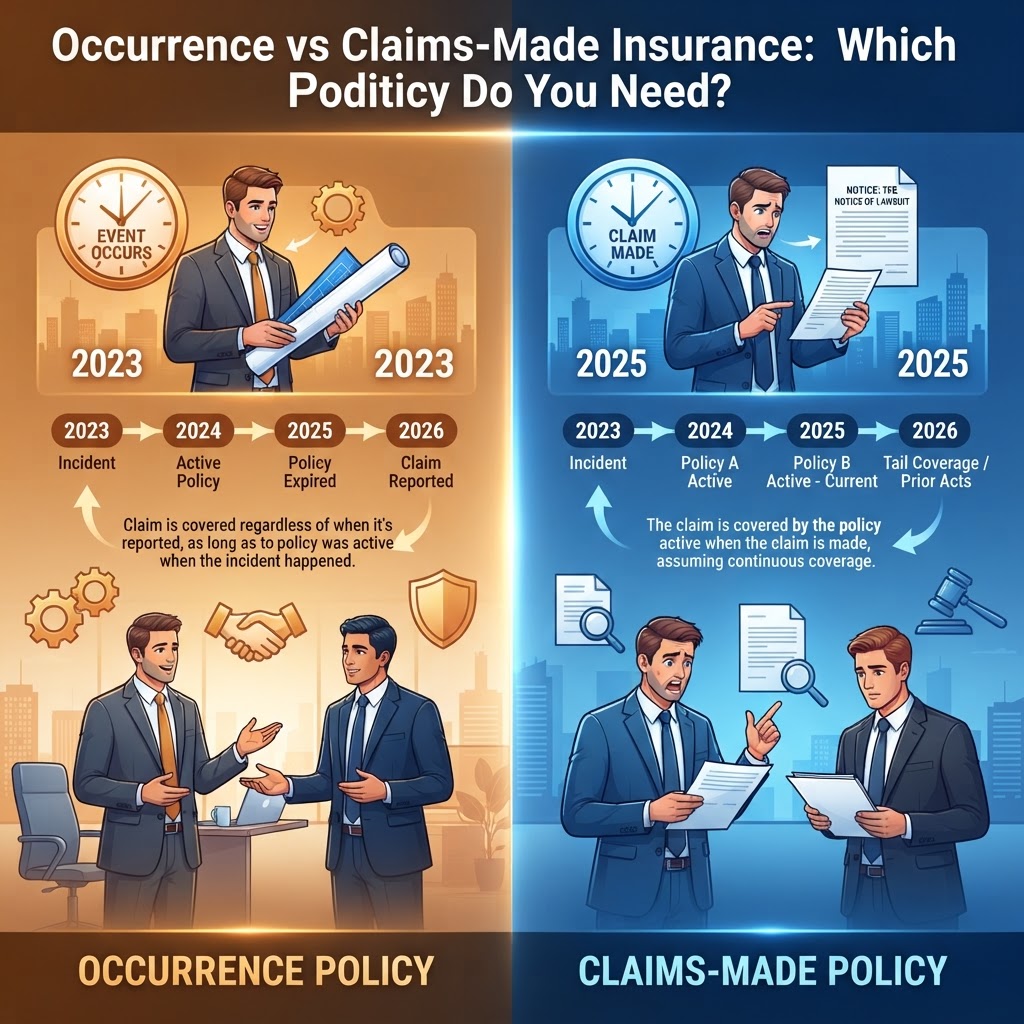
    • Occurrence-based policies cover incidents that happen during the policy period, regardless of when the claim is eventually filed.
    • Claims-made policies only provide coverage if the policy is active both when the incident occurs and when the claim is reported.
    • A “retroactive date” is a critical component of claims-made policies that limits coverage for incidents occurring before a specific point in time.
    • Choosing between these liability insurance types depends on your industry risk profile, budget, and long-term business stability.

    For any business owner or risk manager, navigating the complexities of commercial liability is a fundamental challenge. When you purchase coverage, you aren’t just buying protection for today; you are building a legal defense apparatus for potential future conflicts. The most pivotal decision you will make regarding your coverage architecture is understanding the mechanism that activates your policy. Often, entrepreneurs are caught off-guard by the nuances of the insurance policy trigger, leading to gaps in protection that can be financially devastating. Whether you are a consultant, a manufacturer, or a tech startup, the debate over occurrence vs claims-made is not merely academic—it is a strategic business decision. By the insureiqguru Editorial Team, this guide is designed to dissect these business insurance policy differences so you can make an informed decision for your company’s longevity.

    1. Understanding the Basics of Liability Insurance Triggers

    To grasp why business owners often struggle with the distinction between liability insurance types, one must first define what an “insurance trigger” actually is. In the world of commercial liability, a trigger is the specific event or set of circumstances that mandates an insurance carrier to provide a defense and indemnity for a lawsuit. Without a clear trigger, there would be no objective way to determine which policy—if you have switched carriers over the years—is responsible for a claim that might be filed three or five years after the fact.

    Think of the trigger as the “activation switch.” In general civil liability, lawsuits are rarely immediate. A product you manufactured today might not cause an injury until years down the road. A professional advice error made this morning might only be discovered after a client audits your work in 2027. Because time is a constant variable in litigation, insurance companies have developed two distinct methodologies for “triggering” a policy: the date of the event (occurrence) and the date of the notice (claims-made).

    Why does this distinction exist? Because insurance is inherently a predictive science. Carriers need to manage their reserves and their risk exposure. If a company offered infinite coverage for any event regardless of when a claim was reported, it would be impossible to accurately price premiums. Consequently, claims-made vs occurrence explained in simple terms boils down to how an insurer calculates its future liabilities. If you are operating in a high-risk industry, such as medical services or professional liability, you are almost certainly looking at a claims-made structure. Conversely, general contractors or retail businesses often lean toward occurrence-based structures because they provide a more predictable, long-term safety net.

    Understanding these triggers requires acknowledging that businesses are not static. You will change insurers, you will update your coverage limits, and you may even experience periods of business interruption. If you do not understand the trigger mechanism of your current policy, you might inadvertently find yourself in a “coverage gap” where you are essentially self-insuring against a past event. This is why risk management experts emphasize that insurance is a contract of timing as much as it is a contract of indemnity. Before you sign your next renewal agreement, you must identify whether your policy is triggered by the event or the report. This is the cornerstone of responsible business insurance management.

    2. What Is an Occurrence-Based Insurance Policy?

    An occurrence-based policy is often considered the “gold standard” for simplicity and long-term peace of mind. Under an occurrence form, the trigger is the date the injury or property damage actually occurred. If your business was covered by a specific occurrence-based policy on the day an accident happened, that policy will cover the claim, even if the claim is filed five, ten, or even twenty years later.

    Let us consider a practical example to illustrate this. Imagine you own a commercial flooring installation company. You install a floor for a retail client in January 2024. Your occurrence-based general liability policy is active for the 2024 calendar year. In 2026, a customer trips on an uneven tile, claiming the installation was faulty, and files a lawsuit. Even though your 2024 policy has long since expired and you may have switched to a different insurance carrier, the 2024 policy remains the active responder for that claim. Because the “occurrence”—the faulty installation or the subsequent injury—happened while that policy was in effect, you are protected.

    The primary advantage of this model is “evergreen” protection. You do not have to worry about maintaining a specific policy in perpetuity just to ensure coverage for past work. For business owners who plan to retire, sell their company, or eventually close their doors, occurrence-based policies offer a clean exit. You do not need to purchase expensive “tail coverage” (which we will discuss later in the context of claims-made policies) because the protection for your past years of operation is already baked into the expired policy.

    However, occurrence-based coverage is not without its drawbacks. Because the insurer is on the hook for claims that might not be filed for many years, they must account for inflation and the rising costs of litigation. These factors are typically baked into the premium. As a result, premiums for occurrence-based policies are often higher than those for claims-made policies. Additionally, some specific types of liability, such as Errors and Omissions (E&O) or Directors and Officers (D&O) coverage, are rarely available on an occurrence basis. Carriers are hesitant to offer this structure for professional services because the “date of discovery” for professional negligence can be highly subjective and difficult to peg to a specific day, unlike a physical injury or broken equipment. For many businesses, the trade-off is higher premiums today for the comfort of knowing that your past is permanently covered.

    3. How Claims-Made Insurance Policies Work

    Claims-made insurance policies operate on a fundamentally different premise: the “trigger” is the date the claim is formally reported to the insurance company. For a claim to be covered under a claims-made policy, two conditions must be satisfied: first, the policy must have been in effect when the incident occurred (subject to a retroactive date), and second, the policy must be in effect at the time the claim is reported.

    This creates a continuous requirement for coverage. If you have a claims-made policy and you cancel it or allow it to lapse, you lose your protection for any incidents that occurred in the past but haven’t been reported yet. This is why businesses using claims-made policies must be extremely diligent about renewal. A gap in coverage in your claims-made history is essentially a gap in your total liability protection.

    Why would a business choose this over an occurrence policy? The primary driver is cost-effectiveness, particularly in the early years of a policy. Because the insurer’s risk of an “unknown” long-term claim is lower (or more specifically defined), premiums for claims-made policies are often significantly lower than occurrence premiums during the first few years. As you renew the policy, the premiums typically step up to reflect the increasing risk that a claim will eventually be reported. This is known as “step-rating.”

    Common industries that utilize claims-made coverage include technology consultants, legal firms, healthcare providers, and architects. In these sectors, professional errors may remain undiscovered for years. A software bug might lie dormant for three years before crashing a client’s system. An architectural flaw might only be revealed when a building undergoes a renovation years later. Because these professions deal in abstract concepts rather than physical occurrences, defining the “incident date” is often impossible. Claims-made policies simplify this by focusing on when the demand for compensation is actually made. While this requires more administrative rigor to ensure policies remain active, it allows professionals to obtain high limits of liability at a more manageable price point during their career growth.

    Feature Occurrence-Based Claims-Made Best For
    Trigger Incident date Report date Dependant on industry
    Tail Coverage Not required Often required at exit Long-term continuity
    Cost Profile Steady/Higher Low initial/Rising Growth-stage firms
    Flexibility High (Once paid, done) Low (Requires renewal) Risk-tolerant businesses

    4. Key Differences Between Occurrence and Claims-Made Coverage

    When comparing occurrence vs claims-made, the primary difference lies in the longevity of the contract and the portability of your protection. As noted previously, occurrence policies are “set it and forget it” products regarding their past coverage. Once you pay the premium for a policy period, the coverage for incidents occurring during that period is locked in, regardless of what happens to your business or your insurance carrier in the future. This creates a clear boundary: the insurance carrier takes on the full weight of the risk for the defined year, regardless of when the bill eventually comes due.

    Conversely, claims-made policies create an ongoing dependency between the insured and the insurer. You are effectively tethered to the claims-made model for as long as you want protection for your past work. If you decide to switch insurance carriers, you cannot simply leave your old policy behind; you must ensure that your new policy provides “prior acts coverage.” This ensures that the new carrier acknowledges the work you did while insured under your previous carrier. If you fail to secure this, you will have a massive gap in your coverage—you would have no protection for any work performed before the new policy started, nor would you have protection from the old policy because that policy is no longer active.

    Another subtle but critical difference is how these policies respond to market changes. During periods where liability insurance is expensive, premiums for occurrence-based policies are generally higher because insurers are pricing in long-term inflation. However, because the price is set at the time of the event, it is fixed. In contrast, claims-made policies can be subject to significant premium spikes at the time of renewal. If the insurance market hardens and litigation becomes more expensive, your claims-made premiums can rise sharply, even if your business volume remains constant, because the insurer is re-evaluating the risk of all your historical work every time you renew.

    Finally, there is the matter of litigation control. In an occurrence-based scenario, if a claim arises years later, the insurer that was active at the time is responsible. This simplifies the claims process—you know exactly which policy to file against. With claims-made, you must be careful to document when a claim is made and report it immediately to your current carrier. Failure to report a potential claim within the policy window can result in a denial of coverage. This “notice-of-claim” requirement is one of the most common reasons claims are denied in the claims-made world. Business owners using claims-made insurance must have robust record-keeping and internal reporting protocols to ensure they do not miss a notification window.

    5. The Importance of the Retroactive Date in Claims-Made Policies

    The retroactive date is perhaps the most misunderstood yet vital element of a claims-made policy. It acts as a hard deadline for coverage. Simply put, the retroactive date is the date on or after which an incident must occur to be covered by the policy. If the incident happened before your retroactive date, the insurance carrier will not provide coverage, even if the claim is filed while your policy is active.

    When a business first buys a claims-made policy, the retroactive date is usually set to the inception date of that policy. As the business renews year after year, that date typically remains the same. This is crucial: you want your retroactive date to be as early as possible. In fact, if you switch to a new insurance carrier, you must negotiate to keep your “original” retroactive date. If the new carrier insists on setting the retroactive date to the start of their new policy, you have just created a coverage gap for all the work you performed during your previous years in business.

    Consider the scenario of a marketing agency. If they bought their first claims-made policy on January 1, 2020, that date becomes their retroactive date. If they switch carriers in 2024, they must ensure the 2024 policy carries a retroactive date of January 1, 2020. If they neglect this and the new policy has a 2024 retroactive date, they are entirely exposed for any errors made between 2020 and 2023. If a client sues in 2025 for a project completed in 2022, neither the old (now canceled) policy nor the new policy will cover them. The old policy won’t cover them because it’s expired, and the new policy won’t cover them because the incident occurred before the retroactive date.

    This reality is why “tail coverage,” or an Extended Reporting Period (ERP), is so essential. An ERP is an endorsement that extends the time allowed to report a claim after a claims-made policy is cancelled or not renewed. It essentially turns your claims-made policy into an occurrence-like structure for your past history. If you are selling your business or retiring, purchasing tail coverage is non-negotiable. It protects you against the “long tail” of liability—those claims that have yet to be discovered. Without this, your professional history remains a liability, and any future claim could lead to personal financial ruin. Understanding how to manage your retroactive date and when to trigger an ERP is what separates savvy business operators from those who are vulnerable to catastrophic professional litigation risks.

    Understanding Extended Reporting Periods and Tail Coverage

    Because claims-made policies only provide coverage if the policy is active both when the incident occurs and when the claim is filed, businesses face a significant coverage gap if they decide to switch insurance carriers, change to an occurrence-based policy, or cease operations. This is where Extended Reporting Periods (ERP), often referred to as “tail coverage,” become a vital component of your business risk management strategy.

    Tail coverage effectively extends the window during which you can report a claim for an incident that happened while your claims-made policy was in effect, even though the policy itself has been canceled or expired. Without this safety net, a business could be left personally liable for a lawsuit involving a past project or service long after the insurance policy has been terminated.

    When purchasing tail coverage, businesses typically have a few options regarding the length of the extension. You may choose a one-year, three-year, five-year, or even an unlimited reporting period. The “unlimited” option is frequently considered the gold standard for high-risk professions, such as medical practices or engineering firms, where the discovery of a professional error might not occur for several years.

    It is important to note that tail coverage is usually purchased as a one-time premium payment. This lump sum can be substantial, sometimes costing a multiple of the annual premium of the expiring claims-made policy. Because of this high upfront cost, businesses should factor the potential expense of an “insurance exit” into their budget as early as possible. If a company is acquired, the acquiring firm often requires the acquired business to secure tail coverage to ensure that prior acts are fully protected, preventing the new owner from inheriting unknown liabilities.

    Proactive businesses often negotiate the cost of tail coverage at the inception of their claims-made policy. By locking in a predetermined price or a method of calculation for the tail, you can avoid unexpected financial shocks during a business transition. Always consult with your insurance broker to understand the specific “trigger” requirements for your ERP, as some policies have strict windows of time—sometimes as short as 30 to 60 days—in which you must request the tail coverage after your primary policy concludes.

    Pros and Cons of Occurrence-Based Liability Insurance

    Occurrence-based policies are often favored for their simplicity and long-term peace of mind. By covering any incident that happens during the policy period, regardless of when the claim is actually filed, these policies provide a static level of protection that endures even if you retire, sell your business, or switch insurance companies a decade later.

    The Advantages

    • Predictable Coverage Longevity: The primary benefit is the lack of a “tail.” Once the policy period ends, you are still protected for any covered incident that occurred during that time. You do not need to worry about purchasing additional coverage if you close your business.
    • Simplified Administrative Burden: You do not need to track and renew separate tail coverage policies or manage Extended Reporting Periods, reducing the administrative complexity when transitioning between insurers.
    • Budgeting Certainty: While premiums may fluctuate due to market conditions, you are not faced with the sudden, large, one-time expense of purchasing tail coverage to “close out” your liability exposure.

    The Drawbacks

    • Higher Initial Premiums: Because occurrence policies carry the burden of long-term risk for the insurer, the annual premiums are typically higher than those of a claims-made policy, especially in the early years of a business.
    • Inflationary Risk: Since the claim might be settled years after the incident, the original policy limits may not account for inflation or the rising costs of legal defense, potentially leaving the business underinsured for a modern-day settlement of a past event.
    • Limited Availability: Some high-risk industries, such as technology liability or specialized medical fields, rarely have access to occurrence-based policies because the risks are too unpredictable to price accurately for an infinite coverage horizon.

    Advantages and Risks of Claims-Made Insurance Plans

    Claims-made insurance is the industry standard for professional liability, often called Errors and Omissions (E&O) insurance. While it requires more diligent management of the “reporting window,” it offers significant financial advantages, particularly for businesses that are still growing or operating on tighter margins.

    The Advantages

    • Lower Starting Costs: Claims-made premiums are generally lower in the first few years because the probability of a claim being filed for a brand-new policy is statistically low. This “step-rating” allows startups and small firms to afford higher coverage limits earlier in their development.
    • Alignment with Current Legal Costs: Because the claim is handled under the policy limits active at the time the claim is made, those limits are more likely to reflect current legal costs and inflation, rather than outdated limits from years prior.
    • Flexibility: Policies can often be tailored more easily to match the current risk profile of the business, as you are essentially renewing the scope of your coverage every year based on present-day risks.

    The Risks

    • The “Gap” Hazard: The most significant risk is failing to renew a policy or failing to purchase tail coverage when canceling. If a claim arises for a past project after the policy expires without a tail, the business is completely exposed.
    • Retroactive Date Management: You must carefully track your “retroactive date”—the date your first claims-made policy began. If you switch carriers, you must ensure the new policy retains the same retroactive date; otherwise, you may accidentally create a window of time where you have no coverage for past work.
    • Rising Costs Over Time: As the “mature” risk of a claims-made policy increases over the first 5 to 7 years, premiums typically increase annually until they plateau. This can be a shock for businesses that do not plan for the “step-up” in premium costs.

    Which Policy Type Is Better for Your Industry?

    Determining whether your business requires an occurrence or claims-made policy often depends on the nature of your service delivery and the likelihood of “latent” claims—those where the error is not discovered until much later.

    Industry/Business Type Preferred Policy Type Reasoning Best for
    General Contractors Occurrence Physical injuries or property damage are usually discovered immediately. Businesses with immediate, clear-cut risks.
    Technology/Software Consulting Claims-Made Software bugs or data breaches often remain undiscovered for years. Services with long-tail discovery periods.
    Medical Professionals Claims-Made Medical complications can emerge long after a procedure. High-stakes liability environments.
    Retail and Hospitality Occurrence Slip-and-fall claims are reported at the scene. High-traffic physical locations.

    For most general businesses involving physical labor, such as landscaping, plumbing, or manufacturing, occurrence-based policies are the standard. They provide the most straightforward protection for tangible accidents. Conversely, if your business provides advice, design, or intellectual property—where a mistake in a blueprint or a line of code might lead to litigation five years down the road—claims-made is almost always the industry requirement. Insurance carriers in these fields have moved toward claims-made because it allows them to adjust for changes in legal standards and potential damages over time.

    Evaluating Cost Factors and Long-Term Premium Stability

    When comparing the total cost of ownership between occurrence and claims-made policies, it is a mistake to look only at the first year’s premium. You must perform a multi-year analysis.

    An occurrence policy often starts higher, but the cost remains relatively stable, subject only to general market trends. There are no “hidden” backend costs because the policy provides a finished product from day one. You are effectively paying for the entire liability tail upfront through a higher premium. This makes occurrence policies a favorite for businesses that prioritize predictability and are planning to eventually close their doors without the worry of managing insurance buyouts.

    Claims-made policies require a “maturity” strategy. If you are starting a new company, your claims-made premiums will be quite affordable. However, you should expect those premiums to rise every year for the first five years as your “exposure” grows. By year five, the premium will likely stabilize. The true financial test of a claims-made policy arrives when you decide to exit the business or switch carriers. You must set aside capital to pay for the tail coverage, which can range from 150% to 300% of your final year’s premium. If you fail to account for this, the unexpected expense could jeopardize your exit strategy.

    Experts generally agree that businesses should conduct an annual audit of their liability insurance costs. If your claims-made policy is reaching its mature phase, check the quotes for occurrence policies. Sometimes, if a carrier is looking to gain market share, they may offer an occurrence policy at a competitive rate that makes the switch worthwhile, potentially eliminating the need for tail coverage in the future. Always obtain multiple quotes and explicitly ask about the “tail cost” structure of any claims-made policy before signing the contract.

    Frequently Asked Questions

    What happens if I forget to renew my claims-made policy?

    If you fail to renew your claims-made policy, your coverage ceases immediately. Any claims reported after the expiration date, even for work performed while the policy was active, will not be covered unless you have already purchased tail coverage. This is why many carriers offer automatic grace periods, but you should never rely on them as a substitute for proper policy management.

    Can I switch from a claims-made policy to an occurrence policy?

    Yes, it is possible to switch, but you must be careful about your liability gap. When you transition to an occurrence policy, it will only cover incidents occurring after the new policy start date. To cover incidents that happened during your previous claims-made period, you must purchase tail coverage from your previous insurer. Failure to do so will leave a “hole” in your coverage for past activities.

    What exactly is a “retroactive date” and why does it matter?

    The retroactive date is the date on your claims-made policy that dictates the earliest incident date for which the insurer will provide coverage. If you change insurers, you must ensure the new policy has the exact same retroactive date as your old one. If the new policy uses the date the new policy was signed, you have effectively lost coverage for everything you did before that date.

    Is tail coverage always expensive?

    Tail coverage cost is determined by the insurer based on the risk associated with your industry and the length of the extension you choose. While a one-year tail might be moderately priced, an unlimited tail is significant. However, it is almost always cheaper than the potential cost of defending a professional liability lawsuit out of your own pocket.

    Do I need tail coverage if I am just retiring?

    Yes. Even if you are retiring and closing your business entirely, you are still liable for your past work. If a client sues you two years after you retire for an error you made while in business, you will need active coverage at the time the claim is made. Without tail coverage, your personal assets could be at risk to cover legal fees and settlements.

    How can I lower my business insurance premiums regardless of the policy type?

    The best way to reduce premiums is to implement a robust risk management program. Insurers reward businesses with clear documentation, rigorous safety training for employees, and proactive communication with clients. When you provide evidence that you are actively reducing the likelihood of errors or accidents, you become a more attractive client, which often leads to better premium terms regardless of whether you choose occurrence or claims-made coverage.

    Conclusion

    Selecting between occurrence and claims-made liability insurance is a foundational decision that influences your business’s long-term financial health and operational agility. While occurrence-based policies offer simplicity and peace of mind by eliminating the need for tail coverage, claims-made policies provide the flexibility, lower upfront costs, and modern limit structures that many growing businesses and professional services require. There is no one-size-fits-all solution; the right choice is dictated by your industry’s specific risk profile, your company’s life cycle, and your long-term plans for the business.

    The most important takeaway for any business owner is the necessity of active management. Whether you choose the stability of an occurrence policy or the affordability of claims-made, you must understand your retroactive dates, your reporting requirements, and your exit strategy regarding tail coverage. Neglecting these details can result in catastrophic financial exposure. As your business evolves, revisit these options annually with a qualified broker to ensure your coverage continues to match your risk.

    Ready to secure your business against the unexpected? Evaluate your current insurance posture today and speak with a licensed commercial advisor to confirm that your policy is aligned with your future goals. Protect your hard-earned success by making an informed choice now.

    By insureiqguru Editorial Team

  • Business Interruption Civil Authority: How to File a Claim

    Business Interruption Civil Authority: How to File a Claim

    Key Takeaways

    • Civil authority coverage acts as a specialized extension of business interruption insurance designed to protect revenue when authorities restrict property access.
    • Triggering a claim typically requires a direct physical loss or damage at or near the insured premises that prompts a government mandate.
    • Civil authority differs from standard business interruption by focusing on the external denial of access rather than internal property damage.
    • Documentation is the cornerstone of a successful claim; policyholders must prove that a government order was the proximate cause of their financial downturn.
    • Proactive consultation with a licensed public adjuster or insurance attorney often improves the likelihood of a favorable settlement during complex filing processes.

    When your doors are locked not by choice, but by a government mandate, the financial stability of your enterprise enters a precarious zone. Most business owners are familiar with standard business interruption insurance, which provides a safety net following a fire or a flood. However, when an external force—such as a police cordon, a public health order, or an emergency infrastructure shutdown—prevents customers from reaching your storefront, you encounter the nuanced domain of civil authority coverage. Navigating these claims requires more than just a proof of loss; it demands a clear understanding of the specific language within your commercial property policy. In this guide, the insureiqguru Editorial Team breaks down the complex intersection of government mandate and financial recovery, helping you determine if your recent access restriction qualifies for compensation.

    1. Understanding Civil Authority Insurance Coverage

    At its core, civil authority coverage is an extension or “add-on” often found within the framework of a standard business interruption insurance policy. While business interruption insurance is triggered by direct damage to your own physical assets—such as a burst pipe or a collapsed roof—civil authority coverage is designed to address the secondary effects of damage occurring elsewhere. It is essentially a shield against the economic fallout caused by the decisions of government agencies or law enforcement officials.

    When an emergency occurs in the vicinity of your business, local or state authorities may deem it necessary to restrict access to a specific geographic zone to ensure public safety. For example, if a gas main explodes three blocks away, fire and rescue services might cordon off the entire neighborhood to prevent further injury or damage. During this time, your business may remain physically untouched, yet you are effectively paralyzed because your clients and staff are barred from entry. This is the precise scenario that civil authority coverage aims to address.

    It is important to understand that this coverage does not provide a blank check for any loss of revenue. Insurance carriers typically impose strict requirements before they will acknowledge a claim. Most policies specify that the access restriction must be the direct result of “damage” at a nearby property. This means that a government order issued purely as a proactive measure—such as a general curfew or a broad public health mandate—might not always trigger the policy unless the language specifically accounts for such events. The distinction between a precautionary government action and an action taken in response to specific, nearby property damage is often the primary battleground in commercial property loss disputes.

    Furthermore, this coverage usually includes a waiting period, often referred to as a “deductible period,” before the benefits kick in. While some policies might activate immediately, many have a 24- to 72-hour delay. This is intended to mitigate claims for short-lived disruptions. Business owners should review their declarations page to verify their specific “waiting period” and the maximum duration for which benefits are paid. Because this coverage is frequently capped at a certain dollar amount or a specific number of weeks, the financial recovery is rarely indefinite. Understanding these limits is critical to managing cash flow during an unexpected period of inactivity caused by external mandates.

    2. What Constitutes a Civil Authority Action?

    Determining whether a government decision constitutes a compensable “civil authority action” is a frequent point of confusion for policyholders filing an insurance claim. Not every government decree qualifies as a trigger for coverage. In the context of insurance litigation, a civil authority action is generally defined as a formal order or mandate issued by a recognized public agency that prohibits or significantly limits access to the insured property.

    Public agencies recognized for this purpose typically include police departments, fire departments, public health officials, or emergency management agencies. The action must be official; anecdotal advice from a local official or a casual request from an officer on the street is rarely sufficient. Insurance adjusters will look for a written order, a recorded declaration, or a public notice that specifically outlines the boundaries of the restricted area and the duration of the mandate. The more formal and documented the order, the easier it is for the policyholder to establish the validity of their claim.

    The geography of the order is another critical element. Most policies specify that the civil authority action must arise from damage occurring within a “reasonable distance” or a “specified radius” from your business. For instance, if an industrial fire occurs across the city, the resulting street closures likely would not qualify as a basis for your claim, as the incident is too remote to impact your premises directly. However, if the order arises from damage in the immediate vicinity—often defined as within one mile or even within a specific number of city blocks—the claim gains substantial weight.

    It is also essential to distinguish between a “direct” order and an “indirect” impact. If a mayor suggests that citizens stay home during a storm, that is a recommendation. If the police put up physical barriers and explicitly forbid vehicles and pedestrians from entering a defined zone where your property is located, that is a civil authority action. The latter is intended to prevent people from reaching the site due to a hazard, whereas the former is a general advisory that does not necessarily create a legal impossibility of access. The threshold for coverage usually relies on the existence of a hazard that poses a threat to public safety, forcing the hand of the government to limit access. When that link between the physical hazard, the government order, and the prohibited access is clear, the definition of a civil authority action is generally satisfied.

    Action Type Key Characteristic Best For
    Formal Emergency Mandate Written order closing specific zones Maximizing eligibility for claim payouts
    Public Health Directive Broad, preventative safety measures General business safety and compliance
    Police Cordon / Access Block Immediate physical entry restriction Fast-tracking evidence for loss of access

    3. Common Triggers for Civil Authority Claims

    Identifying the events that typically trigger access restriction insurance can help business owners prepare for potential disruptions. While each policy is unique, certain scenarios are widely recognized by the insurance industry as valid grounds for filing a government shutdown claim. These triggers are almost always tied to an underlying physical peril that necessitates an immediate government response to protect public welfare.

    One of the most common triggers is fire. When a structure burns down, the surrounding area is often deemed unsafe by fire marshals due to the risk of structural collapse, the presence of hazardous debris, or the active work of emergency vehicles. In such cases, the government will mandate that a perimeter be established, effectively locking out local business owners and their customers. This is a classic example of civil authority intervention because the loss of access is a direct, measurable result of the damage to the neighboring building.

    Another frequent trigger involves utility infrastructure failures. If a major water main breaks, flooding streets and endangering foundations, the city may restrict access to the area to allow for heavy repair machinery and utility crews to perform their duties safely. Similarly, a natural gas leak that requires a block-by-block evacuation for safety reasons serves as a prime example of an event that triggers coverage. Because the government is acting to prevent an explosion or environmental catastrophe, their mandate to close the area carries the legal weight necessary to activate civil authority coverage.

    Environmental disasters and large-scale accidents also play a significant role. If a chemical spill from a freight train derailment occurs near a warehouse district, emergency management agencies will often establish “exclusion zones” to prevent exposure to toxic materials. As long as these zones encompass your business premises, the financial loss incurred during the duration of that order can often be captured under your commercial property loss policy. The same applies to structural threats; if a nearby construction crane becomes unstable or a neighboring building is deemed unsafe by a city inspector, the authorities will often restrict pedestrian and vehicle traffic in the vicinity.

    It is important to note that these triggers are situational. Insurance experts often advise that policyholders should not assume every emergency event triggers coverage. If an event occurs but the authorities do not deem it necessary to issue an official, restrictive order—even if they encourage people to stay away—the “civil authority” requirement of your policy remains unmet. The trigger is not the damage itself, nor the fear of damage, but the *government’s active, restrictive intervention* in response to that damage. Recognizing this nuance helps owners maintain realistic expectations when gathering their financial records after an incident.

    4. How Civil Authority Differs from Standard Business Interruption

    Distinguishing between standard business interruption coverage and civil authority coverage is vital for accurate claim filing. While both fall under the broad umbrella of commercial property insurance, they are intended to compensate for very different types of business disturbances. Confusing the two can lead to delays in processing or, in some cases, the denial of a claim altogether.

    Standard business interruption insurance is triggered by direct physical loss or damage to your own property. If a fire breaks out in your kitchen, or a windstorm destroys your roof, your business is sidelined because your own facility has been compromised. The coverage is designed to help you recoup lost profits and pay ongoing operating expenses while you repair your business. In this scenario, the cause of the interruption is internal to your footprint. The adjuster’s focus will be on the damage to your inventory, equipment, and structural elements of your specific facility.

    Civil authority coverage, by contrast, operates on the assumption that your property is likely unscathed. Your equipment, stock, and building might be in perfect condition, yet you are incapable of conducting business because the “world” outside your doors has been cordoned off. The root cause of the interruption is external, not internal. This is a crucial distinction, as the burden of proof shifts. With standard business interruption, you prove that your property was damaged; with civil authority, you prove that a government mandate prevented access due to damage *elsewhere*.

    There are also significant differences in the coverage extensions. Because civil authority is often a supplemental coverage, it may have different limits than your primary policy. For example, your main business interruption policy might cover your lost income for twelve months, but the civil authority clause might be capped at four weeks or a specific dollar limit. These sub-limits are common in commercial policies, yet they are frequently overlooked during the procurement process. Business owners often find that while they are well-protected against an internal disaster, they are significantly more exposed to regional, authority-led interruptions.

    Another major difference lies in the proof of loss requirements. For standard business interruption, the proof is clear: an assessment of your ruined assets and the time required for reconstruction. For civil authority claims, the proof must document the specific duration of the government mandate. You must be able to demonstrate that the restriction was in effect, that your location fell within the prohibited zone, and that the order was directly linked to a specific physical hazard at a nearby property. It requires a more investigative approach to gathering evidence, as you are essentially documenting the state of your neighborhood rather than just the state of your own business. Mastering these distinctions allows for a more streamlined filing process and a better chance at securing the intended financial relief.

    5. Requirements for Successful Policy Activation

    Successfully activating civil authority coverage is a meticulous process that begins long before a claim is filed. Because insurers are inherently cautious, they require substantial evidence to confirm that a policy-defined event has occurred. To ensure a claim has the best chance of approval, policyholders must strictly adhere to the requirements outlined in their specific commercial property insurance contract.

    The first requirement is proof of the “triggering event.” You must provide documentation that a physical loss or damage occurred at a neighboring property. This could be a police report, a fire department incident report, or even credible local news coverage that confirms the location and nature of the damage. Without proof of a specific, tangible event that necessitated an emergency response, the insurer may argue that the access restriction was unjustified or purely administrative, neither of which usually triggers coverage.

    Secondly, the government mandate must be evidenced. You should obtain a copy of the actual order issued by the civil authority. This might take the form of an official proclamation from the mayor’s office, a published notice from a law enforcement agency, or a written directive from a public health officer. If you cannot produce a formal document, you may find it difficult to prove that the access restriction was an official government action rather than a volunteer action or a suggestion by authorities. In the modern era, keeping screenshots of official government websites or social media channels that broadcast these emergency orders can serve as vital secondary evidence.

    Third, you must be able to demonstrate the geographic proximity. The order must apply specifically to your premises. If the authorities closed a five-block radius, you must be able to prove your business falls within that zone. Mapping tools, property tax records, and police diagrams of the exclusion zone are excellent ways to verify this. If your business is on the periphery of the exclusion zone, the insurer might contest whether your access was truly denied. Having clear evidence that your parking lot, front entrance, or main access road was physically blocked is essential to meeting this requirement.

    Finally, financial documentation is paramount. Even if you satisfy the “trigger,” “mandate,” and “proximity” requirements, you must prove that the closure resulted in an actual financial loss. This involves comparing your current revenue during the period of the closure to historical earnings from comparable periods. Keeping meticulous records of canceled appointments, lost sales, or closed shifts during the mandate period provides the quantitative data necessary for the claims adjuster to evaluate the impact. Engaging a professional early, such as a public adjuster, can help ensure that all financial statements, operational logs, and government communications are organized in a format that speaks directly to the insurance carrier’s criteria. Taking these steps systematically turns a chaotic emergency into a well-supported claim.

    Step-by-Step Guide to Documenting Your Business Loss

    Documenting a loss under civil authority coverage requires meticulous attention to detail. Because these claims often hinge on the specific timing and geographic scope of a government order, the burden of proof rests heavily on the policyholder. To ensure your claim is processed efficiently, you should adopt a systematic approach to gathering and organizing your documentation.

    The first step is establishing the timeline of the government action. You must secure a certified copy of the specific mandate, ordinance, or executive order that restricted access to your premises. This document is the cornerstone of your claim; without it, insurance carriers may argue that the closure was voluntary or based on general economic conditions rather than a specific directive. Create a chronological log that includes the date the order was issued, the date it became effective, the date it was lifted, and the precise boundaries of the affected zone as defined by the authorities.

    Next, you must isolate the financial impact. This involves creating a comprehensive “Loss of Income” worksheet. You should compile comparative financial statements, including profit and loss statements, payroll records, and sales data from the same period in previous years. By contrasting your actual performance during the civil authority shutdown with your historical performance, you can more accurately project the “but-for” revenue—what you would have earned had the access restriction not occurred. Be sure to include documentation for any extra expenses incurred, such as costs for relocating operations or notifying clients of temporary closures.

    It is also essential to maintain a “Communication Ledger.” Throughout the period of restricted access, document all interactions with local government officials, law enforcement agencies, and utility providers. If a police officer denied your team entry to your building, record their badge number, the time of the interaction, and the specific reason provided for the denial. This anecdotal evidence, while not a substitute for formal documentation, provides necessary context for the adjuster regarding the actual enforcement of the government order.

    Evidence Needed to Support Your Civil Authority Claim

    A successful civil authority claim relies on a robust evidentiary package that clearly maps out the connection between the government mandate and your commercial property loss. Insurance adjusters are trained to look for gaps in the causal chain, so providing exhaustive documentation is your best defense against a denial or a partial payout.

    To substantiate your claim, you should categorize your evidence into three distinct pillars: Legal Authority, Direct Proximity, and Quantifiable Financial Damage.

    • The Legal Mandate: As noted previously, the actual text of the order is required. If the government order was issued via a press release, social media, or a verbal instruction, you must obtain a formal confirmation from the issuing department to serve as verification of the restriction.
    • Geographic Nexus: Most policies require the property to be within a specific distance (e.g., one mile) of the location where the direct physical damage occurred. You must provide a map clearly marking your property, the location of the damage that prompted the government action, and the perimeter of the restricted area. Photographs or GPS-tagged location data are highly effective here.
    • Evidence of Direct Physical Damage: Even if your building wasn’t damaged, the civil authority order must have been triggered by damage to a nearby property. You need to provide documentation regarding that damage—such as fire department incident reports, news coverage, or public safety bulletins—to prove that the government action was a reasonable response to a physical hazard.
    • Mitigation Efforts: Demonstrating that you attempted to mitigate your losses is a standard requirement in commercial insurance. Provide invoices for redirected shipments, evidence of remote-work software subscriptions, or documented efforts to inform customers of your alternative service points.
    Document Type Purpose Best For
    Certified Government Orders Establishes the legal basis for the closure. Validating the start/end dates of the claim.
    Historical Financial Records Demonstrates lost revenue compared to benchmarks. Calculating the monetary value of the claim.
    Incident Reports (Nearby Damage) Proves the trigger for the government mandate. Meeting the “physical damage to property” requirement.
    Communication Logs Records interactions with law enforcement/officials. Providing evidence of actual access enforcement.
    Mitigation Invoices Shows proactive effort to continue business operations. Supporting “Extra Expense” coverage components.

    How to Work with Your Adjuster During the Process

    The relationship between the policyholder and the insurance adjuster is often the most critical factor in the speed and fairness of a claim settlement. An adjuster’s job is to verify the claim against the policy language and the facts presented. When you approach the process with a professional, collaborative, and organized attitude, you reduce the friction that often leads to delays.

    Start by establishing a clear communication channel. Designate one person within your organization—ideally an owner, a financial controller, or an in-house risk manager—to serve as the primary point of contact. This prevents conflicting information from being shared with the carrier. When you provide data, ensure it is presented in an organized format that mirrors the categories within your policy documents. The easier you make the adjuster’s job, the more quickly they can review and approve your submission.

    Be proactive in explaining the nuances of your business. Adjusters often handle claims across many industries; they may not immediately understand the intricacies of your specific operations or how a partial street closure might disproportionately affect your business model compared to your neighbors. Walk them through the flow of your operations and clearly illustrate why and how the civil authority order specifically crippled your ability to conduct business.

    If the adjuster requests additional information, fulfill the request promptly and in writing. If you disagree with an assessment or a calculation, remain professional. Use the policy language to support your argument rather than resorting to emotional appeals. Ask for written explanations if a portion of your claim is denied, as this provides a paper trail should you need to escalate the matter later.

    Finally, never assume the adjuster knows the full extent of your loss. Their preliminary estimate might be based on standard formulas. If their assessment falls short of your reality, invite them for a site visit or a video walkthrough to provide visual context for your financial documentation. Transparency and consistent record-keeping are your most effective tools for maintaining a positive working relationship.

    When Legal Intervention Is Necessary for Your Claim

    While most insurance claims are resolved through direct negotiation between the policyholder and the carrier, there are scenarios where professional legal intervention becomes necessary. Recognizing when to involve legal counsel can save you significant time, stress, and potential financial shortfall.

    The most obvious indicator that you may need an attorney is a clear denial of coverage based on a specific policy interpretation that you believe is incorrect. Insurance policies are complex legal contracts; adjusters are trained to interpret them in a way that minimizes liability. If the carrier cites a specific exclusion that you believe does not apply to the facts of your civil authority claim, an attorney can draft a “Letter of Position” that challenges that interpretation with legal precedent.

    You should also consider legal help if the claims process hits an indefinite “stalling” phase. If your adjuster is unresponsive, repeatedly asks for the same documentation, or fails to provide an update for weeks at a time, it may be a sign of “bad faith” adjustment. Legal counsel can apply pressure to the carrier’s legal department to enforce your contractual rights and move the claim forward.

    Additionally, if your claim is extremely large or complex—involving multiple government orders, overlapping jurisdictions, or significant business interruption values—the carrier will likely assign an entire team of defense attorneys and forensic accountants to minimize the payout. In these instances, you are at a distinct disadvantage if you are navigating the process alone. Engaging an attorney who specializes in commercial insurance coverage can level the playing field, ensuring that your financial experts are talking to their financial experts on equal footing.

    Finally, if you find that the carrier is acting in bad faith—by intentionally misrepresenting the terms of your policy, conducting an inadequate investigation, or failing to pay a claim that is clearly covered—you have a legal recourse beyond simply arguing over the numbers. Bad faith litigation is a serious matter, and while it should be a last resort, it is an essential protection for businesses that have been improperly treated by their insurers.

    Frequently Asked Questions

    Does my business interruption insurance automatically include civil authority coverage?

    No, coverage is not universal. While civil authority coverage is a common feature in many commercial property and business interruption policies, it is not always a default inclusion. You must carefully review your policy’s “Extensions of Coverage” or “Additional Coverages” sections. In some cases, it may be added as an endorsement that requires an extra premium. Always check your specific declaration page to verify if your policy includes this provision.

    What if my business was closed because of a mandatory evacuation order but there was no physical damage nearby?

    Most standard civil authority provisions require that the government action be triggered by direct physical damage to property in the immediate area of your business. If the evacuation was purely precautionary—such as a government-ordered closure for a potential storm surge that never materialized—your claim may be denied. Without the “triggering event” of nearby physical damage, the policy requirements for a civil authority claim are generally not met.

    How far away can the damage be for my claim to remain valid?

    Policy language varies significantly regarding distance. Some policies define the covered area as being within a one-mile radius, while others are more restrictive, perhaps limiting it to 500 feet. The policy will typically specify a “geographic limitation” for the damage. It is vital to measure the distance between your property and the site of the damage described in the government’s order to determine if you fall within the contractually protected zone.

    Are there time limitations on civil authority claims?

    Yes, civil authority coverage almost always has an inherent waiting period and a maximum duration. A common waiting period is 72 hours, meaning the government order must remain in effect for at least three days before coverage kicks in. Furthermore, most policies limit the payment period, often to a maximum of two to four weeks. Always check the “Limit of Liability” and “Period of Restoration” sections in your policy for these specific constraints.

    Can I file a claim for a voluntary closure?

    No. Civil authority coverage is specifically designed to address instances where you are legally prohibited from accessing your premises by a government entity. If you decide to close your doors due to safety concerns or lack of staff, but no official order forced you to do so, you generally cannot claim under the civil authority provision. The government mandate must be the primary, direct cause of the access restriction.

    What if my loss is caused by a government-mandated curfew rather than a full closure?

    A curfew can qualify as a civil authority claim if it effectively prevents you from conducting your business operations. If your business primarily operates during night hours (such as a nightclub or a late-night delivery service) and a curfew prevents your employees or customers from reaching the property, the “access restriction” criteria may be met. However, you will need to demonstrate that the curfew significantly hindered your ability to generate revenue as outlined in your policy.

    Conclusion

    Navigating a civil authority claim is a complex task that demands both financial precision and a thorough understanding of your insurance contract. While the prospect of dealing with government mandates and insurance adjusters can feel overwhelming, you can manage the process effectively by maintaining rigorous documentation, understanding the specific triggers of your policy, and proactively communicating with your insurance carrier. Remember that the burden of proof rests with the policyholder; the more organized and detailed your submission, the better your chances of securing the coverage you have been paying for.

    As your business faces the challenges of unforeseen access restrictions, don’t wait until a crisis occurs to review your coverage. Evaluate your policies annually, ensure your financial records are digitized and easily accessible, and maintain a close working relationship with your insurance agent or broker. If you find your business in a situation requiring a claim, act quickly to preserve your rights and consult with professional advisors if you feel your claim is being unfairly scrutinized. Protecting your business’s financial health is a proactive duty, and with the right approach, you can recover from disruption and continue to thrive.

    Are you prepared for the unexpected? Contact your insurance representative today to audit your business interruption coverage and ensure your civil authority protections are aligned with your business needs.

    By insureiqguru Editorial Team

  • E&O Insurance for Tech Startups: Why You Need It in 2026

    E&O Insurance for Tech Startups: Why You Need It in 2026

    Key Takeaways

    • E&O insurance for tech startups provides a critical safety net against claims of negligence, service failures, or missed deliverables.
    • The rapid evolution of AI and cybersecurity threats makes comprehensive tech liability insurance a non-negotiable component of modern risk management.
    • Distinguishing between general liability and E&O is essential, as general liability covers physical bodily harm, while E&O addresses financial losses stemming from professional mistakes.
    • E&O coverage should be tailored to include specific triggers like intellectual property infringement, data breaches, and failure to perform contract terms.
    • Securing a robust policy early in a startup’s lifecycle can be a requirement for enterprise-level B2B contracts and VC funding.

    The landscape of the technology sector in 2026 is defined by unprecedented velocity. As startups race to deploy generative AI tools, integrate complex cloud architectures, and scale software solutions, the margin for error has narrowed significantly. In this high-stakes environment, a single glitch, a missed deadline, or a misunderstood project specification is no longer just a technical setback—it is a potential legal liability that can jeopardize a company’s survival. For founders, navigating this terrain requires more than just innovative code; it requires a proactive strategy for institutional stability. This is where E&O insurance for tech startups becomes the cornerstone of your operational security, protecting your balance sheet against the inevitable professional friction that accompanies rapid digital growth.

    What Is Errors and Omissions Insurance for Tech?

    Errors and omissions insurance, often referred to as technology professional liability, is a specialized financial product designed to protect service providers against claims of professional negligence. Unlike standard business insurance, which focuses on physical accidents or property damage, E&O is specifically engineered to address the intangible risks inherent in the digital economy. When a client engages a startup for a software development project or an IT consultation, they are purchasing an outcome. If that outcome fails to materialize, or if it results in a financial loss for the client, the client may initiate litigation to recover their damages. E&O coverage provides the funding for legal defense costs and potential settlements or judgments that arise from such disputes.

    At its core, this form of IT business insurance acts as a buffer between a startup’s limited resources and the massive litigation costs that can arise from contract disputes. In the context of software development insurance, the scope of coverage typically addresses claims regarding failure to deliver professional services, inaccurate advice, or technical errors that render a client’s own systems inoperable. For example, if a SaaS startup deploys a faulty update that causes a client’s e-commerce platform to crash during a peak sales period, the resulting lost revenue is exactly the type of financial damage an E&O policy is designed to cover.

    Furthermore, E&O is not a monolith; it is highly customizable. Policies can be structured to include provisions for intellectual property infringement, libel, slander, and even breaches of contract that result in third-party financial loss. For tech startups, the “error” might be a simple oversight in code quality, while the “omission” might be the failure to include a contractually required feature. In both scenarios, the legal defense alone can cost hundreds of thousands of dollars, effectively bankrupting an early-stage company without the protection of adequate liability coverage.

    Because tech startups often operate in a grey area where service performance is subjective, E&O insurance provides an objective mechanism for resolving disputes. It enables startups to focus on innovation rather than being paralyzed by the fear of litigation. By transferring the financial risk of professional mistakes to an insurer, founders can provide their enterprise clients with the peace of mind necessary to sign lucrative service agreements, knowing that there is a financial safety net in place should a professional dispute arise.

    Why Tech Startups Are Specifically Vulnerable to E&O Claims

    The vulnerability of tech startups to E&O claims is inextricably linked to the nature of their business model. Unlike traditional consulting, where deliverables are often physical or well-defined, software development and IT implementation projects are notoriously susceptible to “scope creep” and evolving requirements. Clients often push for faster release cycles, which can lead to rushed QA processes and subsequently, latent defects in the code. This pressure creates a perfect storm for liability claims.

    One of the primary drivers of this vulnerability is the high dependency on third-party integrations and complex API ecosystems. If a startup builds a product that relies on an external cloud provider or a third-party software library, a failure at that integration layer can look to a client like a failure of the startup’s own service. Even if the startup did not technically “write” the faulty code, they are often the primary point of contact for the client, making them the first target for legal action. This is why tech liability insurance is vital—it covers situations where the chain of causality is complex and potentially involves multiple vendors.

    Additionally, the “beta-first” culture prevalent in the startup ecosystem often encourages launching products before they are fully vetted for all edge-case failures. While this is an excellent strategy for user feedback and market testing, it is a liability nightmare from a legal perspective. If a client relies on a platform that has not been sufficiently stress-tested, and that platform fails under load, the startup faces not only the loss of the client but a lawsuit alleging a breach of the professional standard of care. Startups often operate under the assumption that their limited size protects them, but in the eyes of the law, a business entity is liable for its actions regardless of its valuation or headcount.

    Another factor is the increasing integration of machine learning and autonomous decision-making algorithms. When a software tool makes an automated recommendation that leads to a financial loss for a customer, who is responsible? In many jurisdictions, the developers of that software can be held liable for the “algorithmic error” or the failure to provide adequate guardrails. As these systems become more prevalent, the risk of litigation involving complex, non-deterministic outcomes grows. A comprehensive E&O policy essentially functions as a critical part of a startup’s startup risk management framework, allowing firms to experiment and deploy new technologies while insulating themselves from the catastrophic financial fallout of a malfunctioning algorithm or an unexpected system failure.

    Real-World Examples of Tech E&O Liability Cases

    To understand the necessity of this coverage, one must look at how professional liability claims manifest in the real world. Many cases arise from seemingly minor technical errors that escalate into massive financial losses for the claimant.

    Consider the case of a data analytics startup that contracted to provide predictive modeling for a retail chain. The startup’s software was designed to optimize inventory replenishment based on historical sales data. Due to an error in the software’s handling of time-zone metadata, the system recommended an massive, incorrect reorder of perishable goods. The retailer faced significant losses, not only in the cost of the wasted inventory but in storage and disposal fees. The startup faced a lawsuit alleging that they failed to perform their professional services in accordance with industry standards. Without E&O coverage, the cost of the legal defense and the subsequent settlement would have far exceeded the startup’s annual revenue.

    Another common scenario involves IT service providers who are tasked with migrating a client’s database to the cloud. During the migration process, an unexpected system timeout resulted in the permanent loss of a subset of sensitive client data. Even though the startup had followed standard migration procedures, the client argued that the startup failed to implement adequate backup protocols. The litigation revolved around the definition of “industry-standard care.” The startup was ultimately found liable for the costs of restoring the data and the business interruption losses suffered by the client. An E&O policy allowed the startup to survive this incident by covering the defense costs and the damages awarded to the client.

    These examples illustrate that E&O claims are rarely about intentional malice; they are almost always about performance gaps and disputed professional standards. When a project goes sideways, clients often look for any reason to recoup their losses, and professional liability insurance acts as the primary defense in these disputes. The following table illustrates the types of professional liability scenarios that frequently trigger claims against tech startups.

    Risk Scenario Potential Consequence Best For
    Software Bug Causing Downtime Loss of revenue for client; breach of SLA SaaS providers & Dev shops
    Inaccurate AI Recommendation Financial loss from automated decisions AI/ML model developers
    Migration Failure/Data Loss Restoration costs and third-party claims Managed IT services/Consultants
    Failed Feature Deployment Breach of contract/missed milestones Custom software contractors

    How E&O Insurance Differs From Professional Liability

    One of the most frequent sources of confusion for startup founders is the distinction between E&O insurance and general professional liability. In many contexts, these terms are used interchangeably, but it is critical to understand the nuances if you are to maintain a robust startup risk management strategy. In the insurance industry, E&O is effectively a subset of professional liability. However, “professional liability” is a broad umbrella term, and in the tech sector, it is essential to ensure that your specific policy addresses digital service risks rather than just general malpractice.

    General Liability (GL) insurance is the standard policy that covers physical risks, such as a delivery person tripping in your office or accidental damage to a client’s physical property. It does not cover claims arising from professional services, coding errors, or bad advice. If you accidentally spill coffee on a server in your client’s office, your GL policy covers it. If you accidentally write a line of code that deletes the client’s entire database, your GL policy will almost certainly deny the claim. This is where E&O fills the gap.

    While some older professional liability policies were designed for architects, engineers, or doctors, tech liability insurance is written specifically for the intangible nature of digital deliverables. A standard medical malpractice policy will not provide the coverage required for a cybersecurity failure or a software bug. Therefore, when searching for the right coverage, you must ensure that your policy is specifically endorsed for technology services. This includes provisions for intangible harm, such as business interruption, that typical professional liability policies might overlook.

    Furthermore, E&O for tech is increasingly bundled with cyber liability insurance. While E&O focuses on the professional failure to deliver on a contract, cyber liability focuses on the fallout from a data breach or hacking incident. Because these two events often overlap—for instance, a bug in your software could simultaneously be the vulnerability that leads to a data breach—it is essential to have a policy that integrates both. Relying on an outdated professional liability definition is a major risk, as it often leaves the startup exposed to the specific digital and algorithmic perils that characterize the 2026 tech economy.

    Key Components of a Comprehensive E&O Policy

    When shopping for E&O insurance for tech startups, it is not enough to simply buy the first policy that fits your budget. The devil is in the details, and a policy is only as effective as the coverage triggers and exclusions it contains. A comprehensive policy must be reviewed by someone who understands the technical nuances of your business, as even a small change in policy language can result in a denied claim.

    First and foremost, check the “claims-made” vs. “occurrence” language. Most E&O policies are claims-made, meaning the policy must be active both when the alleged error occurred and when the claim is filed. This necessitates consistent renewal of your coverage; if you allow your policy to lapse, you lose protection for previous work. A crucial feature to negotiate is the “retroactive date.” You want this date to reach back to the beginning of your professional services or at least to the start of your current project cycle, ensuring you are covered for work performed in the past.

    Secondly, look for coverage that includes “failure to perform.” This is the core of software development insurance. It ensures that if you fail to deliver on a milestone or if the software does not meet the specified functional requirements of the contract, the insurer covers the resulting damages. Some basic policies exclude contractual disputes, which is problematic for any startup that makes money via signed service agreements. You want a policy that explicitly covers breaches of contract arising from professional services.

    Thirdly, pay close attention to the definition of “professional services.” This should be broad enough to cover all the activities your startup performs. If you are a software developer who also provides consulting and maintenance, the policy must include all these facets. If a claim arises from your consulting work but your policy only covers “software development,” the insurer may refuse to pay.

    Finally, evaluate the defense and settlement provisions. A major benefit of E&O insurance is the access to legal counsel that specializes in tech-related litigation. Ensure that your policy includes “duty to defend” language, which compels the insurer to pay for your legal defense costs as they are incurred, rather than requiring you to pay up-front and seek reimbursement later. This liquidity is crucial for early-stage startups that may not have the cash reserves to fund a million-dollar defense while waiting for a legal resolution.

    Does General Liability Cover Professional Mistakes?

    One of the most persistent misconceptions in the tech startup ecosystem is the belief that a standard General Liability (GL) policy provides a safety net for all business-related mishaps. To navigate startup risk management effectively, founders must understand the distinct boundary between “bodily injury and property damage” versus “professional negligence.”

    General Liability insurance is designed to protect your startup against third-party claims involving physical accidents. For example, if a client visits your office, trips over a loose floor tile, and sustains an injury, or if an employee accidentally knocks over an expensive server rack while installing software at a client site, your General Liability policy is the primary line of defense. It is fundamentally focused on tangible, physical loss.

    In stark contrast, Errors and Omissions (E&O) insurance—or technology professional liability—is designed specifically for the digital realm where your primary product is intellectual or functional. General Liability policies almost universally contain “professional services” exclusions. This means that if a client claims your software deployment caused a data breach, resulted in massive server downtime, or failed to deliver the promised analytical output, your General Liability provider will likely issue a denial of coverage letter. They are not in the business of insuring your technical expertise or your code quality.

    For a tech startup, the distinction is critical. If your product fails to perform as advertised, the financial damages sought by a client are usually based on economic loss rather than physical injury. Without E&O insurance, your startup is essentially self-insuring against these professional mistakes. Given that the costs of litigation, discovery, and expert witness testimony can easily escalate into the hundreds of thousands of dollars, relying solely on General Liability is a high-stakes gamble that often leads to insolvency when a service failure occurs.

    Factors That Influence Your E&O Insurance Premiums

    Understanding how insurers price tech liability insurance can help founders proactively manage their risk profiles. While every carrier has a proprietary underwriting model, several universal factors influence the final premium for your software development insurance or IT business insurance policy.

    Revenue and Scale: Higher annual revenue typically suggests a larger volume of client contracts and a broader range of exposure. An insurer will look at your financial trajectory to assess the potential magnitude of a professional liability claim.

    Nature of Services: Not all tech businesses are viewed with the same level of risk. A startup providing simple web design services usually carries a lower risk profile than a company developing proprietary AI models that manage critical infrastructure or sensitive health data. The more “mission-critical” your software is to a client’s bottom line, the higher the perceived risk of a costly claim.

    Client Contractual Requirements: Your clients often dictate your insurance needs. If you are selling to Fortune 500 companies or government entities, they will likely mandate specific coverage limits in your Master Services Agreements (MSAs). These requirements reflect the high stakes of those contracts, which in turn influences the premium the insurer will charge.

    History of Claims: Much like personal auto insurance, a history of prior professional liability claims will make an underwriter wary. Conversely, a clean track record can sometimes qualify startups for better pricing or more favorable policy terms.

    Security Protocols: In the current era, cybersecurity maturity is a massive component of E&O pricing. Insurers look for evidence of robust internal processes, such as regular penetration testing, multi-factor authentication (MFA) implementation, and a formal incident response plan. Startups that demonstrate a “security-first” culture are often seen as lower risk.

    Factor Impact on Premium Best For
    High-Risk Industry (FinTech/HealthTech) Higher Companies handling sensitive data
    High Revenue/Large Client Base Higher Scaling startups
    Robust Cybersecurity Framework Lower Startups demonstrating due diligence
    No Prior Litigation History Lower New or boutique firms

    How to Choose the Right Coverage Limits for Your Startup

    Determining the appropriate limit of liability—the maximum amount an insurer will pay per claim and in the aggregate—is a balancing act. Choosing a limit that is too low leaves the business exposed, while choosing one that is unnecessarily high inflates your operational costs during a phase where capital preservation is critical.

    Begin by conducting a “worst-case scenario” assessment. If your primary piece of software failed tomorrow and caused your biggest client to suffer an outage or a breach, what is the maximum amount they could reasonably sue for? Look at your contract language; many MSAs contain “limitation of liability” clauses that cap your exposure to the amount paid to you over the previous 12 months. If your client contracts do not contain these protections, or if your contracts involve “uncapped” liability for data breaches, you must carry significantly higher limits.

    Consult with your legal counsel to understand the specific risks associated with your client base. For example, if you are working with public sector clients, they may have specific statutory requirements for insurance limits that you must meet before being awarded a contract.

    Consider the “aggregate limit” versus the “per-claim limit.” The per-claim limit is the maximum the insurer pays for a single incident, while the aggregate limit is the maximum the policy will pay out during the entire term (usually one year). If you have a high volume of small projects, your primary concern might be a higher aggregate limit to handle multiple small errors. If you have one “whale” client that generates 80% of your revenue, a high per-claim limit is essential to protect the startup from a single, catastrophic failure.

    Finally, factor in defense costs. In many E&O policies, legal defense costs are part of the coverage limit, meaning the money spent on lawyers reduces the amount available for a potential settlement. Always ensure that your limit provides enough “room” to cover high-priced legal fees without exhausting the policy before the case reaches resolution.

    Steps to Take When Your Startup Faces a Potential Claim

    Receiving a notification of a claim or a formal complaint from a client is a high-stress moment for any founder. The way you respond in the first 24 to 48 hours is vital to ensuring your coverage is not compromised.

    1. Notify Your Insurer Immediately: Do not wait to see if the problem “goes away.” Most E&O policies are “claims-made,” meaning the claim must be reported to the insurer during the policy period. Failing to provide timely notice can give the insurer grounds to deny coverage entirely. Even if you aren’t sure if the situation will escalate, report it as a “circumstance that could lead to a claim.”

    2. Preserve All Documentation: Once a dispute arises, treat all internal communications as if they might be evidence in court. This includes Slack messages, emails, version control logs, code commits, and project management updates. Do not delete or modify any records related to the project in question. Spoliation of evidence can significantly damage your defense.

    3. Do Not Admit Liability: In the heat of the moment, founders often want to apologize to maintain the client relationship. However, an apology can be legally construed as an admission of fault or negligence. Advise your team that all communications with the aggrieved client should be handled by your legal team or in coordination with your insurance claims adjuster.

    4. Coordinate with Your Broker: Your insurance broker is your advocate. They can act as a liaison between you and the insurance carrier’s claims department, helping to ensure that the process moves smoothly and that you have access to the counsel you need. They have seen many claims before and can help guide you through the process, providing a necessary layer of emotional and strategic distance from the conflict.

    Frequently Asked Questions

    What is a “claims-made” policy?

    A claims-made policy is a common structure for E&O insurance where the policy must be active both when the professional error occurred and when the claim is officially filed against you. If you switch insurance providers or let your policy lapse, you may lose protection for past work unless you purchase “tail coverage” or an “extended reporting period.”

    Does E&O insurance cover criminal activities?

    No. Professional liability insurance is designed to protect against claims of negligence, mistakes, or failures in services provided. It does not cover intentional criminal acts, such as fraud, embezzlement, or willful misconduct. Engaging in such behavior will typically void your policy and may lead to uninsurability in the future.

    Is E&O insurance mandatory for tech startups?

    While not strictly required by law in most jurisdictions, it is effectively mandatory in the tech sector. Most B2B contracts will contain clauses requiring the startup to maintain professional liability insurance as a condition of doing business. Without it, you will likely be locked out of working with enterprise-level clients or securing venture capital funding that prioritizes risk mitigation.

    What is the difference between E&O and Cyber Liability insurance?

    E&O insurance covers failures in your services or products that lead to financial loss for the client, such as software glitches or project delays. Cyber Liability insurance is specifically focused on data breaches, hacking events, and the costs associated with recovery, including notification requirements, forensic investigations, and credit monitoring for affected users.

    Can I add E&O coverage to my existing business policy?

    Often, yes. Many insurers offer a “Business Owner’s Policy” (BOP) that bundles General Liability and Property coverage, and many allow you to add an E&O endorsement or a separate “Tech E&O” policy onto that bundle. However, ensure that the limits provided by the endorsement are sufficient for your specific software development risks, as basic endorsements may not have the depth required for complex tech projects.

    How long should I keep my E&O insurance?

    Because E&O claims can sometimes arise months or even years after a project is completed, you should maintain coverage for as long as your contractual obligations remain active. Even after you cease operations or shut down a project, consider purchasing “tail coverage” to cover any potential legacy claims that might arise from work performed in the past.

    Conclusion

    In the rapidly evolving landscape of 2026, the tech startup environment is more competitive and litigious than ever. As your code becomes more integral to your clients’ infrastructure, the potential for a professional liability claim grows in tandem. Errors and Omissions insurance is no longer just an optional administrative task; it is a foundational pillar of responsible startup risk management. By understanding the distinction between general and professional liability, accurately assessing your exposure, and maintaining a proactive approach to risk, you can safeguard your intellectual property and your company’s future. Don’t wait for a legal challenge to test the integrity of your business—secure the protection your startup deserves today.

    Ready to protect your startup from professional liability? Reach out to our expert team for a personalized risk assessment and find the right coverage plan for your unique tech stack.

    By insureiqguru Editorial Team

  • How Much Does General Liability Insurance Cost for a Small Business in 2026?

    How Much Does General Liability Insurance Cost for a Small Business in 2026?

    🏷️ Category: Business Insurance

    By InsureIQGuru Editorial Team

    How Much Does General Liability Insurance Cost for a Small Business?

    Key Takeaways

    • There is no universal general liability insurance price: business activity, location, revenue, payroll, claims history, limits, and contracts all influence the quote.
    • Illustrative price ranges found online are not guarantees. Request comparable written quotes and verify the final premium, fees, exclusions, and limits with the provider.
    • The cheapest policy may be based on the wrong business classification or narrower protection. Accurate information is more important than chasing a headline number.
    • General liability is only one part of a business insurance program. Workers’ compensation, professional liability, commercial auto, property, cyber, or other coverage may also be relevant.
    • Before buying, compare the declarations page, endorsements, exclusions, deductibles, claim process, audit terms, cancellation rules, and certificate requirements.

    Important pricing note: All dollar amounts and examples in this article are illustrative planning figures only. They are not current quotes, rate tables, or endorsements of any insurer. Premiums and coverage availability vary by provider, business, location, policy wording, taxes, fees, and underwriting. Verify every number and coverage detail directly with the provider or a licensed insurance professional.

    What general liability insurance is designed to cover

    General liability insurance is usually intended to respond when a third party alleges that your business caused bodily injury, property damage, or certain personal and advertising injuries. A customer who slips in a store, a contractor who damages a client’s floor, or a business accused of using another party’s advertising material may present the types of allegations a policy is designed to evaluate. The policy does not guarantee that every claim will be paid. The insurer reviews the facts, the policy wording, exclusions, conditions, limits, and applicable law.

    The phrase “third party” matters. General liability is primarily about claims from customers, visitors, clients, landlords, vendors, or other people outside the business. It is not a substitute for workers’ compensation, commercial auto coverage, professional liability, cyber insurance, property insurance, or employment practices liability insurance. A business may need several policies because each responds to a different group of risks.

    Coverage is commonly discussed in terms of per-occurrence and aggregate limits. The per-occurrence limit is the most the policy may pay for a covered occurrence, subject to the wording. The aggregate is the most the policy may pay for covered claims during the policy period, again subject to terms and sublimits. A low premium may reflect lower limits or narrower terms rather than a bargain. Always compare like with like.

    How much does general liability insurance cost?

    There is no single reliable national price for every small business. As a broad planning exercise only, a low-risk home-based consultant might see an illustrative annual premium in the low hundreds, while a customer-facing retail or service business could see a higher amount. A construction, installation, manufacturing, hospitality, or high-hazard operation may be several times higher or may require additional policies and underwriting. These ranges are not quotes and should not be used as a promise of what any provider will charge.

    For an apples-to-apples comparison, ask each provider to quote the same effective dates, business description, limits, deductible, locations, additional insured requirements, and payroll or revenue assumptions. A quote based on “consulting” can change materially when the actual work involves equipment installation, physical labor, subcontractors, customer property, or advice that creates professional errors-and-omissions exposure.

    Some insurers quote monthly installments, while others show an annual premium with a payment plan. A payment plan may involve installment fees, minimum earned premium provisions, audit terms, or a deposit. Taxes, policy fees, broker fees, inspection fees, and state assessments may also affect the total amount paid. Request a written summary of the total cost over the policy term, not just the first payment.

    Illustrative business profile Planning-level annual range Why the quote can vary
    Remote, low-risk professional service Low hundreds in some situations Services, revenue, client contracts, professional exposure
    Small retail or customer-facing service Several hundred to more, illustratively Foot traffic, premises, products, location, limits
    Cleaning, maintenance, or installation business Often higher than office-only work Customer property, employees, chemicals, completed work
    Construction or high-hazard trade Highly variable; may be substantially higher Height, tools, subcontractors, project size, claims history

    These are deliberately broad examples rather than promises. A provider may quote outside these illustrations, decline a class, require an inspection, or offer different terms. Verify with the provider before relying on any estimate.

    Nine factors that influence the premium

    1. Business activity: Underwriters distinguish between office-based work and activities involving public premises, tools, heavy equipment, heights, heat, chemicals, food preparation, animals, children, or customer property. Use an accurate description rather than the broadest or cheapest label.

    2. Annual revenue and payroll: Revenue can help indicate the scale of customer interactions and the amount of work being performed. Payroll and subcontractor costs may be relevant for labor-intensive operations. Guessing too low can create audit surprises or coverage issues; estimate honestly and update the insurer when the business changes.

    3. Location and premises: A business with a storefront, warehouse, workshop, or multiple locations may face different premises and foot-traffic exposures than a remote business. Building features, neighborhood conditions, local rules, and whether the property is owned or leased can affect underwriting.

    4. Claims history: Prior claims do not automatically mean a business is uninsurable, but insurers may ask what happened, what changed afterward, and whether the claim was closed. Keep accurate loss information and do not omit known incidents from an application.

    5. Coverage limits: Higher limits generally can increase premium, although the relationship is not perfectly linear. Many commercial landlords, clients, marketplaces, and government contracts request specific limits and certificates of insurance. Buy limits based on realistic contracts and exposure, not an arbitrary internet average.

    6. Deductible and retention: Some liability policies may have a deductible or self-insured retention for particular coverages. A higher amount you retain can affect price, but it also changes what the business must pay before insurance responds. Confirm whether the deductible applies per claim, per occurrence, or in another way.

    7. Subcontractors and vendors: If you hire subcontractors, the insurer may ask whether they carry their own insurance, whether written contracts are used, and whether certificates are collected. Your policy may not automatically cover every act of every subcontractor. Contractual risk transfer should be reviewed carefully.

    8. Required endorsements: Customers or landlords may request additional insured status, primary and noncontributory wording, waiver of subrogation, or a specific cancellation notice. Endorsements can change premium and coverage. A certificate alone does not create coverage or replace the policy.

    9. Industry and insurer appetite: Pricing changes as insurers adjust capacity, catastrophe concerns, litigation trends, and appetite for a class of business. Two reputable providers can quote different amounts because they use different models and exclusions.

    Illustrative cost scenarios for different businesses

    The following scenarios are designed to show how pricing logic works, not to predict a quote. Imagine a remote graphic designer with no employees, no customer visits, and modest revenue. The main general liability exposure may be limited, but the business could have professional liability and cyber exposures that deserve separate attention. A very low general liability premium would not make the overall insurance program complete.

    Now consider a small cleaning company with employees entering customer homes. The exposure includes accidental property damage, bodily injury, use of cleaning products, keys or access codes, and employee-related issues. A provider may ask about background checks, training, contracts, payroll, subcontractors, and the types of premises served. Comparing only the annual premium without comparing these questions can be misleading.

    A small café or retail shop has customer foot traffic, premises maintenance, products, food or beverage issues, and possibly equipment. The business may also need property, business income, workers’ compensation, and equipment coverage. General liability is one layer of protection, not a complete business continuity plan.

    A roofing or remodeling contractor may face work-at-height, completed operations, property damage, subcontractor, vehicle, and contractual risks. The application may require detailed information about types of projects, project size, residential versus commercial work, subcontracting, safety procedures, and certificates. A quote that looks inexpensive because the activity was described inaccurately is not a safe strategy.

    What to compare besides the premium

    Start with the declarations page and confirm the named insured, legal entity, locations, policy period, limits, and business classification. A mismatch in the legal name can create practical problems when a client requests a certificate or when a claim is reported. If the business has multiple trade names, ask how they are handled.

    Read the exclusions and endorsements that relate to your actual work. Common areas requiring careful questions include professional services, products-completed operations, damage to your work, damage to property in your care, custody, or control, contractual liability, pollution, cyber events, employment disputes, auto use, and intentional acts. The point is not to memorize every insurance term; it is to identify where your real activities intersect with limitations.

    Ask whether the policy is occurrence-based or claims-made for the coverage being considered. Claims-made forms can involve retroactive dates, continuous coverage requirements, and extended reporting options. The right structure depends on the coverage and business situation. Do not cancel or replace a claims-made policy without understanding the effect on earlier work.

    Check the insurer’s claims reporting instructions and the provider’s financial and service information through reliable sources. A policy is only useful if the business understands how to report an incident promptly and preserve relevant records. Ask who can answer coverage questions after purchase and how certificates or endorsements are requested.

    Comparison item What to check Why it matters
    Limits Per occurrence and aggregate Shows the financial ceiling stated in the policy
    Form Occurrence or claims-made Changes how timing and reporting may work
    Exclusions Professional services, auto, cyber, care/custody/control May leave important activities outside the policy
    Endorsements Additional insured, products-completed operations, contract terms May be required by clients or landlords
    Total cost Premium, fees, taxes, installments, audits Reveals what the business will actually pay

    How to lower cost without weakening protection

    Improve risk controls first. Keep walkways clear, document inspections, train employees, use written safety procedures, maintain equipment, and record incidents even when no claim is filed. Good controls do not guarantee a lower premium, but they help the business explain its risk and may support underwriting decisions.

    Use written contracts that clearly describe scope, responsibilities, payment terms, change orders, and insurance requirements. Avoid copying a contract from the internet without adapting it to the work and local law. A contract cannot transfer every risk, and it cannot create coverage that the policy excludes, but it can reduce uncertainty and help prevent disputes.

    Review whether the business is paying for limits or endorsements it no longer needs, while avoiding the temptation to remove coverage solely to reach a target price. Revisit the policy after adding employees, vehicles, locations, equipment, services, or new customer segments. Underinsuring after growth is a common false economy.

    Get multiple comparable quotes and give every provider the same accurate information. Ask why quotes differ. Sometimes the difference is limits or exclusions; sometimes it is an installment plan, an audit basis, or a classification issue. A broker or agent can help explain options, but request clear documentation and verify the final policy yourself.

    When a business may need other insurance too

    General liability does not normally replace workers’ compensation, which may be required when a business has employees. Requirements vary by jurisdiction and can depend on owners, employee count, job duties, and entity type. Confirm obligations with the relevant government authority and an insurance professional.

    Professional liability, sometimes called errors and omissions coverage, addresses a different exposure: allegations that professional services, advice, designs, or deliverables caused a financial loss. A consultant, designer, accountant, technology provider, or coach may need to discuss this separately even if the general liability policy is active.

    Commercial auto may be relevant when vehicles are owned, leased, hired, or used for business. Personal auto insurance may not respond as expected to business use. Cyber coverage, property insurance, business income coverage, crime coverage, and employment practices liability may also be relevant depending on the operation.

    If the business stores customer information, accepts online payments, sells products, has valuable equipment, or depends on a particular person or location, ask for a risk review rather than assuming a general liability policy handles everything. Insurance planning works best when it follows the business model.

    How to request and evaluate quotes

    Prepare a one-page submission before requesting quotes. Include legal name, years in business, website, locations, services, customer types, annual revenue, payroll, employee count, subcontractor use, prior claims, contracts requiring insurance, and desired effective date. Accuracy helps prevent rework and reduces the temptation to accept a quote based on an incomplete description.

    Ask each provider for a proposal showing limits, deductibles, exclusions or important endorsements, total premium, fees, taxes, payment terms, audit provisions, cancellation terms, and certificate process. If a proposal uses an unfamiliar abbreviation, ask for an explanation in plain language. Keep the answer with your records.

    Do not choose solely on the lowest number. Score each option for scope, limits, exclusions, service, claims process, contract fit, financial stability information, and total cost. A slightly higher premium can be reasonable if it addresses a meaningful exposure, but “more expensive” does not automatically mean “better.”

    Before binding coverage, verify the insurer, agency, policyholder name, effective date, and payment instructions through trusted contact information. Be cautious of pressure to pay through unusual channels or to send sensitive information by unsecured email. Keep the policy, endorsements, certificates, applications, and correspondence together.

    Questions to ask before buying

    Which activities are included in the classification, and which would require an endorsement or separate policy?

    Are products-completed operations included, and how does the wording apply after work is finished?

    How are customer property, rented premises, tools, subcontractors, and contractual requirements treated?

    What are the per-occurrence and aggregate limits, and are there sublimits or separate deductibles?

    Is the policy occurrence-based or claims-made, and are there retroactive or reporting-period conditions?

    What information will be audited, when can the premium change, and how should business growth be reported?

    How quickly can certificates and endorsements be issued, and who handles a claim after business hours?

    Practical examples of quote differences

    Suppose two businesses both report the same annual revenue but operate differently. Business A is a remote bookkeeping practice with no visitors, no employees, and no physical products. Business B is a small flooring installer that sends crews into occupied homes and stores materials overnight. Revenue alone does not describe the risk. The second business may need underwriting questions about customer property, completed operations, tools, vehicles, subcontractors, and employee practices. This is why a revenue-only online calculator can be a starting point but not a final answer.

    Consider two retailers with the same floor area. One sells packaged stationery and has limited customer handling. The other sells candles, furniture, and children’s products. Product type, displays, delivery, assembly, customer traffic, and product liability can alter the risk profile. A responsible application describes what is actually sold and how customers interact with it. Selecting a convenient category that omits a material activity can create a serious coverage problem later.

    A third example is a technology consultant who begins by advising clients but later installs hardware and manages cloud systems. The original description may no longer be accurate. Professional liability, cyber exposures, property in the consultant’s care, and physical installation risks may need separate discussion. Business evolution should trigger an insurance review, not just a website update.

    Common mistakes that make comparisons unreliable

    One common mistake is comparing a monthly installment from one provider with an annual total from another. Ask for the total policy cost, including fees and taxes, and confirm whether the installment plan changes the amount paid. Another mistake is comparing a quote with a low limit against a quote with a higher limit. Put the proposals side by side and normalize the limits before drawing a conclusion.

    A second mistake is focusing on the certificate of insurance rather than the policy. A certificate is evidence that someone reported coverage; it generally does not amend the policy or expand protection. If a customer asks for special wording, request the actual endorsement and verify that it is attached. Ask the provider how long it takes to issue certificates and whether there is a fee.

    A third mistake is treating “all risks” language in marketing as a promise that every event is covered. Commercial policies contain exclusions, conditions, definitions, and endorsements. Marketing summaries are useful for orientation, but the policy wording controls. Ask the provider to explain any exclusion connected to the core work of the business.

    A fourth mistake is failing to disclose subcontractors or temporary workers. A business that hires help may have responsibilities that differ from a solo operation. Ask how subcontractors are treated, whether certificates are required, and whether the policy responds to work they perform. Keep contracts and insurance evidence organized by project.

    A fifth mistake is waiting until a contract is signed to investigate insurance. A client may require limits or endorsements that take time to arrange. Review recurring contract requirements before renewal season, and ask for help interpreting insurance language. Never promise a client that a policy includes a feature until the provider confirms it in writing.

    Recordkeeping that helps at renewal and during a claim

    Keep the application, quote, policy, endorsements, certificates, invoices, audit correspondence, and renewal notices in one secure location. Record when the business notified the provider of a new service, location, employee group, vehicle, or material contract. Good records do not change coverage, but they help reconstruct what was disclosed and what was agreed.

    Maintain basic incident records even when an event appears minor. Note the date, people involved, location, description, photographs, witnesses, repairs, customer communications, and steps taken to prevent recurrence. Promptly follow the policy’s notice instructions if an incident may lead to a claim. Do not admit liability or promise payment on behalf of the insurer without understanding the process.

    At renewal, compare the new declarations page to the prior year. Look for changes in limits, deductibles, exclusions, endorsements, named insured, locations, classification, premium basis, and cancellation language. Ask why any change occurred. Renewal is a chance to correct an outdated description, not an automatic approval of every term.

    Questions for a first-time business owner

    If this is your first commercial policy, ask the provider to explain the difference between an occurrence, a claim, a suit, a demand letter, and an incident that should be reported. Ask how defense costs affect the limits and whether the policy includes a duty to defend. These details can matter when a dispute is still developing and the business is deciding what to do next.

    Ask whether coverage follows the legal entity, the owner, employees, temporary workers, volunteers, and former employees. Confirm how a trade name is listed and whether newly acquired or newly formed entities receive any temporary protection. Do not assume that a personal side business, partnership, corporation, and individual owner are interchangeable insureds.

    Ask how the provider handles international work, remote employees, customer property, rented equipment, and online marketplaces if any apply. A business can be physically located in one place while serving clients in several jurisdictions. The answer may involve territorial limits, contract requirements, or a separate product. Get the explanation in writing.

    Use the first renewal as a learning checkpoint. Compare your original assumptions with the work you actually performed, the incidents you recorded, the contracts you signed, and the questions customers asked. Then update the application honestly. A transparent conversation with the provider is safer than allowing an old description to remain because it once produced a lower premium.

    For a final review, ask the provider to identify the three most important exclusions for your business and the three facts that could change the quote. Write those answers down, share them with the person responsible for purchasing insurance, and schedule a reminder before renewal. This small process makes the decision easier to explain and revisit.

    Balancing affordability and protection

    A practical budget starts with the largest plausible loss the business could absorb, the requirements imposed by clients or landlords, and the risks that could threaten the business’s survival. The right answer is not always the maximum available limit, and it is not always the lowest premium. It is a documented decision that matches the business’s exposure, cash reserves, contracts, and tolerance for retained risk.

    Ask what the business would have to pay before coverage responds and what events remain outside the policy. A higher deductible may be manageable for a well-funded company but dangerous for a new business with limited cash. Conversely, paying for a very low deductible may not be worthwhile if the business can comfortably retain small losses. Discuss the tradeoff with the provider using realistic loss scenarios.

    Finally, do not confuse insurance with prevention. Training, maintenance, clear contracts, secure data practices, visitor procedures, and careful product selection can reduce the chance of a loss. Insurance is a financial tool for transferring some risk under defined terms. The strongest plan combines prevention, reserves, contracts, and suitable coverage.

    Frequently Asked Questions

    Is general liability insurance required for every small business?

    Not every business faces the same legal or contractual requirement, and rules vary by jurisdiction and industry. A landlord, client, marketplace, lender, or government contract may require evidence of coverage even when a statute does not. Check local requirements and your contracts, then verify the appropriate coverage with a licensed professional.

    Can I get general liability insurance for a home-based business?

    Often, but the answer depends on the activity, visitors, equipment, revenue, and existing homeowners or renters policy. A personal policy may restrict business activity, so disclose the business and ask what is covered. Do not assume a home policy replaces commercial coverage.

    Does general liability cover mistakes in professional advice?

    Usually not as the main purpose of the policy. Professional errors, omissions, or advice-related financial loss may require professional liability coverage. Ask the provider to explain the boundary for your actual services.

    Will a low premium protect me from a lawsuit?

    A premium alone does not answer that question. Protection depends on the claim, policy wording, limits, exclusions, conditions, deductible, and the facts. Read the policy and ask specific questions about the risks your business actually creates.

    How often should I review my policy?

    Review it at renewal and whenever the business changes materially: new services, employees, locations, vehicles, products, equipment, contracts, or revenue levels. Report changes promptly and ask for written confirmation of any endorsement.

    Should I use an online quote or an agent?

    Either can be useful depending on complexity. A simple low-risk operation may find online comparison convenient, while a business with contracts, employees, physical work, or multiple exposures may benefit from an experienced commercial insurance professional. In both cases, verify the final policy rather than relying on a summary page.

    Are the cost examples in this article current rates?

    No. They are illustrative explanations of relative pricing only, not current rates or quotes. Verify price, limits, exclusions, fees, and availability directly with the provider before making a purchase.

    Conclusion

    The cost of general liability insurance for a small business is best understood as the result of a risk profile, not a universal sticker price. Start with an accurate description of the work, then compare comparable proposals that show limits, exclusions, endorsements, deductibles, fees, payment terms, and audit conditions. This approach is more useful than choosing a policy because an online article listed a low average.

    Use the policy as one part of a broader risk plan. Consider the people, property, vehicles, data, contracts, professional services, and income streams that could be affected by an incident. Revisit coverage as the business grows, and keep written records of your questions and the provider’s answers.

    Insurance disclaimer: InsureIQGuru provides general educational information and does not sell insurance or provide individualized legal, financial, tax, or insurance advice. Policy terms, exclusions, requirements, prices, and availability vary. The illustrative figures in this article are not quotes and should not be treated as verified current rates. Consult a licensed insurance professional and verify all details directly with the relevant provider before purchasing, changing, or cancelling coverage.

    InsureIQGuru Editorial Team — researched for small-business owners seeking practical insurance education.

  • Excess Liability vs Umbrella Insurance: Which Do You Need?

    Excess Liability vs Umbrella Insurance: Which Do You Need?

    Key Takeaways

    • Excess liability insurance provides an additional layer of financial protection once your primary business insurance limits are exhausted.
    • While often confused, umbrella insurance vs excess liability coverage differ significantly in terms of scope and underlying requirements.
    • Excess coverage typically follows the exact terms and conditions of the underlying primary policy, offering no broader protection than the original contract.
    • Businesses in high-risk sectors, such as construction, manufacturing, and transportation, are prime candidates for excess layers of protection.
    • Effective risk management for businesses involves regularly assessing potential litigation costs to determine if primary policy limits remain sufficient.

    In the modern commercial landscape, the threat of a catastrophic lawsuit is more than just a theoretical concern—it is a distinct possibility that can derail years of growth and operational success. As businesses expand, the complexity of their risk profiles grows in tandem. While a standard commercial liability insurance policy provides a robust first line of defense, even the most comprehensive primary policies have defined ceilings. When a legal claim exceeds these thresholds, the financial burden falls squarely on the business entity. This is where the strategic implementation of excess liability insurance becomes a vital component of a comprehensive risk management plan. Understanding the nuanced differences between coverage types is essential for decision-makers who must balance cost-effectiveness with the need for total asset protection. By exploring the architecture of excess coverage and comparing the nuances of umbrella insurance vs excess liability, business owners can ensure they are not just insured, but strategically fortified against the unexpected.

    Understanding the Basics of Excess Liability Insurance

    At its core, excess liability insurance is designed to provide a secondary layer of financial security that sits directly on top of your primary business insurance policies. Think of it as a safety net that activates only when your primary policy’s limits are fully depleted. For many businesses, primary commercial liability insurance—such as a General Liability or Commercial Auto policy—will handle the majority of day-to-day claims. However, in the event of a severe incident, such as a multi-vehicle accident involving a company fleet or a catastrophic product failure leading to widespread injury, the costs of defense fees and settlements can easily surpass the standard policy limits.

    Excess liability insurance is not a standalone product; it relies on the existence of an underlying primary policy. Its primary function is to increase the total amount of available coverage for specific types of claims covered under that primary agreement. For example, if your business has a $1 million limit on its primary general liability policy and you incur a $2 million judgment, the excess policy steps in to cover the remaining $1 million. This mechanism ensures that a company’s balance sheet remains protected even when facing litigation that is statistically rare but potentially ruinous.

    One of the most important aspects of this coverage is that it is typically designed to “follow form.” This means that the excess policy usually adopts the same terms, conditions, exclusions, and definitions found in the primary policy. There is no ambiguity regarding what is covered because the excess layer is essentially a direct extension of the primary contract. This simplicity is a major advantage for businesses that are satisfied with the language of their primary coverage and simply need higher limits to meet contractual requirements or internal risk tolerance thresholds.

    Furthermore, excess liability coverage is a key element of risk management for businesses that operate in litigious environments. As juries become increasingly unpredictable and the costs associated with legal defense, expert witnesses, and court fees continue to climb, relying solely on primary limits can be a dangerous gamble. By adding an excess layer, a business is essentially purchasing peace of mind, ensuring that an extraordinary event does not result in the liquidation of business assets or the forced closure of the company. It allows a business to maintain its operational continuity even when faced with high-exposure liability events, providing the financial runway necessary to manage complex litigation without the immediate pressure of personal or company-wide insolvency.

    How Excess Liability Differs From Primary Coverage

    Distinguishing between primary coverage and excess liability coverage is fundamental to understanding how a business shields itself from financial shock. Primary coverage is the first layer of insurance that responds to a claim. It is the policy that pays from the first dollar of loss (minus any applicable deductibles) up to the limit specified in the policy declaration. This coverage is responsible for the duty to defend, meaning the primary insurer provides legal representation and manages the investigation and settlement of claims. In almost every insurance contract, the primary policy takes the lead, meaning it must be exhausted before any subsequent layer is even considered.

    Excess liability, by contrast, is a secondary responder. It does not activate until the limits of the primary policy have been fully utilized. A common misconception is that excess coverage is meant to fill gaps in coverage or expand the types of events insured. This is rarely the case. While primary coverage is designed to handle common, high-frequency, low-severity claims, excess coverage is specifically intended for low-frequency, high-severity claims. The differences in their design reflect their specific roles within a comprehensive insurance program.

    The primary insurer is intimately involved in the claims process from the beginning. They hire the defense counsel, interface with the insured, and negotiate settlements. The excess insurer, however, remains largely silent until the primary limits are reached. In many cases, the excess insurer does not have a “duty to defend” in the same way the primary insurer does. Instead, they often have the “right to associate” in the defense if they believe the claim is likely to exceed the primary limits. This allows the excess insurer to monitor the litigation to ensure that the defense is being handled appropriately and that the settlement amounts are not inflated.

    For a business, this distinction is critical for budgetary and operational planning. Primary coverage typically carries a set premium that reflects the day-to-day operational risks. Excess liability premiums are often more cost-effective because the likelihood of the primary policy being exhausted is statistically lower. However, because excess coverage is tied to the primary policy, any changes to the primary policy—such as reducing limits or removing certain coverages—can have a cascading effect on the excess layer. If the primary limits are reduced, the excess layer may not trigger when it is most needed. Therefore, maintaining a well-structured insurance program requires constant communication between the insured and the broker to ensure that the primary and excess layers remain properly aligned and that there are no “gaps” created by misaligned limits or conflicting contractual requirements.

    The Structural Differences: Excess Liability vs Umbrella Insurance

    While the terms are often used interchangeably in casual conversation, there is a distinct difference when analyzing umbrella insurance vs excess liability. Understanding these differences is crucial for any business owner looking to optimize their commercial liability insurance portfolio. While both products offer higher limits of liability, their structural mechanics and the way they interact with underlying policies can vary significantly.

    Feature Excess Liability Umbrella Insurance Best For
    Coverage Scope Follows the form of the primary policy exactly. Can provide broader coverage than the primary policy. Large corps with specific contractual requirements.
    Underlying Policy Usually applies to one specific type of policy (e.g., General Liability). Often sits over multiple types of policies (Auto, GL, Employers Liability). SMEs needing blanket protection.
    Self-Insured Retention Not typically applicable beyond primary exhaustion. May include a self-insured retention for gaps in primary coverage. Businesses seeking to fill coverage gaps.

    Excess liability is a targeted tool. It provides a “follow-form” approach, meaning it mirrors the language of the underlying primary policy precisely. If your primary General Liability policy does not cover pollution liability, the excess liability policy will generally not cover it either. It serves to increase the limit of that specific underlying policy. It is a precise instrument often used by larger organizations that have very clear, specific risk exposures and have negotiated bespoke terms in their primary policies that they wish to preserve at higher limits.

    Umbrella insurance, on the other hand, is designed to be a broader, “wrap-around” coverage. It is often described as a blanket policy. An umbrella can sit over multiple underlying policies, such as your General Liability, Commercial Auto, and Employers Liability policies simultaneously. A key distinguishing feature of an umbrella policy is its ability to provide coverage for certain types of claims that might not be covered by the primary policy, albeit usually subject to a self-insured retention (a deductible of sorts). In this scenario, the umbrella policy “drops down” to act as the primary insurer, filling a gap that the underlying policy left vacant.

    For smaller to medium-sized businesses, an umbrella policy is often the preferred choice because it provides a simplified, holistic approach to risk. By having one umbrella policy, the business creates a single, high-limit layer that protects against a variety of potential triggers. However, larger enterprises or those with specialized risk needs may find that excess liability is a better fit because it allows them to customize the limits for each specific line of coverage. For example, a global manufacturing firm might choose to have $10 million in excess liability coverage specifically for product liability, while opting for a different amount of coverage for its automotive fleet. This level of granularity is generally easier to manage through a dedicated excess liability program than through a traditional umbrella structure.

    Ultimately, the choice between these two structural approaches depends on your organization’s risk profile and administrative capacity. Umbrella policies are generally easier to administer as they provide a single limit for multiple exposures, but they may lack the specific alignment needed for a highly complex, contractually driven business environment. Excess liability provides precision and consistency, but it requires careful management of every underlying policy to ensure that no coverage gaps are inadvertently left behind. Both strategies, when properly executed, provide the necessary financial shield to ensure that primary business insurance limits do not become the point of failure for your organization.

    Identifying When Your Business Has Reached Primary Policy Limits

    Knowing when a business has reached its primary policy limits is not always as straightforward as checking an account balance. It involves a complex interplay of legal defense costs, settlement negotiations, and the specific language found in your insurance contract. The primary policy limit is the maximum amount the insurer will pay for a loss. However, it is essential to understand whether those limits are “eroding” or “non-eroding.” In an eroding policy (also known as “defense-within-limits”), the costs of your legal defense—attorney fees, court costs, and expert witness fees—are subtracted from your policy limit. This means that even if a settlement is relatively small, the cost of fighting the lawsuit can rapidly deplete the available coverage, leaving the business exposed.

    Identifying the approach of this threshold is a proactive process. Businesses should engage in regular audits of their active claims. If a legal proceeding is ongoing and the defense costs are escalating, it is the responsibility of the business’s risk manager or legal department to communicate this trajectory to the primary insurer. Most primary policies have a “duty to notify” clause, which mandates that the insured must inform the insurer as soon as a claim appears likely to pierce the primary limit. Failure to provide timely notice can jeopardize the availability of the excess coverage, as insurers often have specific protocols for how and when they wish to be involved in the management of high-exposure claims.

    Another indicator that you are reaching primary limits is when the nature of the litigation shifts. Often, plaintiffs will target the maximum available insurance coverage during the discovery phase of a lawsuit. If your primary policy limit is $1 million, plaintiffs will frequently aim for settlements or judgments that hover near or just above that figure. When the demands from opposing counsel begin to exceed your primary limit, it is a clear signal that the claim has migrated into the excess layer. At this juncture, the primary insurer will typically send a “reservation of rights” letter or a formal notification to the excess insurance carrier to place them on notice of a potential loss.

    Practically, businesses should maintain a “claim monitoring” dashboard. This tool should track not just the total face value of the policy, but the specific legal and administrative expenses incurred to date. For businesses involved in long-tail litigation—claims that take years to resolve—it is vital to account for the inflationary impact on defense costs. A case that seems manageable today could become a nightmare in two years due to prolonged discovery, extensive expert testimony, or secondary legal actions. By keeping a close watch on these metrics, businesses can avoid the “limit gap,” where the primary insurer exhausts its funds and the excess insurer denies coverage due to improper notification or an failure to follow the claims management procedures outlined in the policy. Ensuring this visibility is a cornerstone of effective risk management for businesses operating in high-liability sectors.

    Industries That Benefit Most From Excess Liability Coverage

    While any business can theoretically benefit from higher limits, certain industries face systemic risks that make excess liability insurance not just an option, but an operational necessity. These are industries where the probability of high-severity accidents is statistically higher, and the financial impact of a single incident can be catastrophic. The construction industry is perhaps the most prominent example. Between the high risk of workplace injuries, the potential for structural failures, and the complex web of subcontractors, the potential for multi-million dollar lawsuits is baked into every project. General contractors often require their subcontractors to carry excess liability insurance as a contractual prerequisite to enter a job site, ensuring that the entire chain of liability is protected by a sufficiently thick financial cushion.

    The transportation and logistics sector is another prime candidate for excess coverage. A single truck accident involving multiple vehicles or injuries to third parties can quickly exhaust a $1 million primary auto liability policy. With the rise of “nuclear verdicts”—exceptionally large jury awards—transportation companies are increasingly looking at $5 million, $10 million, or even $50 million in excess liability coverage. The exposure here is continuous; every mile driven by a fleet introduces new variables, from road conditions to driver fatigue, making higher insurance limits an essential hedge against the unpredictability of the open road.

    Manufacturing firms also face significant, long-term liability risks. A product defect, whether related to a small electronic component or a massive piece of industrial machinery, can lead to a class-action lawsuit or a widespread product recall. Unlike a simple accident, product liability claims can grow over time as more plaintiffs come forward, leading to mounting legal costs and potential settlements that reach deep into the millions. For manufacturers, excess coverage acts as a vital bridge, protecting the company’s capital investments and research and development budgets from being cannibalized by historical product claims.

    Healthcare providers, specialized service firms, and real estate developers also stand to benefit significantly from excess layers. In real estate, the risk of “slip-and-fall” incidents or property damage claims on large commercial sites can be substantial. In healthcare, the potential for professional liability claims and malpractice suits is a constant concern. Essentially, any industry where the business is responsible for the safety of people or the integrity of expensive infrastructure should be evaluating their primary insurance limits against the cost of an excess liability policy. It is rarely a question of whether the business *can* afford the coverage, but rather whether it can afford to operate without it. When viewed as a protection of long-term solvency, the cost of excess liability is a small premium to pay to ensure that a single bad day does not mark the end of a successful business venture.

    Key Factors to Consider Before Increasing Your Liability Limits

    Deciding to expand your business insurance limits is a strategic financial decision that goes beyond simple peace of mind. As your enterprise scales, your risk surface inevitably widens, necessitating a more robust defense strategy. Before you commit to additional excess liability insurance, you must audit your current operational landscape to ensure that your capital is allocated effectively toward meaningful protection rather than redundant coverage.

    The primary factor to evaluate is your total contract-value exposure. If your business operations involve high-stakes agreements with major vendors, corporate clients, or government entities, these contracts often stipulate minimum insurance requirements. Failing to meet these contractual obligations can lead to a breach of contract, resulting in potential litigation or the loss of lucrative partnerships. Your first step should be an audit of all active contracts to determine the baseline coverage required to remain in compliance.

    Secondly, consider the nature of your industry’s litigation trends. Some sectors are inherently more prone to high-value lawsuits, particularly those involved in manufacturing, healthcare, or public-facing service industries where personal injury claims are prevalent. If your industry is seeing a rise in “nuclear verdicts”—exceptionally large damage awards handed down by juries—your existing commercial liability insurance may be insufficient to cover legal fees and settlement costs. You must analyze the litigation history of peer organizations to gauge the realistic potential for large-scale financial loss.

    Thirdly, evaluate the value and vulnerability of your balance sheet. Excess coverage serves as a firewall that protects your company’s liquid assets, physical property, and intellectual property. If a catastrophic event occurs, would your current business insurance limits allow for the continuation of payroll and operations during a multi-year legal battle? Companies with high overhead and significant fixed assets often face greater pressure to settle lawsuits quickly if they lack adequate liability protection, whereas those with robust excess layers can afford to defend their reputation properly in court.

    Finally, consider the geographic spread of your operations. If your business operates across multiple states, you are subject to a patchwork of varying judicial environments. Some jurisdictions are known for being more plaintiff-friendly, which can dramatically inflate the cost of liability claims. Your risk management strategy must account for the legal climate of every region where you have employees, inventory, or customers. Increasing your limits is often a proactive measure to mitigate the unpredictability of operating in high-litigation jurisdictions.

    How Excess Liability Policies Interact With Existing Coverage

    To understand the utility of excess liability insurance, one must first view the architecture of a business insurance portfolio as a tiered system. Your primary commercial liability insurance policy sits at the base. It is the “first responder” that handles claims up to its defined limit. When a claim exceeds these primary limits, the excess liability policy is triggered to bridge the gap between the exhausted primary policy and the total cost of the claim.

    Unlike umbrella policies, which may occasionally broaden coverage, an excess liability policy is typically “follow-form.” This means the policy mirrors the terms, conditions, and exclusions of your underlying primary policy. If a claim is not covered by your primary commercial liability insurance—for example, if the damage is excluded due to specific contractual language or policy gaps—the excess policy will generally not cover it either. The seamless interaction between these layers is vital; if your primary policy has a specific exclusion, your excess policy will likely have the same limitation. This is why it is imperative to ensure that your primary policy is as comprehensive as possible.

    Effective risk management requires that you coordinate the expiration dates and notification protocols for both your primary and excess carriers. If a claim arises that threatens to penetrate the excess layer, your primary insurer will typically handle the initial defense. However, the excess carrier has a vested interest in the outcome and will often require regular updates and the right to associate in the defense as the primary limits approach exhaustion. Mismanagement of this communication can lead to coverage disputes where the excess carrier refuses to pay because they were not properly notified of the escalating claim.

    Furthermore, excess liability coverage is usually structured in layers. You might have a primary policy, followed by a primary excess layer, and then a secondary excess layer. This creates a “vertical” stack of coverage. Managing this stack requires careful attention to the “attachment point”—the exact dollar amount at which the excess policy begins to pay. If the attachment point is not perfectly aligned with the primary policy’s limit, you could face a “gap in coverage” where you are personally responsible for the difference between the exhaustion of the primary limit and the inception of the excess limit. Periodic reconciliation of these policies is a critical function of any professional risk management program.

    The Financial Impact of Choosing the Wrong Liability Limits

    Selecting the wrong liability limits is one of the most common, yet most preventable, financial errors in corporate risk management. The impact of inadequate coverage often manifests in two ways: the direct cost of out-of-pocket settlements and the indirect cost of lost operational capacity.

    When you suffer a loss that exceeds your coverage limits, the remaining financial burden falls directly on the balance sheet. For many small-to-midsize businesses, a single judgment exceeding the insurance limit can lead to immediate insolvency. Even if the company survives the judgment, the process of liquidating assets to pay for defense and damages can derail long-term growth plans, force the layoff of staff, or result in the forced sale of core business assets. The “wrong” limit is often one that was set three or five years ago based on a smaller, less risky version of your business.

    Conversely, choosing limits that are too high relative to your risk exposure results in “premium drag.” Businesses often fall into the trap of purchasing excessive layers of insurance simply because they are risk-averse, failing to account for the opportunity cost of those premium dollars. That capital, if reinvested into R&D, market expansion, or talent acquisition, could generate a higher return on investment than the theoretical value of the redundant insurance. The goal is to find the “optimal limit”—a ceiling where the marginal cost of additional insurance is balanced against the marginal reduction in catastrophic financial risk.

    Furthermore, failing to recognize the nuances of “aggregate limits” versus “per-occurrence limits” can be financially devastating. If your business faces multiple claims within a single policy year, a policy with a low aggregate limit may be exhausted halfway through the year, leaving the company completely exposed for subsequent incidents. If your strategy focuses only on a single, massive incident while ignoring the cumulative risk of multiple smaller, frequent claims, you have effectively chosen the wrong limits for your actual risk profile.

    Coverage Type Primary Function Best For
    Primary General Liability Base-level defense against day-to-day claims. All businesses, regardless of size.
    Umbrella Insurance Provides excess limits and expands coverage scope. Small-to-medium businesses with diverse risks.
    Excess Liability Insurance Provides pure limit expansion for specific policies. Large enterprises and high-risk industries.

    Comparing Premium Costs and Coverage Gaps in 2026

    As we move through 2026, the insurance market remains dynamic, with premium volatility continuing to be a reality for many industries. In the current economic climate, insurers are increasingly focused on the “accuracy of risk” rather than broad-based pricing. This means that businesses with clean claims histories and proactive safety management programs are often able to negotiate more favorable premium structures for their excess liability insurance.

    One of the notable trends in 2026 is the widening spread between the cost of primary insurance and the cost of excess layers. Primary insurers are facing higher costs due to rising repair costs and inflation-adjusted legal fees. As a result, they are often tightening their capacity. Businesses are finding that filling the gaps between primary and excess coverage requires more granular underwriting. You must be prepared to provide detailed documentation on your loss control procedures to justify the pricing of your excess layers.

    Coverage gaps remain a significant concern in 2026, particularly regarding emerging risks such as digital liability and climate-related claims. Many legacy policies were not written with these modern exposures in mind. When you evaluate your excess insurance, you must specifically look for “drop-down” features. A policy with drop-down coverage can essentially replace the primary policy if that primary insurer becomes insolvent or if the underlying limits are exhausted in a way that wasn’t initially anticipated. Without these protective features, you may find that your excess policy—while appearing to provide high limits—is actually riddled with gaps that appear only when a complex claim is filed.

    Another factor in the 2026 landscape is the shift toward more rigorous self-insured retentions (SIRs). By taking on a higher SIR, businesses can often lower their premiums for excess coverage. However, this is a double-edged sword. While you save on annual premiums, you increase your potential cash outflow in the event of a loss. In 2026, the most sophisticated risk managers are utilizing actuarial modeling to determine the “sweet spot” of their SIR, ensuring that their annual premiums are minimized without jeopardizing the firm’s liquidity during a claim event.

    Best Practices for Assessing Your Enterprise Risk Exposure

    Assessing enterprise risk is not a one-time annual event; it is a continuous loop of data collection, analysis, and strategy adjustment. To effectively manage your exposure and determine your need for excess liability insurance, you should implement a structured risk assessment framework that involves stakeholders from finance, legal, and operations.

    Start by conducting a “Failure Mode and Effects Analysis” (FMEA). This involves looking at every core process in your business—from supply chain management to customer service—and asking, “What could go wrong here, and what is the maximum financial impact if it does?” By quantifying the potential loss for each operational area, you create a risk map that identifies which areas of your business require the most robust insurance backing.

    Integrate your insurance strategy with your broader risk mitigation efforts. Insurance is not a replacement for safety; it is the final backstop. If you are purchasing high levels of excess liability insurance but your workplace safety protocols are outdated, you are merely paying to insure failure. Best-in-class companies use their insurance brokers as consultants, regularly reviewing their loss runs—the history of all claims filed—to identify trends. If you notice a spike in slip-and-fall claims at a specific branch, that is not an insurance problem to be covered; it is an operational problem to be fixed. By reducing the frequency and severity of losses at the source, you make your business a much more attractive risk to underwriters, which can lead to better pricing on your excess policies.

    Lastly, foster a culture of transparent reporting. Many enterprise-level losses start as minor incidents that go unreported, only to escalate into major liabilities months or years later. Ensure that your staff and management teams understand the importance of immediate incident reporting. A claim that is reported early allows the insurance carrier to intervene, investigate, and potentially settle the matter before it spirals into a multi-million dollar lawsuit. Your ability to demonstrate to your insurer that you have a rapid, efficient claims reporting process is a critical factor in maintaining the long-term sustainability and affordability of your liability coverage.

    Frequently Asked Questions

    Is excess liability insurance the same as umbrella insurance?

    While often discussed interchangeably, they are distinct instruments. Excess liability insurance typically provides additional coverage limits above the same terms as your primary policy. Umbrella insurance may provide higher limits and, in many cases, can “drop down” to provide broader coverage that extends beyond what the underlying policy provides.

    Do I need excess liability insurance if I have a small business?

    The need for excess liability insurance depends on your risk profile rather than your company size. If your business operates in a high-risk industry, manages significant property, or serves large clients who require high indemnity limits in contracts, you may need excess coverage regardless of your headcount or annual revenue.

    How are premiums determined for excess liability coverage?

    Premiums are generally based on the level of risk the underwriter perceives in your operations. Key variables include your industry classification, your historical claims data, the attachment point of the coverage, the limits being purchased, and the current financial health of your business. Underwriters also factor in the prevailing litigation environment in your geographic area.

    Can excess liability insurance cover claims that were excluded from my primary policy?

    In most instances, no. Excess liability policies are typically “follow-form,” meaning they mirror the exclusions and conditions of your primary commercial liability insurance. If a loss is specifically excluded from your primary coverage, it will generally remain uncovered by the excess layer, unless you have specifically negotiated different, broader terms for the excess policy.

    What is an attachment point in excess liability insurance?

    An attachment point is the exact dollar amount of loss at which your excess liability coverage begins to pay. For example, if your primary policy has a limit of $1 million and your excess policy has an attachment point of $1 million, the excess policy starts paying only once the first $1 million in damages has been exhausted.

    How often should I review my liability limits?

    Risk management experts recommend reviewing your liability limits annually, or whenever there is a significant change in your business. This includes acquiring new assets, entering new markets, changing the scope of your services, or signing high-value contracts. Regular reviews ensure your coverage remains aligned with your actual risk exposure.

    Conclusion

    Navigating the complex world of commercial liability requires a balance between rigorous risk management and the strategic use of insurance products. While the primary commercial liability policy provides the necessary foundation, excess liability insurance and umbrella policies are the crucial architectural elements that protect your enterprise from catastrophic financial loss. Understanding the nuances of how these layers interact, the importance of contractual compliance, and the impact of selecting the right limits is essential for any business leader concerned with long-term stability.

    As you assess your enterprise’s future, remember that the most effective insurance strategy is one that is proactively reviewed and adjusted to reflect your evolving business reality. Do not let your coverage limits become stagnant while your risks continue to expand. Take the time to conduct a thorough audit of your liabilities, engage with your insurance partners, and ensure that your protection is as robust as your ambitions.

    If you are unsure whether your current business insurance limits are sufficient, contact a qualified commercial insurance broker or risk advisor today to perform a comprehensive coverage analysis.

    By insureiqguru Editorial Team

  • Public Liability vs General Liability: Which One Do You Need?

    Public Liability vs General Liability: Which One Do You Need?

    Key Takeaways

    • General Liability primarily addresses third-party bodily injury and property damage arising from your operations, products, or completed work.
    • Public Liability is often synonymous with General Liability in the U.S. but represents a distinct, narrower coverage category in international markets like the UK or Australia.
    • Understanding the liability insurance differences is essential to prevent coverage gaps that could leave your business personally vulnerable to litigation.
    • Choosing business insurance requires a deep analysis of your physical footprint—whether you interact with the public on-site, off-site, or via digital products.
    • Many growing enterprises find that relying on a single policy is insufficient, necessitating a combined approach to manage varied risk exposures.

    Navigating the complex landscape of commercial risk management can feel like deciphering a foreign language, especially when the terminology seems to shift depending on who you ask. For many business owners, the debate between public liability vs general liability is a source of genuine confusion. While these terms are frequently used interchangeably in certain regions, they often denote specific risk protections that can significantly alter your financial safety net if a lawsuit occurs. As you work to choose business insurance that aligns with your operational reality, it is vital to peel back the layers of these policies to understand not just what they cost, but what they truly defend. This comprehensive commercial insurance guide serves to clarify your business liability coverage options and ensure you are protected against the unpredictable nature of third-party claims.

    Understanding the Core Purpose of General Liability Insurance

    General Liability (GL) insurance is widely considered the foundational pillar of any business risk management strategy. Often referred to as “slip-and-fall” insurance, its primary objective is to shield your company from financial ruin when a third party—someone not employed by your business—alleges that your actions, products, or services caused them physical harm or damaged their property. From a risk exposure standpoint, this is the first line of defense for almost every entity, from small local boutiques to massive manufacturing firms.

    The scope of General Liability is broad by design. It typically encompasses three main areas: bodily injury, property damage, and personal and advertising injury. Bodily injury coverage addresses medical expenses and potential legal fees if a customer trips over a stray cable in your office or slips on a wet floor in your retail space. Property damage coverage is equally critical; if one of your employees accidentally destroys a client’s high-end equipment while installing software, your GL policy is generally the mechanism that covers the replacement or repair costs.

    Furthermore, the “personal and advertising injury” component is a frequently overlooked but essential feature. This protects your business against claims involving libel, slander, or unintentional infringement of copyright during your marketing activities. In an age where digital presence is everything, a single aggressive social media post or an improperly cleared image used in a newsletter could trigger a lawsuit. General Liability provides the legal defense costs and settlement payouts necessary to navigate these high-stakes disputes without liquidating your business assets.

    It is important to note that General Liability is not a catch-all solution. It does not protect your own employees—that is the domain of workers’ compensation—nor does it cover professional errors or omissions, which require separate specialized policies. However, for the average business owner, the core purpose remains clear: it acts as a buffer against the everyday, physical, and communication-based risks that are inherent to being a public-facing entity. By integrating this into your broader insurance framework, you create a baseline level of stability that allows your operations to continue even when faced with unforeseen litigation threats.

    What Public Liability Insurance Actually Covers

    While the terms are often conflated in the United States, Public Liability insurance carries a specific, slightly more nuanced weight in global markets. In many jurisdictions outside of North America, Public Liability is explicitly designed to cover the legal liability a business incurs for injury or damage to members of the public. The fundamental difference between liability vs general liability in these contexts often boils down to how “operations” are defined. Public Liability is heavily focused on the physical interaction between your business activities and the public at large.

    Public Liability covers the costs of legal fees and compensation claims when a member of the public suffers a loss due to your business’s negligence. This might include an incident occurring at your business premises or at a location where you are performing work for a client. For instance, if you run a plumbing service and a pipe bursts due to a poorly soldered joint, damaging a client’s floorboards or furniture, a Public Liability policy is typically triggered. It is the insurance of “being out and about.”

    This coverage is particularly vital for contractors, tradespeople, and mobile service providers who move from site to site. Unlike a standard office-bound GL policy, Public Liability often requires careful scrutiny of where and how you conduct your work. If you are a consultant who visits clients’ homes, or a food truck operator serving crowds on the street, your risk exposure is dynamic. You are creating contact points with strangers in environments you do not control. Public Liability insurance is built to manage these “third-party interactions,” covering the medical costs or property repair bills that arise when your presence or work creates a hazard for an outsider.

    Moreover, Public Liability often extends to legal costs involved in defending yourself against claims, even if those claims prove to be frivolous or meritless. The cost of legal counsel alone can be enough to paralyze a small business, regardless of the ultimate verdict. Having a dedicated Public Liability policy provides the financial resources to hire experts, gather evidence, and sustain a vigorous defense. By focusing specifically on the relationship between your work and the public environment, this insurance ensures that your business can withstand the scrutiny of a claim and emerge on the other side without irreparable damage to your reputation or bottom line.

    Policy Type Primary Focus Best For
    General Liability Premises and operational hazards Retail stores, offices, and stationary businesses
    Public Liability Third-party contact at varying locations Contractors, tradespeople, and mobile service providers
    Combined Liability Comprehensive protection across all risks Growing enterprises with mixed-risk exposures

    Key Differences in Coverage Scope and Risk Exposure

    When analyzing the liability insurance differences between these two products, one must consider the geographical and environmental context of the risk. A General Liability policy is typically structured around the concept of “fixed premises.” If you operate a restaurant, your risk is centered on the dining room, the kitchen, and the walkway immediately adjacent to your storefront. The GL policy is mapped to these locations. In contrast, Public Liability often emphasizes the “activity” rather than the “address.” It follows the business entity, providing coverage wherever the work is performed, whether that is a residential kitchen, a busy event space, or a public thoroughfare.

    Another area where these policies diverge is in the handling of “Completed Operations.” General Liability specifically addresses risks that persist after a job is finished. For example, if you are an electrician who completes a wiring project in a home, and six months later that wiring causes a fire, General Liability provides coverage for those “completed operations.” While some Public Liability policies may offer similar protection, many are structured strictly for “active” incidents—meaning the accident must occur while you are physically present or performing the work. Misunderstanding this distinction can leave a business wide open to post-contract litigation, which can be devastating if you have moved on to new projects.

    Risk exposure analysis also requires looking at the nuance of “negligence.” Both policies operate on the principle that the business must be proven negligent, but the interpretation of negligence can differ based on policy wording. Public Liability policies are often highly responsive to specific event-based claims, such as someone slipping at an event you are sponsoring. General Liability, being more systemic, covers the broader umbrella of operations, including the potential for advertising injury—a risk factor that is often excluded entirely from standard Public Liability plans. If your business relies heavily on branding, marketing campaigns, and digital communication, a policy that ignores “personal and advertising injury” is inherently inferior, regardless of how well it covers your physical work sites.

    Finally, experts generally agree that the difference lies in the breadth of protection. A GL policy is a “macro” instrument, designed to cover the business as a holistic entity with multifaceted risks. Public Liability is a “micro” instrument, often favored for its precision in covering specific mobile or field-based operations. When evaluating which to choose, you aren’t just looking at the name on the policy—you are looking at the specific legal definitions within the fine print regarding “when” and “where” a covered occurrence must take place. Failure to align these definitions with your actual operational flow is one of the most common reasons businesses find themselves underinsured during a claim.

    Why Business Size and Industry Dictate Your Insurance Needs

    The size and industry of your company act as the primary filters through which you should view your liability insurance differences. A solopreneur who offers virtual coding services has a wildly different risk profile than a general contractor with thirty employees on a construction site. Consequently, the conversation regarding public liability vs general liability shifts based on the volume of foot traffic, the physical nature of the work, and the legal requirements imposed by local regulations or client contracts.

    For large companies with physical storefronts or high-traffic headquarters, General Liability is essentially non-negotiable. The sheer number of people passing through your doors on a daily basis creates a statistical certainty that, eventually, an injury or damage incident will occur. In these industries, the focus of the policy must be on broad-spectrum protection that covers premises liability, product liability, and the myriad of day-to-day accidents that happen in high-traffic settings. Larger businesses also face greater scrutiny from regulators, meaning that having a robust, standard GL policy is often a requirement for securing commercial leases or bank financing.

    Conversely, for the small business owner, such as a landscape architect or a mobile photographer, the risks are more episodic. These professionals operate in environments they don’t control. If you are doing work on a high-end estate, your risk of property damage is significantly higher than your risk of a slip-and-fall in your home office. Here, the industry dictates the need for specific liability coverage that follows you to the site. Many insurance providers offer “package” policies for these specific trades, which effectively combine the elements of Public Liability and General Liability into a single, manageable product. This simplification is a strategic advantage for smaller firms that may not have the capacity to manage multiple disparate insurance policies.

    Furthermore, industry-specific standards cannot be ignored. Some sectors, such as event management or hospitality, face strict “minimum liability coverage” requirements before they are even allowed to bid on contracts. In these cases, the choice between these policies is often made for you by external authorities. However, even when mandated, it is the responsibility of the business owner to ensure that the policy limit is sufficient to cover the worst-case scenario. A policy that meets the bare minimum for your industry may satisfy a contract, but it may fail to protect your personal assets in the event of a significant liability claim. Assessing the potential cost of a worst-case accident—such as a major fire or a debilitating injury—should always be the North Star of your insurance selection process, regardless of your company’s size.

    The Overlap: When Businesses Need Both Liability Policies

    In many complex operational environments, the lines between public liability vs general liability become blurred to the point that relying on one alone creates an unacceptable level of risk. This is the “overlap” zone, where the sophisticated business owner realizes that they require a layered defense. Most established firms, particularly those that maintain a permanent physical presence while also performing off-site project work, find that a dual-policy or an integrated commercial umbrella approach is the only way to ensure 360-degree coverage. Trying to stretch a single policy to cover both the risks of a fixed shop and the variable hazards of remote site work often results in “coverage thinning,” where the policy limits are exhausted far too quickly when multiple incidents occur.

    Consider a landscaping company that owns a nursery (fixed premises) but also handles large-scale commercial contracts at various office parks (mobile operations). If they rely solely on a basic Public Liability policy, they might find their coverage insufficient for the product liability risks associated with the fertilizers and materials they sell at their nursery. If they rely only on a standard General Liability policy, they might find that their insurer denies claims for work performed at specific high-risk commercial sites due to restrictive definitions of “premises.” In this scenario, the overlap is not a redundancy; it is a strategic necessity. By holding both, or by purchasing a comprehensive Business Owner’s Policy (BOP) that bridges these gaps, the business ensures that it is protected regardless of where the accident happens.

    The decision to hold both policies also serves as a powerful signal to potential clients and partners. In the world of B2B contracting, proof of comprehensive insurance is often a prerequisite for partnership. When you can present evidence of robust, multi-faceted liability coverage, you immediately signal that your business is well-managed and financially stable. It de-risks the relationship for your client, making them much more likely to choose you over a competitor who presents only a bare-minimum policy. This “insurance confidence” is a subtle but effective marketing tool in competitive bidding environments.

    Ultimately, the overlap period is where a business transitions from “just trying to get insured” to “actively managing enterprise risk.” It involves identifying the gaps where one policy ends and another begins. If you find yourself asking, “Is this covered?” and the answer is “maybe,” you are currently in an area of danger. Proactive business owners consult with their insurance agents to conduct a “gap analysis,” ensuring that there is no space between their General Liability and their other coverage forms where a lawsuit could fall through. Protecting your business is not about choosing the cheapest option; it is about building a cohesive structure that leaves no room for catastrophic financial loss.

    Geographical Variations: How Location Affects Policy Naming

    One of the most confusing aspects for business owners operating across state lines or international borders is the variation in terminology. When researching public liability vs general liability, you will quickly discover that insurance industry jargon is not universal. What a business owner in the United Kingdom or Australia calls “Public Liability Insurance” is often synonymous with what a business owner in the United States refers to as the “Premises Liability” portion of a Commercial General Liability (CGL) policy.

    In the United States, the term “General Liability” is the industry standard. It acts as an umbrella for a variety of risks, including bodily injury, property damage, and personal and advertising injury. However, if you move your operations to the UK, Canada, or Australia, you will find that “Public Liability” is the primary term used to describe coverage for third-party injuries or property damage. If you try to ask for “General Liability” in these regions, you may be met with confusion, as local brokers expect to hear “Public Liability” for standard third-party risk management.

    Furthermore, geographical location dictates the statutory requirements for these policies. In many jurisdictions, having public liability coverage is a de facto requirement for businesses that interact with the public, even if it is not explicitly written in the law as a “compulsory” insurance. For example, in many parts of Europe, hosting an event or opening a retail space requires proof of insurance before a local council will issue a business permit. Conversely, in certain U.S. states, general liability is not legally mandated for all businesses, though it is almost always required by commercial landlords and professional associations.

    Business owners must also be aware that the scope of coverage shifts based on geography. In some legal systems, public liability policies are strictly limited to accidents occurring on the business premises. In others, they may extend to cover activities conducted off-site, such as work performed at a client’s home or construction site. Understanding these regional nuances is critical when expanding your footprint, as your existing policy may not provide the territorial coverage you assume it does.

    Common Mistakes When Choosing Between Liability Policies

    The insurance marketplace is complex, and the pressure to save on premiums often leads business owners to make decisions based on incomplete information. When debating public liability vs general liability, the most common mistake is assuming that one policy is a direct, global substitute for the other. This misunderstanding can leave a business dangerously exposed.

    Another frequent error is “Under-insurance through categorization.” Many business owners categorize their risk based on their current revenue rather than their potential liability. For example, a consulting firm might assume they only need minimal coverage because they don’t have a high-traffic storefront. However, if that consultant visits a client’s site and accidentally causes significant property damage or triggers a lawsuit due to an unforeseen accident, the resulting legal costs could bankrupt the firm if their liability coverage was scaled only for “office-based” work.

    Relying solely on “bundled” policies without reading the fine print is a third major mistake. Many insurers offer a Business Owner’s Policy (BOP) that combines general liability with commercial property insurance. While these are cost-effective, they are often standardized. Business owners frequently fail to check if these policies include specific exclusions for their unique operations, such as cyber-related incidents, contractual liability, or specialized professional services. If the policy is too broad, it may not trigger in the specific scenario where your business is most vulnerable.

    Lastly, ignoring the “occurrence vs. claims-made” distinction is a trap many fall into. An “occurrence” policy covers incidents that happen during the policy period, regardless of when the claim is filed. A “claims-made” policy only covers claims filed while the policy is active. Choosing the wrong type—or failing to maintain “tail coverage” when switching providers—is a common oversight that results in businesses being left without a safety net when a past incident finally leads to a lawsuit.

    Policy Type Primary Focus Scope of Coverage Best For
    Commercial General Liability (CGL) Broad-spectrum business risk Bodily injury, property damage, advertising injury, and products-completed operations. Most standard businesses, retail shops, and companies with physical locations.
    Public Liability Third-party interactions Legal costs and compensation for injury or property damage to members of the public. Service providers, event organizers, and businesses with frequent public contact.
    Product Liability Post-sale risks Damages caused by defective products manufactured or sold by the business. Manufacturers, wholesalers, and e-commerce retailers.
    Professional Liability (E&O) Negligence in services Financial losses resulting from errors, omissions, or bad advice. Consultants, accountants, lawyers, and tech professionals.

    How to Assess Your Business Risk Profile for 2026

    As we head into 2026, the risk landscape for small and mid-sized businesses is evolving. Technology, remote work, and shifting consumer expectations mean that a static insurance strategy is no longer sufficient. To assess your risk profile accurately, start by performing a comprehensive audit of your operations.

    First, analyze your physical footprint. If you have moved from a traditional office to a hybrid or fully remote model, your liability needs have shifted. While you may have fewer visitors to an office, you may have increased reliance on contractors or third-party digital service providers. You must determine if your liability insurance covers damages caused by these external entities working on your behalf.

    Second, evaluate your contractual obligations. Take an inventory of every lease, vendor agreement, and client contract you hold. These documents often contain “indemnity clauses” that legally obligate your business to cover costs if something goes wrong. If your current policy does not provide enough coverage to satisfy these contractual requirements, you are in breach of contract and exposed to significant financial risk.

    Third, consider the nature of your growth. Are you expanding into new product lines or new markets? If your business model is shifting from selling goods to providing services, your risk profile is fundamentally changing. A policy that was designed to protect a retailer will not effectively cover a consultant. Use the transition period to consult with a risk advisor who can compare your historical claims data against your projected business activities for the coming year.

    Finally, factor in “reputational risk.” In the current social climate, public perception is a tangible asset. If a lawsuit or liability claim hits your business, the potential for brand damage is high. Ensure that your coverage limits are high enough to not only cover legal fees and settlements but to provide the financial cushion necessary to manage a potential crisis that could affect your long-term viability.

    Cost Comparison: Budgeting for Liability Protections

    Budgeting for insurance is rarely about choosing the cheapest option; it is about finding the optimal ratio between cost and protection. When comparing the costs of various liability policies, business owners should focus on the “total cost of risk,” which includes the premiums, deductibles, and the financial impact of potential coverage gaps.

    General Liability insurance costs are typically determined by three primary factors: the industry you operate in, your annual revenue, and your location. A restaurant, for instance, will pay higher premiums than a software developer because the physical risk of a slip-and-fall or foodborne illness is objectively higher. Public liability, when purchased as a standalone policy in regions where it is common, is often priced based on the volume of foot traffic or the nature of the events you host.

    To manage these costs effectively, consider the following strategies:

    • Raise your deductible: If your cash flow allows, taking on a higher deductible can significantly lower your annual premium. This is a common tactic for established businesses with healthy cash reserves.
    • Implement rigorous risk management: Insurance providers often offer discounts to businesses that demonstrate proactive safety measures, such as documented employee safety training, updated fire protection systems, or thorough site-access protocols.
    • Bundle when possible: Often, purchasing a Commercial General Liability policy alongside property and cyber insurance from a single carrier results in a “multi-line” discount.
    • Conduct annual reviews: Avoid the “auto-renew” trap. Business conditions change, and a policy that was appropriately priced last year may be over- or under-priced today.

    Always remember that the cheapest premium can be the most expensive mistake if a claim occurs and you find yourself under-insured. When budgeting, treat your insurance premium as a fixed operational cost that protects your primary revenue source, rather than an optional expense to be slashed when funds are tight.

    Evaluating Your Existing Coverage for Potential Gaps

    Your business insurance policy is a living document, yet many owners store it in a digital folder and forget about it until a crisis occurs. Periodically evaluating your coverage is essential to ensuring that your liability vs general liability choices still align with your business reality. The evaluation process should be systematic and rigorous.

    Begin by comparing your current “limits of liability” against the current industry standards for your specific niche. Limits that felt sufficient three years ago may now be below the market average. If a court awards damages that exceed your policy limit, your business assets—and potentially your personal assets—become vulnerable. Increasing your coverage limits is often much more affordable than you might expect, providing significant peace of mind for a marginal increase in premium.

    Look specifically for “endorsements” or “riders.” These are additions to your policy that cover specific, non-standard risks. For instance, if you have started offering delivery services, you may need an endorsement that specifically covers commercial auto liability, which is almost certainly excluded from a standard general liability policy. If you have begun hosting events, check for “liquor liability” exclusions. Many standard policies will deny a claim entirely if an incident involves alcohol, even if the policy itself is active.

    Check the definition of “insured” within your policy. Does it cover just you, the business entity, or does it extend to your employees, board members, and volunteers? If you have recently hired staff or entered a partnership, your existing policy might not automatically extend protection to these new stakeholders. Failing to update your policy to include all necessary parties can lead to a denial of coverage when it matters most.

    Finally, engage in a “what-if” scenario exercise. Take your policy document to your insurance agent and present them with three potential disaster scenarios—a major fire, a customer injury during a service delivery, and a data breach involving sensitive client information. Ask the agent directly: “Where would we be covered, and where would we have to pay out of pocket?” This exercise often reveals glaring gaps that aren’t apparent when simply reading the policy text.

    Frequently Asked Questions

    Is General Liability insurance mandatory for my business?

    In most jurisdictions, General Liability insurance is not strictly mandated by law for every type of business. However, it is effectively mandatory in practice because it is required by commercial landlords, major clients, and lenders. Operating without it often prevents you from signing leases or securing contracts with larger corporate entities.

    Can I get away with just having Public Liability insurance?

    If your business is very small and carries no inventory, has no physical office, and deals only with services provided off-site, you might feel that Public Liability is enough. However, this leaves you exposed to risks like advertising injury, damage to equipment while in your possession, and other liabilities covered by General Liability. It is usually more cost-effective to have a comprehensive CGL policy.

    How do I know if my business is under-insured?

    You are likely under-insured if your current liability limits are lower than the potential cost of a major lawsuit in your industry, or if you have recently added services, locations, or employees without updating your policy. If a claim would force you to dip into your personal savings or business operating capital, your coverage limits are likely too low.

    Does General Liability cover employee injuries?

    No, General Liability insurance does not cover employee injuries. Employee injuries are typically covered by Workers’ Compensation insurance, which is almost always a legal requirement for businesses with staff. Relying on General Liability for workplace injuries will result in a denied claim.

    What is the difference between “occurrence” and “claims-made” policies?

    An “occurrence” policy covers any incident that happens during the policy term, regardless of when the claim is filed, even if you cancel the policy later. A “claims-made” policy only covers you if the policy is active both when the incident occurs and when the claim is filed. Claims-made policies are often cheaper initially but carry more risk if not managed correctly.

    How often should I review my liability coverage?

    You should conduct a formal insurance review at least once per year. Additionally, you should review your coverage immediately whenever there is a significant change in your business, such as hiring new staff, moving to a new office, launching a new product line, or signing a major new contract with a high-value client.

    Conclusion

    Navigating the nuances of public liability vs general liability is more than a simple administrative task; it is a fundamental pillar of responsible business management. Whether you are a small startup or a scaling enterprise, the insurance choices you make today will define your ability to weather the storms of tomorrow. By understanding the geographical, operational, and financial dimensions of these policies, you move from a state of passive compliance to active risk stewardship.

    Do not wait for a legal challenge or an unexpected accident to discover the limitations of your current coverage. Take the time to audit your risk profile, consult with qualified professionals, and ensure that your liability protections are as robust as the business you have worked so hard to build. Protecting your assets, your reputation, and your employees starts with the right coverage. Review your policy today and secure your business’s future.

    By insureiqguru Editorial Team

  • Business Interruption Civil Authority: What You Need to Know

    Business Interruption Civil Authority: What You Need to Know

    Key Takeaways

    • Civil authority coverage provides financial protection when government mandates prevent access to your business property, even if your physical location remains undamaged.
    • This extension is typically found within commercial property insurance policies as a specialized supplement to standard business interruption insurance.
    • Most policies require proof that a covered peril—such as fire, wind, or civil unrest—occurred in the immediate vicinity to trigger the mandate.
    • Navigating commercial property insurance claims involving civil authority requires precise documentation of government-issued closure notices and financial loss timelines.
    • Understanding specific policy sub-limits, waiting periods, and geographic proximity requirements is essential to managing your expectations during a claim.

    When a natural disaster strikes, a fire destroys a neighboring building, or a sudden public safety threat forces authorities to cordon off a city block, your business may grind to a halt through no fault of your own. Even if your physical storefront or office remains completely unscathed, the inability to operate because you cannot reach your property can be financially devastating. This is where business interruption civil authority coverage becomes a vital component of your corporate risk management strategy. For many business owners, standard coverage feels like an invisible safety net until an unexpected government order forces the doors shut. By understanding the intricacies of civil authority coverage, business leaders can better prepare their organizations for the sudden, unpredictable interruptions that characterize the modern commercial landscape. This guide explores the essential components of these extensions, how they interact with broader policies, and what you need to track to ensure your recovery process remains efficient.

    What Is Civil Authority Coverage in Business Insurance?

    Civil authority coverage is an essential extension often found within the broader framework of business interruption insurance. At its core, this coverage is designed to provide financial relief when a government entity, such as a municipal government, state agency, or federal authority, prohibits access to your business premises due to an emergency event. Unlike standard business interruption policies, which typically require direct physical loss or damage to the insured property itself, civil authority coverage acts as a bridge for businesses that are “locked out” by official action.

    Think of it as a form of protection against the ripple effects of a disaster. For example, if a major chemical leak occurs three buildings away, local emergency services may establish a security perimeter that effectively prevents customers, staff, and deliveries from reaching your business. Even though your building sustained no damage, you are essentially barred from conducting revenue-generating activities. Because there was no physical damage to your insured property, a standard business interruption claim might be denied. However, because a formal government order has restricted access, the civil authority clause serves as the policy trigger.

    It is important to recognize that this is not a standalone policy but rather an extension of your existing commercial property insurance. Most policies categorize this as an “Additional Coverage” or “Coverage Extension.” While the core purpose is to replace lost income and pay for continuing expenses during the period of restoration, the definition of what constitutes a “civil authority” can be quite specific. Typically, it refers to a police department, fire department, military branch, or civil defense agency authorized to enforce public safety.

    In practice, this coverage covers the income you would have reasonably expected to earn had the order not been in place. This includes net profit, ongoing fixed costs—such as rent, payroll, and insurance premiums—and sometimes even the costs associated with reopening. Because every insurance carrier drafts its own language, the specific geographic triggers and the duration of the coverage period can vary significantly. Some policies may require the order to be in place for a minimum number of hours before coverage begins, while others may apply immediately upon the issuance of the directive. Understanding these definitions is the first step in assessing whether your current policy is adequate for your specific location and industry risks.

    How Civil Authority Coverage Triggers Benefit Payments

    Triggering a claim for business interruption civil authority coverage is a structured process that relies heavily on the technical language of your policy. It is rarely as simple as merely closing your doors; you must satisfy specific conditions set by your insurer to demonstrate that the closure was a direct result of an qualifying event. Generally, the mechanism of triggering these benefits follows a logical sequence: the occurrence of a covered peril, the subsequent government action, and the physical restriction of your property.

    First, most policies require that the government order be issued in response to a “covered peril.” If your policy covers fire, windstorm, or explosion, the civil authority order must be linked to one of these events occurring in the immediate vicinity of your premises. If the government shuts down your street for a parade or a planned infrastructure upgrade, civil authority coverage does not apply. The trigger requires an emergency situation that poses a threat to public safety.

    Second, the issuance of a formal order is paramount. Insurance adjusters will look for documentation showing that a competent authority—such as a Mayor’s office, the Police Chief, or the Fire Marshall—has issued an official directive preventing access. This can sometimes be in the form of a written proclamation, a barricade announcement, or even an official public broadcast. If there is no clear evidence of an order, or if the closure is merely a voluntary decision by the business owner based on safety concerns, the insurer will typically deny the claim. You must be able to prove that you *wanted* to be open, but were legally prevented from doing so.

    Third, the geographic proximity requirement must be met. Policies define “vicinity” or “immediate area” with varying degrees of strictness. Some policies might limit the trigger to properties within a one-mile radius, while others may be more flexible. If the disaster occurs ten miles away, even if it leads to a road closure that affects your business, the insurer may argue that the event is too remote to trigger the coverage.

    Once these conditions are satisfied, the insurer begins calculating the period of restoration. This is the timeline during which your benefits are paid. It typically begins after a specific “waiting period” (which could be anywhere from 24 to 72 hours) and lasts until the order is rescinded or until a specific maximum duration (often two to four weeks) is reached. Because the waiting period is often significant, it is vital to maintain accurate records of exactly when the restriction began and ended. Maintaining a copy of the government order or a log of police activity in front of your location is a best practice for streamlining the claims process.

    Understanding the Difference Between Civil Authority and Business Interruption

    Distinguishing between standard business interruption insurance and civil authority coverage is vital for anyone managing commercial property insurance claims. While they are intrinsically linked, they address different causal factors for financial loss. Business interruption insurance is primarily concerned with *direct* consequences, while civil authority acts as a safety valve for *indirect* consequences that nonetheless halt your ability to earn revenue.

    Standard business interruption coverage serves to replace the income your business loses after a direct physical loss—such as a fire, storm, or burst pipe—occurs *at your specific premises*. It requires that your building or the equipment inside it be damaged to the point where you cannot operate. In these cases, the “trigger” is the physical damage itself. If a fire burns your warehouse, the loss of business income stems from your inability to fulfill orders or house your inventory due to that specific, localized damage.

    Conversely, civil authority coverage does not require any damage to your physical assets. It addresses scenarios where the “damage” is effectively to the accessibility of your location. Imagine a fire occurs at a neighboring gas station. Your own building is perfectly intact, the electricity is running, and your inventory is safe. However, the local fire department declares the entire block a hazardous zone and prohibits all traffic, including your customers and staff, from entering the area. In this instance, your standard business interruption insurance will not pay out because your property hasn’t been damaged. Civil authority coverage becomes the primary mechanism for recovery, as it acknowledges that the government’s intervention—caused by the fire next door—is the root cause of your lost income.

    The table below summarizes the core operational differences between these two coverages.

    Feature Standard Business Interruption Civil Authority Extension Best For
    Trigger Event Direct physical damage to your premises Government-mandated access restriction Comprehensive protection
    Proximity Requirement N/A (Damage must be on-site) Immediate vicinity of property Geographically vulnerable sites
    Dependency Primary Coverage Secondary/Extension Total risk mitigation

    It is critical to note that you cannot “double dip.” If an event occurs that both damages your property and prompts a government closure, the insurer will calculate the loss under the primary business interruption clause. Civil authority is intended to fill the gap where standard coverage falls short, ensuring that you are not left financially vulnerable simply because the damage happened “next door” rather than “in your office.” By understanding this distinction, you can better audit your current insurance policy limits to ensure that both areas of risk are sufficiently covered.

    Common Situations Where Civil Authority Coverage Applies

    Civil authority coverage is most frequently utilized in response to sudden, unpredictable events that necessitate a fast and protective reaction from local officials. While every event is unique, certain scenarios consistently trigger these types of claims. Being aware of these common occurrences can help business owners conduct a more accurate risk assessment of their operating environment.

    One of the most common applications involves severe weather events. If a major storm hits a coastal region, municipal authorities often issue mandatory evacuation orders. These orders are not requests; they are directives that force businesses to shutter their operations to protect human life. Even if the business remains standing once the storm clears, the period during which the evacuation order was in effect is covered under the civil authority provision, provided the order was issued due to the dangerous conditions of the storm.

    Another frequent scenario involves infrastructure failures or industrial accidents. A water main break that floods a downtown intersection, a gas line explosion in a nearby industrial park, or a chemical spill in a commercial district can all lead to an immediate and total lockdown of the area by the police or fire department. Because these events present a tangible risk of harm, the government is authorized to declare the area “off-limits.” Since your business occupies space within that restricted perimeter, the financial loss you suffer during the time the perimeter is guarded is eligible for recovery.

    Civil unrest also represents a recurring, if volatile, catalyst for civil authority claims. During periods of widespread public protest or social instability, local governments may implement curfews or cordon off specific blocks to maintain public order and prevent property damage. If your business is located within the zone where the government has prohibited movement, you may be able to claim lost income. However, it is essential to check your policy language here; some policies include specific “civil commotion” or “riot” exclusions that may apply depending on the nature of the events.

    Finally, unexpected public health directives have emerged as a significant, albeit complex, category. While historical policies were largely designed to address physical damage, some modern interpretations and endorsements have grappled with how government-mandated closures during public health emergencies are treated. Generally, unless the policy specifically covers “communicable disease” or “virus” triggers, many standard civil authority clauses will not provide coverage for lockdowns related solely to health. This highlights the importance of working closely with a broker to review the specific “peril” requirements in your policy. If your business is located in an area prone to specific environmental or security risks, discussing these potential scenarios with your insurance advisor before a loss occurs is the most effective way to ensure your policy isn’t just a document, but a functional tool for business continuity.

    Key Exclusions and Limitations to Watch For

    While civil authority coverage provides a critical layer of protection, it is rarely an unlimited safety net. Insurance carriers incorporate specific exclusions and limitations to define the boundaries of their risk. Failing to account for these nuances can lead to significant coverage gaps when you need them most. The most sophisticated business owners are those who audit their policies with a critical eye for what is *not* covered.

    First, the “waiting period” is a classic limitation. Many commercial property insurance claims involving civil authority are subject to a deductible in the form of a time-based wait. For example, a policy might state that coverage for civil authority does not kick in until 72 hours after the order is issued. If the government restricts access for only 48 hours, you would be responsible for the entire loss. For businesses operating on thin margins, a three-day, non-reimbursable shutdown can still represent a massive hit to cash flow. Always verify the waiting period duration in your specific policy declaration page.

    Second, the geographic limitation is a frequent source of contention. Many policies specify that the triggering event must occur within a certain distance—often 1 mile or 5 miles—from your premises. If an explosion occurs 10 miles away, forcing the closure of roads that your employees use to reach your office, the insurer might argue that the event is too geographically removed to satisfy the “immediate vicinity” requirement. Understanding the exact scope of this proximity requirement is vital, especially for businesses in urban environments where a blockade several blocks away could effectively cut off your entire customer base.

    Third, look for “peril” exclusions. Civil authority coverage is generally tied to the same perils covered by your property policy. If your policy covers fire and windstorm, but excludes flooding, and a government order is issued to close your area due to rising floodwaters, your claim will almost certainly be denied. Because civil authority is an extension, it inherits the limitations of the underlying coverage. If the primary cause of the government mandate is an excluded event, the extension will not override that exclusion.

    Fourth, keep a close watch on your “policy limits.” Civil authority is often subject to a sub-limit. Even if your overall business interruption limit is $1,000,000, your policy might cap the civil authority extension at a much smaller amount, such as $50,000 or $100,000. These sub-limits can be exhausted rapidly if the government order remains in effect for an extended period.

    Finally, be wary of the “causation” requirement. The order must be a *direct result* of the covered peril. If the police close your street for an unrelated reason—such as a film shoot or a street fair—there is no coverage. Adjusters will often request the specific official documentation or police reports that led to the restriction to verify the cause. If the stated reason for the closure is bureaucratic or discretionary rather than an emergency response to a covered peril, the financial loss will likely fall outside the scope of your policy protections. Thoroughly vetting these limitations during the policy renewal phase is essential to avoiding unpleasant surprises.

    How to Document a Claim for Restricted Business Access

    When a government entity restricts access to your place of business, the burden of proof rests heavily on the policyholder. Successfully navigating commercial property insurance claims involving civil authority coverage requires meticulous, contemporaneous documentation. You cannot rely on memory or generalized statements of financial loss; you must provide a clear, forensic trail that links the specific government order to the inability to conduct business operations.

    First and foremost, secure a digital and physical copy of the actual government mandate. Whether it is an executive order, a local police blockade, or a health department closure notice, the specific language contained within the document is critical. Insurance adjusters will examine whether the order was issued due to “direct physical loss or damage” to property in the immediate vicinity of your premises. Ensure you have the exact date, time, and geographic scope of the order.

    Next, maintain a detailed log of your business operations during the restriction. This log should categorize the specific ways in which the government order prohibited access. For instance, if a road closure prevented employees from reaching the office, document the specific shift times affected and the number of personnel unable to perform their duties. If the restriction prevented customers from entering your retail space, document the average foot traffic for similar time periods in previous years compared to the restricted period.

    Financial record-keeping must be granular. Do not simply submit a profit and loss statement for the month. Instead, isolate your daily revenue during the civil authority event. Use historical data to create a “but-for” projection—what your revenue would have been had the restriction not been in place. When seeking reimbursement under business interruption civil authority, you must also be prepared to disclose any expenses saved because of the closure, such as un-incurred utility costs or temporary staff reductions. Transparency in these calculations prevents the perception of padding your claim.

    Finally, utilize photographic and video evidence if possible. While you should never breach a legal blockade, document the perimeter of the restriction to show the physical limitations imposed on your business premises. If your facility remained open but empty because of the civil order, interior photos capturing an idle facility serve as powerful evidence of the business interruption.

    Determining the Right Coverage Limits for Your Operations

    Many business owners mistakenly assume their business interruption insurance is a catch-all safety net. In reality, sub-limits often apply specifically to civil authority coverage. These sub-limits are frequently much lower than the general business interruption limit, sometimes capped at a flat dollar amount or a limited period of time, such as 14 or 30 days. Understanding these constraints is vital during the policy renewal phase.

    To determine the appropriate coverage levels, you must perform a comprehensive business impact analysis. Start by calculating your “worst-case scenario” for a sustained government-mandated shutdown. How long could your business remain closed before cash flow becomes critical? Consider your fixed costs—rent, debt service, essential salaries, and insurance premiums—that persist even when revenue drops to zero.

    You should also factor in the “geographic risk profile” of your location. Businesses located in urban centers, near major transit hubs, or in areas prone to industrial accidents may face a higher frequency of civil authority events. If your business is located within one mile of a major chemical plant or a high-traffic highway, your exposure to an event that triggers a perimeter closure is statistically higher than a business in a low-density suburban office park.

    Coverage Type Typical Focus Best For
    Standard Business Interruption Losses from damage to your property Physical destruction of your assets
    Civil Authority Coverage Losses from restricted access (nearby) Businesses impacted by regional disasters
    Extra Expense Coverage Costs to relocate or expedite operations Businesses that must stay open at any cost

    When reviewing your policy with your broker, ask specifically about the “waiting period” or “deductible” associated with your civil authority provisions. Some policies require a 72-hour delay before the coverage kicks in. If your operations typically recover from minor disruptions within 48 hours, a 72-hour waiting period might effectively render your coverage useless. Adjusting these limits and waiting periods is a strategic decision that balances your premium costs against your actual risk exposure.

    The Role of Government Orders in Insurance Disputes

    The core of most insurance disputes regarding civil authority coverage hinges on the definition of “direct physical loss or damage.” Insurance carriers often argue that a government order is only enforceable if it was issued in response to actual property damage in the surrounding area. For example, if a fire destroys a building two blocks away, and the fire department shuts down the surrounding streets to fight the blaze, that is a classic trigger for civil authority coverage. The damage exists, and the authority has restricted access to protect the public.

    However, disputes frequently arise when the government order is issued as a precautionary measure rather than as a reaction to immediate physical destruction. During public health crises or civil unrest, government officials may issue broad proclamations that restrict movement across entire regions. Insurance companies may contest these claims by arguing that the civil authority order was not a direct result of damage to adjacent property, but rather an administrative decision based on generalized risk.

    This “proximate cause” issue is a frequent battleground. If you find yourself in a dispute, it is essential to review the specific language of your insurance contract. Does the policy require “physical loss to property” or simply “an act of civil authority”? Policies with broader language are generally more favorable to the policyholder. Furthermore, the distance from your premises to the site of the damage matters. Most policies stipulate a specific radius (e.g., one mile or five miles) for the damage to be considered “proximate” enough to warrant coverage.

    If a claim is denied based on the nature of the government order, you should involve legal counsel specializing in insurance coverage. They can help analyze whether the carrier’s interpretation of the policy is overly restrictive. Often, carriers rely on standard denial letters that may not adequately account for the nuances of your specific local mandates. Challenging an initial denial often requires showing that the government order was a direct, localized response to a physical hazard, effectively linking your business’s inability to operate to the protected property nearby.

    Proactive Steps to Take Before a Civil Authority Event Occurs

    The best time to prepare for a civil authority disruption is long before the police tape goes up. Business resilience planning should integrate insurance strategy as a core component of your risk management framework. First, review your existing policy to map out your specific coverage thresholds. Do not wait for an emergency to discover that your civil authority sub-limit is insufficient for your monthly overhead.

    Second, develop a “digital redundancy” plan. Many businesses are forced to close during civil authority events because their physical infrastructure is inaccessible. If your business can operate remotely, ensure that your data is backed up in the cloud and your employees have the remote access tools necessary to maintain operations. If your business can prove that it shifted to remote work immediately following a closure order, you can often mitigate the extent of your business interruption claim, which insurers generally view favorably.

    Third, establish a communication protocol with your local authorities. Knowing which department (police, fire, public health, or department of transportation) is likely to issue orders in your area helps you understand the nature of the risks you face. Should an event occur, having a designated point of contact within your business who is responsible for obtaining written documentation of closures is essential. They should be tasked with securing copies of press releases, official notices, and any subsequent updates that might change the scope or duration of the restriction.

    Finally, engage in periodic “tabletop exercises” with your management team. Simulate a scenario where a neighboring property is closed due to a major event and walk through the steps required to file a claim. By practicing the collection of financial and operational data, you eliminate the confusion and panic that typically accompany a crisis. A proactive approach not only streamlines the claims process but also demonstrates to your insurer that you are a well-managed entity, which can potentially lead to more favorable terms at renewal.

    Frequently Asked Questions

    Does civil authority coverage pay for all lost profits during a closure?

    Generally, civil authority coverage is intended to replace net income that would have been earned, along with continuing normal operating expenses. However, this is subject to your policy’s specific sub-limits, the duration of the order, and the “waiting period” stipulated in your contract. It rarely covers 100% of potential growth, but rather focuses on stabilizing the business based on historical performance.

    What if my business can still operate online while the physical location is closed?

    Insurers typically look at the “net” impact on your business. If your online sales successfully offset the losses from your physical storefront, you may find that you have a reduced claim or no claim at all. However, if your physical operation accounts for the vast majority of your revenue, you may still be entitled to a significant portion of your lost income, provided you can document the direct impact of the access restriction.

    How far away can the “physical damage” be for me to make a claim?

    Most commercial property insurance policies specify a geographic radius within which the “direct physical loss or damage” must occur for your civil authority coverage to trigger. This is commonly limited to one mile or five miles, but it varies significantly by policy. Always check the “Civil Authority” section of your declarations page for the exact language regarding distance.

    Do I need to prove my business was profitable before I can file a claim?

    While having a profitable business history makes the calculation of “lost income” straightforward, it is not always a strict requirement. If your business was in a startup phase or experiencing a temporary downturn, insurers will use alternative benchmarks, such as industry standards or projected budgets, to determine the “but-for” income. The documentation remains key, regardless of current profitability.

    What happens if the government order is extended?

    Most civil authority coverages have a maximum time limit, often stated as a consecutive number of days (e.g., 14, 30, or 60 days). If the government mandate exceeds this limit, your coverage will generally cease at the end of the policy’s specified term, even if the closure remains in effect. Review your policy’s “period of restoration” to understand how it applies to civil authority versus standard physical damage.

    Can I claim expenses for moving my operations to a temporary location?

    You may be able to claim these expenses under “Extra Expense” coverage, which is often bundled with or sits alongside civil authority coverage. If you must set up shop elsewhere to minimize the interruption caused by a government-mandated closure, check your policy to see if “reasonable and necessary” extra expenses are reimbursable. Keeping detailed receipts for all temporary relocation costs is mandatory for these claims.

    Conclusion

    Navigating the complexities of business interruption civil authority coverage requires more than just a standard insurance policy; it requires a proactive strategy rooted in documentation, risk awareness, and precise policy management. As we have explored, government-ordered access restrictions can threaten the financial viability of even the most resilient enterprises. By understanding the specific triggers of your policy—such as the requirement for physical damage in your vicinity and the constraints of your geographic sub-limits—you can move from a reactive posture to a position of control.

    Do not wait until a crisis occurs to review the fine print of your commercial property coverage. Assess your current risk profile, communicate with your insurance broker about potential coverage gaps, and ensure your operational records are robust enough to withstand the scrutiny of a claims adjuster. Being prepared is the most effective way to protect your business assets and ensure your doors can reopen, no matter what external challenges arise.

    If you are unsure whether your current business interruption policy provides sufficient protection against civil authority events, schedule a comprehensive audit with your broker today. Secure your operations, safeguard your revenue, and stay informed on the evolving landscape of commercial insurance.

    By insureiqguru Editorial Team

  • Business Interruption Waiting Period: How to Choose the Right One

    Business Interruption Waiting Period: How to Choose the Right One

    Key Takeaways

    • The business interruption insurance waiting period acts as a time-based trigger before your coverage begins, rather than a monetary cost.
    • Distinguishing between a time-based waiting period and a traditional dollar-based business insurance deductible is critical for accurate risk assessment.
    • Your choice of waiting period directly impacts the speed of your recovery; shorter periods provide faster cash flow but higher premiums.
    • Businesses with low operating margins should carefully weigh the potential for a “gap” in coverage against the cost of the policy.
    • Balancing your business income waiting period requires analyzing historical data on typical recovery timelines for common local perils.

    When disaster strikes your operations—whether through a fire, a burst pipe, or a natural catastrophe—the primary concern for most owners is immediate survival. While standard property insurance covers the physical repair of your building and equipment, it does not replace the revenue lost while your doors are closed. This is where business interruption insurance becomes a lifeline. However, understanding the policy nuances is just as important as having the coverage itself. One of the most critical, yet often misunderstood, components of these policies is the business interruption insurance waiting period. This specific provision dictates exactly when your coverage kicks in, serving as a time-based threshold that determines the scope of your financial protection. For business owners, choosing the right duration for this period is not merely a technical decision; it is a strategic financial move that shapes your organization’s resilience in the face of an unforeseen closure.

    What Is a Business Interruption Waiting Period?

    To understand the business interruption insurance waiting period, it is helpful to view it as a “time deductible.” Unlike standard insurance policies where you pay a specific dollar amount out of pocket before the insurer covers a loss, a business interruption waiting period is measured in hours or days. It represents the period during which your business must be unable to operate due to a covered peril before the insurance company begins paying for your lost income and ongoing fixed expenses. For instance, if your policy includes a 72-hour waiting period, your business must remain non-operational for three full days following the incident before you are eligible for any reimbursement of lost profits.

    This “time element,” as it is often referred to in the industry, exists to prevent insurers from having to process and pay out claims for minor, short-term inconveniences. Insurance companies design these policies to protect against significant, disruptive events that threaten the long-term viability of a business, rather than minor interruptions that last only a few hours. By implementing an insurance waiting period explained by the contract terms, carriers effectively reduce the administrative burden of handling hundreds of micro-claims, which in turn helps keep premium costs more manageable for policyholders across the board.

    The waiting period applies to the business interruption portion of your policy, which typically covers your “net income” (the profit you would have made had no loss occurred) plus your “continuing operating expenses” (such as rent, payroll, taxes, and debt interest). Even if your business suffers a direct physical loss on day one, the insurer will look at the clock. If the disruption resolves itself within the span of your designated waiting period, you will essentially bear the cost of that closure entirely on your own. If the closure extends beyond that timeframe, the policy coverage generally triggers retroactively to the start of the event, though this can vary depending on your specific policy language. This mechanism makes the business income waiting period a fundamental variable in your business continuity planning, as it defines your own “self-insured” window of time.

    For many small businesses, a 24-hour waiting period might seem attractive, but the practical implications depend on the nature of your operations. If you operate a high-volume retail storefront, a 48-hour disruption could result in significant lost sales that you can never recover. Conversely, a large manufacturing plant might have the inventory buffers or backup production lines to handle a two-day shutdown with minimal impact on their bottom line. Therefore, defining the waiting period requires a deep understanding of your business’s specific dependency on daily, uninterrupted operations. It is not a “one size fits all” choice, but a tactical selection based on your organization’s risk tolerance and financial stability.

    How the Waiting Period Differs from a Standard Deductible

    A frequent point of confusion for many business owners is the relationship between the business interruption insurance waiting period and the standard business insurance deductible. While both serve the purpose of shifting some risk back to the policyholder, they function through entirely different mechanisms. A standard deductible is a monetary threshold. If you have a $5,000 deductible on your property policy, and you incur $50,000 in damage, your insurance company will pay $45,000 after you pay the first $5,000 out of pocket. It is a straightforward reduction of the total claim payout.

    In contrast, the business income waiting period is a temporal threshold. It does not reduce the payout amount directly; rather, it dictates the eligibility of the claim based on the duration of the interruption. If you have a 48-hour waiting period and your business is closed for 72 hours, the insurer will compensate you for the loss of income generated during that total 72-hour period (depending on specific policy wording), but you are responsible for absorbing the revenue loss for the first 48 hours without any insurance assistance. This is why it is vital to contrast waiting period vs deductible when building your risk management profile. A deductible impacts your cash flow by requiring an immediate cash outlay at the time of repair or replacement, whereas a waiting period impacts your cash flow by leaving you without revenue for a specific duration of time.

    The distinction is also vital when considering the business interruption time element. Because the waiting period is time-based, it can be much more volatile than a fixed-dollar deductible. A dollar deductible is static; you know exactly how much you are on the hook for if a loss occurs. A time-based waiting period, however, is subject to the unpredictable nature of repairs and supply chain logistics. If you underestimate the time it takes to restore your operations, a short waiting period could quickly turn into a long, expensive period of downtime for which you are financially liable.

    The table below provides a quick comparison of these two core insurance concepts:

    Feature Standard Insurance Deductible Business Interruption Waiting Period
    Core Metric Monetary Value (e.g., $1,000) Time Value (e.g., 24 hours)
    Purpose Reduces claims frequency/cost Establishes eligibility for coverage
    Financial Impact Direct cash outflow for repairs Loss of revenue during downtime
    Best For Managing property repair costs Managing business continuity risk

    Understanding these differences allows you to structure your insurance portfolio more effectively. Some businesses may choose a higher dollar-value deductible in exchange for a shorter time-based waiting period, effectively buying peace of mind that they won’t be without income for long, even if they have to pay a bit more toward the physical repair costs. Others, confident in their ability to absorb short-term dips in revenue, might choose a longer waiting period to lower their overall insurance premiums. Balancing these two variables is a sophisticated approach to risk management that goes beyond merely shopping for the lowest policy rate.

    Why the Waiting Period Duration Matters for Cash Flow

    Cash flow is the lifeblood of any business, and the business interruption insurance waiting period is a direct variable in your cash flow model. Every day your business is not operating is a day where you are potentially hemorrhaging revenue while still being expected to cover fixed costs like payroll, rent, and utility commitments. When choosing a waiting period, you are essentially determining how much of a cash flow “buffer” you can afford to maintain in your operating accounts in the event of an emergency.

    If you choose a waiting period that is too long, you are placing a significant burden on your business’s emergency reserves. For example, if your business generates high daily revenue and you have a seven-day waiting period, you would need to be prepared to cover an entire week of lost income yourself. For a company with slim margins or high daily overhead, this could be the difference between a temporary setback and insolvency. The insurance waiting period explained in your policy is not just a line item; it is a potential liability that must be backed by liquid capital.

    Conversely, selecting a very short waiting period—such as 6 or 12 hours—can ensure that your income loss is covered almost immediately. However, this comes with the reality that you are paying for that protection through higher monthly premiums. If your business has a highly predictable cash flow or if you operate in a low-risk environment, paying for a 6-hour waiting period might be an inefficient use of capital. The key is to map your cash flow cycles against the potential length of a disruptive event. Ask yourself: how long can we survive without our primary revenue stream before we hit a liquidity crisis?

    Consider the cumulative impact of an interruption. Often, businesses focus only on the lost revenue during the period of restoration. However, the business interruption time element also includes the “period of indemnity,” which is the amount of time the policy covers for your business to return to its pre-loss level of operations. If your waiting period is long, you have a larger gap to fill. If you are forced to spend your cash reserves just to survive the waiting period, you may find that you lack the capital needed to jumpstart your operations once the property damage is fixed. This is why experts generally recommend that businesses with lower cash reserves opt for shorter waiting periods if possible, as it preserves their liquidity for the post-disaster recovery phase, where every dollar counts toward regaining market position.

    Furthermore, consider your accounts receivable cycles. If you operate on a “pay on delivery” basis, a waiting period hit is immediate and painful. If you operate on net-30 or net-60 day terms, the impact of a 48-hour disruption might not be felt until weeks later, when those specific invoices aren’t paid. A business owner must look at their cash conversion cycle when determining how long they can safely wait for an insurance payout. Your waiting period selection should align with the reality of your specific industry’s payment timing, ensuring that your insurance truly protects the flow of money into your business when it is needed most.

    Factors to Consider When Choosing Your Waiting Period

    Choosing the right waiting period for your business is a strategic decision that requires a multi-faceted analysis of your operations. There is no one-size-fits-all answer, but by evaluating your unique organizational characteristics, you can identify the “sweet spot” that provides adequate protection without unnecessary cost. Start by looking at your business’s physical vulnerability. If you operate in a region prone to natural disasters like floods, hurricanes, or wildfires, the likelihood of a long-term shutdown is statistically higher. In these scenarios, the difference between a 24-hour and a 72-hour waiting period might seem small in the moment, but it represents a significant portion of your financial risk profile.

    Another crucial factor is the nature of your supply chain. A business that relies on a “just-in-time” inventory model is highly sensitive to disruptions. If a fire at a distribution center prevents you from getting the parts you need to assemble your products, your business effectively stops, even if your physical storefront remains pristine. In this case, your choosing waiting period insurance strategy should prioritize a shorter interval. If you can’t source your inputs quickly, a 12-hour or 24-hour waiting period is often the safest bet to ensure that your business continuity isn’t compromised by someone else’s inability to deliver.

    Historical data also plays a major role. Many business owners have experienced minor power outages or small maintenance-related closures. Think about how long those past interruptions lasted. If your historical “worst-case scenario” for a closure was 36 hours, choosing a 24-hour waiting period makes sense, as it ensures you are covered for anything that exceeds your typical disruption. However, if your history shows that most disruptions are resolved in 4-6 hours, then a 24-hour waiting period is likely sufficient and saves you money. Being honest about the typical length of recovery for your specific industry is essential for data-driven decision-making.

    Next, evaluate your business’s elasticity and backup options. Do you have a secondary location? Can your team work remotely? If your operations are highly elastic, you might be able to shift production or service delivery to a different channel within a few hours. A company with high redundancy might be comfortable with a longer waiting period, knowing they can minimize the total impact of a localized event. In contrast, a business with a “single point of failure”—like a restaurant that cannot function without its commercial kitchen—should prioritize a shorter waiting period, as they have little room to pivot if the primary facility goes down.

    Finally, weigh the competitive landscape. If you are in a crowded, high-competition market, every hour you are closed allows your competitors to capture your customers. In these industries, the cost of a long waiting period isn’t just the lost revenue; it’s the potential loss of market share and customer loyalty. Choosing waiting period insurance that is as short as possible can be a defensive measure, allowing you to focus on marketing and customer retention immediately after a disaster rather than worrying about the immediate financial hole in your budget. By documenting these factors, you can approach your insurance broker with a clear rationale for the policy terms that best suit your specific business needs.

    How Waiting Periods Affect Your Insurance Premiums

    The relationship between your insurance waiting period and your premium is a classic example of the “risk-versus-reward” trade-off in the insurance marketplace. Generally speaking, the shorter the waiting period, the higher your annual premium will be. This is because the insurance company is taking on more liability. By agreeing to cover your income losses starting after only 12 or 24 hours, the insurer accepts the risk of paying out for a larger number of smaller events. From the underwriter’s perspective, this increased frequency of potential claims necessitates a higher premium to ensure the pool of funds remains solvent.

    Conversely, choosing a longer waiting period—such as 72 hours or even a full week—effectively signals to the insurer that you are willing to manage the minor, short-term interruptions yourself. By self-insuring the first few days of a potential outage, you are reducing the administrative and financial burden on the insurance carrier. In exchange for this risk-sharing, the insurer typically offers a discount on your premiums. For businesses that are financially stable and have cash reserves, this can be an effective way to lower overhead costs without sacrificing the protection needed for truly catastrophic, long-term events.

    However, it is important to avoid a common mistake: assuming that doubling your waiting period will cut your premium in half. Insurance pricing is rarely linear. While you will likely see a reduction in cost, it may be incremental rather than drastic. Furthermore, the savings gained from extending your waiting period might be overshadowed by the increased risk you are assuming. You must calculate the “crossover point”—the moment where the potential revenue lost during the additional time in your waiting period exceeds the money saved in reduced premiums over the course of a year. If you find that the cost of just one or two days of lost revenue is significantly higher than the annual premium savings, then a longer waiting period is mathematically unwise, regardless of the reduced insurance cost.

    When discussing these premiums with your agent, ask for a comparison of multiple waiting period options. Most insurance companies have the flexibility to adjust this parameter and provide you with a tiered list of pricing. By looking at the premiums for 24, 48, and 72-hour waiting periods side-by-side, you can better understand how much you are actually paying for the “speed” of your coverage. This transparency allows you to make an informed decision based on your specific business income waiting period tolerance. Many businesses find that there is a “sweet spot” at 48 hours, where the premiums become significantly more attractive compared to a 24-hour period, yet the duration is still short enough to prevent a liquidity crisis during a moderate disruption.

    Ultimately, the impact on your premium should be viewed as part of your overall risk management budget. Think of it as a tradeoff between fixed costs (your premiums) and potential variable costs (the risk of lost revenue during an outage). If your business is seasonal, or if you operate in a cyclical industry where cash flow is highly variable, you may find that you prefer to pay a slightly higher premium in exchange for the peace of mind that comes with a shorter waiting period. By understanding how the insurance waiting period explained here affects your bottom line, you can negotiate a policy that is both cost-effective and structurally sound for your specific risk profile.

    Common Waiting Period Lengths in Commercial Policies

    When reviewing commercial property and business interruption insurance policies, the waiting period—often referred to in industry parlance as an elimination period—is a critical time element. Unlike a traditional business insurance deductible, which is expressed as a flat dollar amount, the waiting period functions as a temporal deductible. It defines the specific duration that a business must remain non-operational or suffer revenue loss before the insurance coverage triggers its payout obligations.

    While policy language varies significantly between carriers, industry standards have gravitated toward specific time increments. Understanding these common durations is essential for business owners to align their coverage with their unique operational risk profile.

    • The 24-Hour Period: This is generally considered the most aggressive and comprehensive waiting period. It is often found in high-end, premium policies or specialized coverage forms. For businesses with razor-thin margins or those that rely on continuous, uninterrupted production (such as specialized manufacturing or data centers), a 24-hour window minimizes the gap in protection, ensuring that claims processing begins almost immediately after a covered loss occurs.
    • The 48-to-72-Hour Period: This is perhaps the most common standard for small-to-mid-sized commercial policies. It strikes a balance between keeping premiums affordable and providing meaningful relief. Most “off-the-shelf” business owner policies (BOPs) utilize a 72-hour threshold. This duration is designed to filter out minor, short-term interruptions—such as a brief power flicker or a minor pipe leak that is resolved over a weekend—that a business is expected to absorb as part of its normal operational risk.
    • The 7-Day to 14-Day Period: These longer waiting periods are often selected by large enterprises or organizations with robust cash reserves and significant self-insurance capabilities. By opting for a week or two of non-coverage, businesses can significantly reduce their annual premiums. This is often a strategic financial decision, as these firms may conclude that they can handle short-term recovery costs independently, reserving insurance coverage for catastrophic events that cause extended shutdowns.

    It is important to note that the business interruption time element does not always apply uniformly across all sub-coverages. For instance, a policy might feature a 72-hour waiting period for general business income, but might have a different or even zero-day waiting period for extra expense coverage—the costs incurred to mitigate the loss, such as renting temporary office space or expediting shipping. Distinguishing between these sub-limits is vital when analyzing your specific policy declarations.

    Waiting Period Length Primary Benefit Cost Implication Best For
    24 Hours Maximum protection Highest premiums High-tech, JIT manufacturing, high-revenue retailers
    72 Hours Balanced risk Moderate premiums Standard retail, professional services, restaurants
    7 to 14 Days Significant savings Lowest premiums Large corporations, businesses with strong cash reserves

    The Impact of Waiting Periods on Small Business Recovery

    The waiting period acts as a financial shock absorber, but for a small business, it can be the difference between a seamless recovery and an existential threat. Because small businesses typically operate with leaner cash buffers than their larger counterparts, the impact of the business income waiting period is magnified.

    Consider the “Day Zero” effect. When a covered peril—like a fire or windstorm—strikes, the initial 72 hours are often a period of high-intensity activity: assessing damage, communicating with vendors, notifying staff, and coordinating with insurance adjusters. If your policy has a 72-hour waiting period, you are essentially paying for those initial cleanup efforts out-of-pocket, without the benefit of insurance reimbursement. If the business lacks the liquid capital to survive those first three days of zero revenue while still paying for emergency repairs, the recovery effort may stall before it even begins.

    Furthermore, the waiting period can create a “hidden” cost structure. Many owners focus on the direct costs of repair but fail to account for the indirect costs that accrue during the elimination phase. During a three-day waiting period, payroll may still need to be satisfied, rent is still due, and debt service obligations remain unchanged. If the waiting period is set too long, the cumulative cost of these static expenses can erode a company’s working capital to the point of insolvency. Conversely, if a business owner chooses a very short waiting period without understanding the premium load, they may be overspending on insurance for risks they could have easily managed with a small emergency fund.

    The psychological impact also cannot be ignored. The certainty of having coverage kick in after a known period helps leadership teams make more confident decisions regarding post-disaster recovery strategies. Without clarity on the business interruption insurance waiting period, management might hesitate to authorize essential repair or mitigation work, fearful that those costs will fall entirely on the bottom line. Therefore, understanding this threshold is a core component of effective business continuity planning.

    Strategic Ways to Manage Waiting Period Financial Risks

    Managing the financial risk of a waiting period is an exercise in balancing self-insurance with risk transfer. There are several strategic maneuvers that savvy business owners utilize to mitigate the exposure created by the insurance waiting period.

    1. Maintain a Dedicated “Disaster Fund”: The most effective way to hedge against a waiting period is to hold sufficient cash reserves. Financial experts often suggest that businesses keep at least one month of fixed operating expenses in a liquid account. If your policy has a 72-hour waiting period, you should be able to cover that gap plus an additional buffer without jeopardizing your ability to pay your employees or service your core debts. This approach allows you to opt for a longer, cheaper waiting period on your insurance policy, effectively lowering your annual fixed costs while keeping yourself safe from the “middle-ground” of loss.

    2. Segment Your Risks: Not all parts of a business are equally affected by a waiting period. You might choose to self-insure the waiting period for one location while purchasing a low-waiting-period policy for a critical distribution center. By performing a rigorous business interruption time element analysis, you can determine where the financial impact of a 48 or 72-hour delay would be most catastrophic and prioritize insurance coverage for those specific nodes of your operation.

    3. Enhance Your Business Continuity Plan: If you know that your policy has a 72-hour wait, your recovery plan should be designed to get you back to at least partial operation within that window. For example, if you have a contingency contract with a third-party IT vendor or a secondary manufacturing site, you might be able to resume partial output even while your primary facility is undergoing repair. Even if you aren’t at full capacity, you may be able to generate enough revenue to offset the burden of the waiting period.

    4. Evaluate Umbrella or Contingency Coverages: In some cases, specialized riders or contingent business interruption policies can be structured to sit “on top” of your primary policy, providing coverage for costs incurred during the elimination period. While these are less common and may require more intensive underwriting, they are a powerful tool for businesses that simply cannot afford to have any revenue-free days.

    Negotiating Policy Terms with Your Insurance Broker

    Negotiating your business interruption insurance waiting period is not about finding the “cheapest” option, but rather the “best-fit” option. To conduct an effective negotiation, you must enter the conversation with a clear understanding of your business’s financial velocity.

    Start by asking your broker to provide a side-by-side premium comparison. Ask them to model the difference in cost between a 24-hour, 48-hour, and 72-hour waiting period. Often, the premium difference is smaller than business owners expect, and upgrading to a shorter waiting period can provide peace of mind that outweighs the cost. However, be wary of the business insurance deductible as well. Ensure your broker explains how the waiting period interacts with your standard property insurance deductible. Sometimes, a policy can be structured to have a lower waiting period but a higher deductible, or vice versa. Finding the right mix depends on whether your biggest concern is a short, sudden shock or a prolonged recovery.

    It is also crucial to discuss how the waiting period is measured. Does the time start the moment the damage occurs, or the moment the business is rendered unable to operate? Is there a specific protocol for how that time is verified by the carrier? A professional broker will be able to help you draft policy language that clarifies these ambiguities, ensuring that when a claim is filed, there is no dispute over whether the waiting period has been satisfied.

    Finally, review your current waiting period annually. As your business grows, your cash reserves and operational dependencies change. A 72-hour wait might have been safe for your startup, but as you scale, your risk profile likely demands a more nuanced approach. Challenge your broker to justify the existing terms based on your current financial statements and operational scale.

    Frequently Asked Questions

    What is the difference between a business interruption waiting period and a standard deductible?

    While both represent the portion of a loss you are responsible for, they function differently. A standard deductible is usually a fixed dollar amount deducted from the final claim payment. A waiting period is a time-based threshold; it is a duration (e.g., 72 hours) during which no business income coverage is triggered. Essentially, you are responsible for the lost income and extra expenses incurred during that specific window of time.

    Can I have a zero-day waiting period on my business interruption insurance?

    Yes, it is possible to negotiate a zero-day waiting period, though it is rare and usually significantly more expensive. Many carriers prefer to include at least a 12-to-24-hour buffer to eliminate the administrative cost of processing extremely small, inconsequential claims. Whether it is worth the cost depends on your cash flow sensitivity and the nature of your operations.

    How does the waiting period impact my extra expense coverage?

    In many policies, the waiting period applies specifically to the loss of net income. However, some insurance forms apply the same waiting period to “Extra Expense” coverage—the costs of temporary rent, equipment rental, or relocation. It is vital to check your policy declarations, as you might find that you are covered for emergency costs immediately, even if your coverage for lost income doesn’t trigger until 72 hours have passed.

    If I have multiple locations, does the waiting period apply to each one separately?

    Generally, the waiting period applies to each individual occurrence of loss per location. However, this depends entirely on the language of your policy. Some policies may have a blanket waiting period for the entire company, while others may trigger the waiting period for every single location affected by a single, multi-site event. Always consult with your broker to ensure the aggregation of losses is handled in a way that aligns with your business structure.

    Does the waiting period only count the hours the business is “open”?

    This is a common point of confusion. Most insurance policies define the waiting period in terms of consecutive hours from the time of the loss, regardless of your operating hours. If your business operates 9-to-5, a 72-hour waiting period doesn’t necessarily mean three “business days”—it means 72 consecutive hours. This is why it is essential to read the specific policy definitions regarding how time is measured.

    What documentation do I need to prove the waiting period has elapsed?

    You should maintain detailed logs documenting the exact time the physical damage occurred, the time your operations were officially halted, and the time you resumed operations (even if at a partial capacity). Photos, time-stamped security footage, emergency repair invoices, and internal communications regarding the closure are all invaluable during the claims process to establish the timeline against the policy’s waiting period requirement.

    Conclusion

    The business interruption waiting period is one of the most frequently overlooked components of a commercial insurance policy, yet it holds significant weight in the event of a disaster. By moving beyond the generic “standard” options and performing a deliberate analysis of your business’s financial resilience, you can customize a recovery strategy that protects your bottom line without overspending on premiums. Whether you choose a shorter period to protect thin margins or a longer period to keep costs down, the decision should be an informed one based on your specific operational data.

    Take the time to audit your policy, speak with your insurance broker, and ensure your disaster recovery plan is synchronized with your coverage. Your business’s survival depends on being prepared for the unforeseen; don’t let a misunderstood time element be the reason your recovery fails. Contact your broker today to review your business interruption coverage and confirm that your waiting period is optimized for your long-term success.

    By insureiqguru Editorial Team

  • Cyber Insurance Exclusions: 8 Mistakes to Avoid in 2026

    Cyber Insurance Exclusions: 8 Mistakes to Avoid in 2026

    Key Takeaways

    • Cyber insurance exclusions represent the most common reason for denied cyber insurance claims in the modern threat landscape.
    • Understanding policy fine print is essential for identifying cyber policy gaps before a breach occurs.
    • Many businesses mistakenly assume their general liability policy covers cyber-related bodily injury or property damage.
    • Security protocol requirements, such as multifactor authentication, are frequently cited as grounds for coverage denial if not strictly maintained.
    • Active business cyber risk management requires aligning your IT security maturity with the specific language of your insurance contract.

    In the digital age, a cyber insurance policy is often viewed as the ultimate safety net for a business facing a ransomware attack or a data breach. However, for many organizations, the promise of protection turns into a devastating realization during the claims process. As we approach 2026, the sophistication of threat actors continues to evolve, yet insurance providers are simultaneously tightening their underwriting standards. What was once considered comprehensive coverage may now be riddled with cyber insurance exclusions that leave your organization vulnerable. Navigating this complex landscape requires more than just purchasing a policy; it demands a proactive approach to auditing your cybersecurity insurance coverage limitations. The difference between a funded recovery and a catastrophic financial loss often lies in the nuanced wording hidden deep within the policy documentation. By avoiding these common mistakes, your business can bridge the gap between perceived security and actual contractual protection.

    Understanding How Cyber Insurance Exclusions Work

    To the uninitiated, a cyber insurance policy can look like a monolithic guarantee of coverage. In practice, however, these contracts are highly modular and restrictive. Cyber insurance exclusions are specific provisions within an insurance policy that explicitly state scenarios or types of losses that the insurer will not cover. These are not merely suggestions; they are legally binding boundaries that dictate the scope of your financial protection. When a claim is filed, the claims adjuster’s primary role is not necessarily to prove the attack occurred, but to determine whether the circumstances of the breach fall within an excluded category.

    Most cyber policy gaps emerge because policyholders fail to realize that cyber insurance is not a catch-all solution for IT-related losses. Exclusions are typically categorized into two types: absolute exclusions, which apply to entire classes of loss, and conditional exclusions, which trigger only if certain technical or behavioral requirements are not met. For example, an insurer might provide coverage for data recovery but exclude any losses resulting from a failure to update third-party software. This creates a significant blind spot for businesses that outsource their software management but fail to verify the security protocols of their vendors.

    The complexity of cyber policy fine print often stems from the fact that cyber risk is dynamic. As hackers develop new methods—such as deepfake-driven social engineering or AI-powered brute force attacks—insurers update their policy language to manage their own risk exposure. If your policy language hasn’t been reviewed in the last twelve months, it is likely outdated in the face of modern threats. Businesses must shift their mindset from “buying coverage” to “managing contract adherence.” This means understanding that the burden of proof often rests on the policyholder to demonstrate that they maintained the required “minimum security baseline.” When you sign a contract, you are effectively agreeing to a set of operational standards. If you fall below those standards, an exclusion clause may trigger, resulting in denied cyber insurance claims that could bankrupt an unprepared firm. Understanding these exclusions requires a collaborative effort between your IT department, your legal team, and your insurance broker. The goal is to identify these limitations before an incident occurs, ensuring that your insurance strategy matches your actual business cyber risk management posture.

    Policy Strategy Operational Focus Best For
    Standard Adherence Focuses on mandatory MFA and patch management. Small to mid-sized businesses with low-complexity IT.
    Vendor-Neutral Mapping Aligns security protocols with multiple insurance carriers. Organizations with multi-cloud or hybrid infrastructures.
    Aggressive Risk Transfer High coverage limits with rigorous security audit trails. Enterprises with significant regulatory and legal liability.

    The Danger of Improper Security Protocol Exclusions

    One of the most insidious types of cybersecurity insurance coverage limitations relates to the failure to implement mandatory security protocols. In recent years, insurers have begun baking specific, granular technical requirements directly into the policy language. These often appear as “conditions precedent” to coverage. If your business experiences a breach and the forensic investigation reveals that you were not using a required technology—such as multifactor authentication (MFA) or endpoint detection and response (EDR)—the insurer may cite these cyber insurance exclusions to deny the entire claim, regardless of whether that specific failure directly caused the breach.

    This is a critical area of business cyber risk management that many executives overlook. The assumption is often that insurance is there to cover “accidents” or “negligence.” While this is true in many contexts, cyber insurance is different. It is increasingly moving toward a “guaranteed security” model where the insurance company acts as a de facto audit authority. If you state on your application that you utilize air-gapped backups for your critical data, but your IT team decides to move that data to a cloud-based server without notifying the insurer, you have effectively voided a crucial component of your coverage. When the ransom demand arrives and you discover your backups are encrypted, your claim could be rejected because you failed to maintain the specific protocol agreed upon in the application.

    To avoid this, businesses must establish a continuous monitoring loop between their IT security roadmap and their insurance policy. It is insufficient to fill out the application once a year and file it away. Instead, organizations should treat their policy as a living document. Whenever a major change to the technical infrastructure occurs, the risk management team must ask: “Does this change impact our policy compliance?” For instance, shifting to a remote-first work policy significantly changes the risk profile and may render your existing firewall or VPN exclusions inadequate. Many denied cyber insurance claims originate from this simple disconnect between the IT department’s operational agility and the legal department’s rigid insurance constraints. Furthermore, avoid the trap of “soft” security implementations. If the policy requires “multifactor authentication on all remote access points,” ensure that this is verified across all departments—including high-level executives who may resist these measures. An exception made for convenience is an opening for an insurer to exclude coverage if a breach occurs through an un-protected account.

    How Intentional Acts and Employee Misconduct Trigger Denials

    The fine print regarding “intentional acts” and “employee misconduct” is frequently misunderstood by business owners. Most cyber policies are designed to cover accidental data losses, external hacks, or system failures. They are not designed to protect against internal sabotage, fraudulent wire transfers performed by internal staff, or intentional violations of company security policy. However, the definition of “intentional” can be surprisingly broad, creating significant cyber policy gaps for unsuspecting companies.

    For example, if a rogue employee decides to bypass a security protocol to facilitate their work, and that bypass leads to a breach, the insurer may classify this as an intentional act, thereby excluding the claim. Even more dangerous is the exclusion of “social engineering” or “fraudulent instructions.” If your finance department is tricked into wiring money to a fraudulent account, this is often treated differently than a traditional ransomware attack. Many standard policies contain strict cybersecurity insurance coverage limitations for social engineering, requiring that specific authentication procedures were followed before the money was moved. If an employee bypassed an internal protocol—like a phone verification process—to speed up a transaction, the insurance company may argue that the claim is excluded due to the failure to follow standard internal controls.

    This reality necessitates a shift in culture, not just a technical fix. Employee training and strict, enforced internal controls are your first line of defense, not just against hackers, but against insurance denials. You must document that you have provided adequate training and that your internal processes are designed to prevent the very actions that insurers exclude. When a breach happens, the forensic team will look for evidence of policy violations. If they find that an employee ignored a security training module or bypassed a multi-step verification process, you are at risk. Furthermore, be wary of the “deliberate act” exclusion. Some policies exclude coverage if any principal of the company “knew” of a vulnerability but failed to act. If your CISO identifies a known, unpatched vulnerability and the organization decides to delay the fix due to operational downtime, you may be creating an uninsurable risk. In the eyes of some insurers, this “willful failure” to patch could invalidate your protection entirely. Transparency with your broker is vital here; if you have a known security gap that you are actively working to remediate, ensure that this is documented in your policy as a scheduled improvement rather than a permanent vulnerability.

    Navigating Prior Acts and Known Vulnerability Clauses

    Perhaps the most complex aspect of modern cyber insurance is the concept of “prior acts.” When you switch insurance carriers or renew your policy, you must pay close attention to your “retroactive date.” This date marks the beginning of the time period for which your policy provides coverage. If a hacker infiltrated your system prior to this date, but the impact of that breach (such as a ransomware event) happens during your current policy term, your insurer may deny the claim by citing that the initial “act” occurred outside the coverage window. This is one of the most common causes of denied cyber insurance claims during mergers, acquisitions, or simply when switching providers for lower premiums.

    The “known vulnerability” clause is a similar trap. Insurers often expect policyholders to act with reasonable due diligence. If it becomes public knowledge that a specific software you use has a critical zero-day vulnerability, insurers may provide a “grace period” for you to patch it. If you fail to do so within that timeframe, any subsequent breach exploiting that vulnerability may be excluded from coverage. This puts the burden on your IT team to stay abreast of threat intelligence and proactively manage your risk. Cyber policy fine print often lists these timeframes in vague terms like “reasonable time,” which provides the insurer significant leverage to dispute claims.

    Managing these risks requires a sophisticated approach to asset management and vulnerability scanning. You cannot protect what you do not know you have. A comprehensive audit should include a full inventory of all software, hardware, and connected devices within your network. When negotiating your policy, you should aim for the broadest “prior acts” coverage possible, ideally negotiating for “full prior acts” coverage if you have a clean history. Be wary of “known circumstance” exclusions, which state that you are not covered for any incident that you were aware of—or reasonably should have been aware of—before the policy inception. If you have had previous minor breaches, document them thoroughly during the underwriting process. Hiding these occurrences to secure a lower rate is a recipe for a denied claim later. The goal of business cyber risk management should be to eliminate these “knowns” as quickly as possible. Every day that a known vulnerability persists, you are effectively self-insuring against a risk that you believed was covered. Proactive patching and a clear communication channel between your security operations team and your insurance advisor can help you close these gaps before they trigger a catastrophic exclusion clause.

    The Risk of Bodily Injury and Property Damage Exclusions

    As the Internet of Things (IoT) and Industrial Control Systems (ICS) integrate deeper into business operations, the line between cyber risk and physical risk is blurring. Many business owners operate under the dangerous assumption that their standard cybersecurity insurance coverage limitations will protect them in the event that a cyberattack causes physical harm or damage to property. In reality, most cyber policies contain specific exclusions for “bodily injury” and “property damage.” This is a significant point of contention in cyber policy gaps for manufacturing, healthcare, and infrastructure-reliant businesses.

    Consider a scenario where a malicious actor hacks a factory’s temperature control system, causing an overheating event that ruins expensive machinery and causes a fire that results in an employee injury. A standard cyber policy will likely cover the cost of the data breach and the notification of affected customers, but it will almost certainly exclude the damage to the machinery and the liability arising from the bodily injury. In this situation, the business is left to rely on its general liability or property insurance. However, many general liability policies also contain “cyber exclusions,” which specifically state that they do not cover losses “arising out of, or resulting from, the access to, or use of, any computer system.” This creates a “coverage donut hole” where neither policy provides indemnity.

    To address this, organizations must seek “silent cyber” coverage or explicitly negotiated endorsements that bridge these two domains. Do not assume your existing policies cover this gap. Instead, perform a cross-policy analysis. Compare your property and casualty insurance with your cyber policy and look for these exclusion triggers. If you operate physical infrastructure that is network-connected, you need to ensure that your insurance portfolio includes “Cyber-Physical” coverage. This is a specialized area of underwriting, and simply opting for a standard policy is insufficient. Furthermore, check the wording on “contingent business interruption.” If a vendor’s cyberattack shuts down your physical manufacturing line, the resulting lost income might be covered, but the damage to your own hardware may not be. Experts generally agree that the best strategy is to have a single, unified risk management approach that explicitly acknowledges the potential for cyber events to cause real-world, physical damages. By explicitly requesting coverage for “physical loss resulting from cyber-peril,” you force your insurer to address these gaps during the underwriting process. Failing to do so leaves your business exposed to events that could exceed your financial reserves, as physical damages are often significantly more expensive to remediate than digital data breaches.

    Why Infrastructure Failures Often Go Uncovered

    One of the most persistent misconceptions among business owners is the belief that cyber insurance acts as a catch-all safety net for any digital disruption. In reality, a significant portion of downtime is triggered by infrastructure failures that fall squarely outside the scope of traditional cyber policies. When a server crashes or a data center goes offline, many policyholders are shocked to find their claims denied because the cause was categorized as a mechanical or electrical failure rather than a malicious cyberattack.

    Cyber insurance is designed to respond to “cyber perils”—incidents involving unauthorized access, data breaches, or intentional malicious acts. Infrastructure failures caused by hardware aging, software bugs, or general power outages are typically governed by commercial property or business interruption policies, not cyber coverage. This creates a critical “no-man’s-land” where businesses suffer massive financial losses, yet have no insurance vehicle to recoup those costs because they failed to map the specific cause of the outage to the right policy language.

    Furthermore, many policies include exclusions for “acts of God” or systemic failures that affect broad swathes of the internet. If your cloud provider experiences a widespread outage due to a faulty software update—a phenomenon known as a cascading failure—insurers often argue that this does not constitute a “cyber event” under the definitions stipulated in your contract. Without explicit “contingent business interruption” coverage that specifically accounts for third-party infrastructure instability, your business remains highly vulnerable to these common, non-malicious operational risks.

    Intellectual Property and Patent Infringement Gaps

    The intersection of technology and liability is fraught with legal complexity, particularly regarding Intellectual Property (IP). A common pitfall in cyber policy management is the assumption that a cyber policy covers the legal costs or damages resulting from claims that your software, algorithms, or digital content infringed on another company’s patents or trademarks. In the vast majority of cases, cyber policies expressly exclude intellectual property disputes.

    Cyber insurance is primarily focused on the privacy and security of data. When an insurer writes a policy, they are underwriting the risk of a breach, not the risk of bad-faith business practices or design infringement. If your firm is sued for allegedly stealing source code, violating a copyright in your digital marketing, or infringing on a patented cybersecurity protocol, your cyber insurance carrier will likely issue a letter of denial citing an IP exclusion clause. These exclusions are often buried in the fine print under “Exclusions and Limitations of Liability.”

    Businesses that fail to bridge this gap often end up paying exorbitant legal fees out-of-pocket. To protect against this, companies must look toward “Media Liability” endorsements or specialized Tech Errors & Omissions (E&O) policies. These separate, yet complementary, insurance products are designed to handle the fallout of creative and proprietary disputes. Relying solely on a standard cyber policy for such risks is a fundamental error in business cyber risk management that can lead to catastrophic fiscal exposure.

    The Reality of Regulatory Fine and Penalty Limitations

    While many businesses purchase cyber insurance specifically to cover the costs of a GDPR, CCPA, or HIPAA violation, the fine print often reveals a much more restrictive reality. Many jurisdictions and insurance contracts prohibit the coverage of “punitive” fines and penalties. While an insurer may cover the costs of a forensic investigation, notification, or legal defense, the actual regulatory fines—which are often the most damaging part of a data breach—may be uninsurable depending on the specific language of the policy and the laws of the jurisdiction.

    Insurers often include “insurability of fines” clauses, which state that if the law of the governing jurisdiction does not permit the insuring of civil or criminal penalties, the carrier will not pay those amounts. This effectively renders your coverage useless if you are targeted by regulators who levy heavy penalties. Furthermore, if a breach is deemed to have occurred due to “gross negligence” or “willful non-compliance” with security standards, the insurance company has a strong baseline to deny the claim entirely, arguing that the business effectively invited the risk through reckless operational habits.

    To navigate this, businesses must be hyper-aware of the distinction between “insurable” and “uninsurable” costs. Companies should prioritize compliance frameworks that satisfy the policy’s minimum security requirements. Many policies stipulate that if you fail to maintain “reasonable security measures,” the coverage for regulatory defense may be reduced or voided. This makes the documentation of security controls not just a technical necessity, but a vital component of your insurance eligibility.

    Policy Type Primary Focus Best For
    Standard Cyber Liability First-party breach costs and third-party liability General business protection against hackers.
    Tech E&O Insurance Performance failure and professional negligence Software developers and managed service providers.
    Media Liability IP infringement, libel, and copyright issues Digital agencies and content creators.
    Directors & Officers (D&O) Fiduciary failure in oversight of security Protecting executives from shareholder lawsuits.

    How to Negotiate Better Cyber Insurance Terms

    Negotiating cyber insurance is not a standard transactional purchase; it is a tactical exercise in risk transfer. The most successful businesses approach the negotiation process by treating their security posture as a competitive advantage that can lower premiums and improve coverage terms. Instead of simply accepting the standard policy offer, savvy business leaders work with brokers to strike specific exclusions from the contract.

    The first step in negotiation is “Endorsement Management.” Many of the most dangerous exclusions—such as those related to social engineering, wire transfer fraud, or cloud provider downtime—can be bought back into the policy through endorsements. By explicitly requesting these, you ensure that the gaps are closed before a claim ever happens. You should also press for “Duty to Defend” language, which forces the insurer to take the lead in legal proceedings, rather than leaving your team to navigate the complexities of data breach litigation alone.

    Additionally, pay close attention to the “Consent to Settle” clause. Without a favorable clause here, an insurer might force a settlement that is damaging to your business reputation, or conversely, refuse to settle when you believe it is the most prudent path forward. By negotiating for more influence over the settlement process, you ensure that the insurer’s response aligns with your long-term business goals and public relations strategy. Always remember that insurance contracts are written in favor of the carrier; your job is to negotiate for the “clarity of intent” that protects your specific business model.

    Conducting a Regular Policy Gap Analysis

    A policy purchased in 2026 may be entirely inadequate by the time renewal rolls around. Cyber risk management is not a “set it and forget it” task. As your business grows, adopts new technologies, and shifts its storage to different cloud environments, your insurance coverage must evolve in lockstep. A regular policy gap analysis is the only way to ensure that your coverage doesn’t drift away from your actual operational risk profile.

    To conduct an effective gap analysis, start by gathering your current security stack documentation and comparing it against your policy’s “security requirements” section. If you have adopted new AI tools, moved to a remote-first work environment, or started collecting a new type of sensitive consumer data, you must determine if your existing policy definitions of “network” or “data” still cover these new vectors. If the policy definition is too narrow, you have a gap.

    Furthermore, involve your IT and legal departments in the annual review. They see the threats in the trenches; their input is invaluable for identifying where the insurance coverage ends and reality begins. Document every discussion with your broker or carrier regarding these gaps. If a claim is denied in the future, having a record of your proactive efforts to identify and address potential holes in your coverage can demonstrate a “good faith” effort that may influence dispute resolution outcomes.

    Frequently Asked Questions

    Why is my cyber insurance policy denying my claim for a phishing attack?

    Many policies treat social engineering—like phishing—differently than a technical system hack. If your policy does not have a specific “Social Engineering” or “Funds Transfer Fraud” endorsement, the insurer may argue that the loss resulted from a voluntary action by an employee rather than a unauthorized breach of the network.

    Does cyber insurance cover the cost of a ransom payment?

    Some policies provide coverage for ransomware payments, while others explicitly exclude them or require pre-approval from the carrier before any funds are released. Additionally, you must be aware of local laws, as some jurisdictions have introduced strict regulations that complicate or prohibit paying ransoms to sanctioned entities.

    What is the difference between first-party and third-party coverage in cyber insurance?

    First-party coverage pays for your own expenses, such as the costs to recover data, investigate the breach, and notify customers. Third-party coverage is designed to pay for legal defense and settlements if a customer or partner sues your business due to the damage caused by the breach of their data.

    Can I be denied coverage if I don’t use Multi-Factor Authentication (MFA)?

    Yes. Many modern cyber insurance carriers now make MFA a mandatory condition for coverage. If your policy stipulates that MFA must be enabled on all remote access points and you fail to comply, an insurer may deny a claim or cancel the policy entirely for misrepresentation of your security posture.

    Will my cyber policy cover physical damage to hardware?

    Generally, no. Cyber insurance is focused on digital assets and electronic data. If a cyberattack causes a fire or physical hardware destruction, you would typically look to your commercial property policy to cover the physical damage, while the cyber policy covers the data restoration and business interruption components.

    How often should I review my cybersecurity insurance policy?

    You should review your policy at least annually or whenever there is a major change in your business operations, such as a merger, acquisition, migration to a new cloud provider, or a significant expansion of your data collection practices. This ensures the fine print of the policy still matches your current risk profile.

    Conclusion

    Cybersecurity insurance is a cornerstone of modern business continuity, yet it is far from a simple safeguard. As we move further into 2026, the complexity of digital threats—and the corresponding complexity of insurance contracts—demands a sophisticated, proactive approach to risk management. The most successful businesses do not treat their insurance as a background utility; they treat it as a strategic asset that must be rigorously maintained, negotiated, and audited.

    By understanding the nuances of policy gaps, scrutinizing the fine print for exclusions, and aligning your security controls with your coverage obligations, you can build a resilient infrastructure that survives even the most sophisticated digital assaults. Do not leave your business’s future to chance by assuming you are protected where you are not. Take the time today to perform a gap analysis and reach out to your broker to tighten your coverage terms. If you haven’t reviewed your policy in the last six months, your coverage is already aging. Contact your advisor today to ensure your protection is as dynamic as the risks you face.

    By insureiqguru Editorial Team

  • Professional Indemnity Insurance: Is It Worth It for Consultants?

    Professional Indemnity Insurance: Is It Worth It for Consultants?

    Key Takeaways

    • Professional indemnity insurance is designed to cover legal defense costs and damages resulting from claims of professional negligence or failure to provide services as promised.
    • Consultants face unique risks because their work is often intangible, making it difficult to define “success” and leaving them vulnerable to dissatisfaction-based lawsuits.
    • Professional indemnity is distinct from general liability; while the latter covers physical accidents, the former focuses strictly on professional output and advice.
    • Real-world claims often stem from project delays, mismanaged expectations, or data security breaches, even when the consultant has performed their work in good faith.
    • Consultant risk management strategies should always include a combination of clear contractual language and adequate professional liability protection.

    In the modern gig economy, where expertise is the primary commodity, your reputation is your most valuable asset. Whether you are an independent IT advisor, a management strategist, or a niche marketing consultant, your professional worth is defined by the quality and accuracy of the advice you provide. However, even the most meticulous experts can find themselves facing a catastrophic legal challenge if a client perceives that a project has failed or that the advice provided resulted in financial loss. This is where professional indemnity insurance serves as a critical safety net, shifting the burden of legal defense and potential settlements away from your personal and business assets. Understanding the nuance of this coverage is not merely a box to check during business setup; it is a fundamental pillar of modern consultant risk management.

    What Is Professional Indemnity Insurance and How Does It Work?

    Professional indemnity insurance, frequently referred to as errors and omissions insurance for consultants, is a specialized form of business insurance for consultants designed to protect against claims of professional negligence. Unlike general business policies that cover physical injuries or property damage, this insurance addresses the financial consequences of mistakes in professional services. When a client alleges that you provided inadequate advice, failed to deliver a project on time, or committed an oversight that resulted in a financial loss for their business, your professional indemnity policy acts as the primary mechanism for financial recovery.

    The mechanics of how this insurance operates are essential for any business owner to understand. Typically, these policies operate on a “claims-made” basis. This means that the policy must be active both when the alleged incident occurred and when the claim is officially filed against you. Because of this, it is crucial for consultants to maintain continuous coverage even if they pivot to new projects or take a hiatus. If a claim arises from work performed three years ago, a current active policy with the appropriate retroactive date will trigger coverage to handle the defense.

    When a lawsuit or formal demand is received, the insurer typically appoints legal counsel to represent you. This is one of the most vital components of the policy; legal defense costs can accrue rapidly—often reaching tens of thousands of dollars—long before a judge or jury ever considers the merits of the case. By carrying professional liability protection, you shift these immense legal fees onto the insurance carrier. This ensures that you can mount a vigorous defense without the threat of bankruptcy looming over your business operations.

    Furthermore, professional indemnity insurance is not solely for when you have made a verifiable mistake. In many cases, it provides a defense against meritless or frivolous claims. Even if the court eventually finds in your favor, the process of proving your innocence is incredibly costly and time-consuming. An insurance policy protects your cash flow during these periods, allowing you to focus on your clients rather than navigating the complexities of litigation alone. In essence, it functions as both a shield against legitimate professional oversights and a fortress against the unpredictable nature of the litigious business environment.

    Why Consultants Are at Higher Risk for Professional Liability Claims

    Consultants operate in a unique professional sphere where the end product is often intellectual capital rather than a physical good. This creates a challenging environment for risk management. Because the results of a consultant’s work—be it a strategic plan, a software implementation, or a marketing audit—are often intangible, they are inherently subjective. What a consultant considers a successful strategic pivot, a client might view as a failed campaign if the expected revenue growth does not manifest immediately. This disconnect between expectation and reality is the breeding ground for consultant liability insurance claims.

    One of the primary drivers of this elevated risk is the nature of the consultant-client relationship. Consultants are hired precisely because they possess specialized knowledge that the client lacks. Consequently, clients often place a high degree of trust in the consultant’s recommendations. When things go wrong, the client is naturally inclined to hold the expert accountable. If a software consultant suggests a specific database architecture that eventually proves insecure, or if a management consultant advises a supply chain strategy that gets derailed by global logistics shifts, the client may claim that the expert should have foreseen these complications.

    Moreover, the modern regulatory landscape has made clients more sensitive to losses. As businesses face tighter margins and increased competition, they are more likely to look for someone to blame when their objectives are not met. If a consultant’s work is remotely connected to a financial dip in the client’s company, that consultant becomes an easy target for litigation. The lack of a tangible “warranty” on intellectual work means that the burden of proof often lands on the consultant to demonstrate that they adhered to the standard of care expected within their industry.

    Consultant risk management is further complicated by “scope creep.” It is common for projects to evolve as client needs change, often without updated contracts or written acknowledgments. When a project goes off the rails, a client may retrospectively claim that the consultant was responsible for tasks that were never formally agreed upon. Without clear documentation, it is the consultant’s word against the client’s, creating a scenario where errors and omissions insurance for consultants becomes the only thing keeping the business from collapsing under the weight of a legal battle. Because consultants often work with diverse clients across multiple industries, they are exposed to a broader array of legal standards, making professional liability protection indispensable.

    Insurance Type Primary Focus Best For
    Professional Indemnity Negligence, errors in advice, failure to deliver services Advisors, architects, IT consultants
    General Liability Bodily injury, property damage, advertising injury All consultants with physical workspaces
    Cyber Liability Data breaches, network security failures IT and data-heavy consultants
    Errors & Omissions Service-based mistakes and financial losses Service providers handling client funds

    Key Coverage Areas: What Does Your Policy Actually Protect?

    When you invest in professional indemnity insurance, it is critical to look beyond the generic marketing language and understand the granular components of your coverage. A robust policy is not a blanket guarantee for every possible misfortune, but it is a targeted instrument designed to address the specific financial risks inherent in your professional practice. Experts generally agree that a well-structured policy should cover several fundamental areas, starting with legal defense costs, which include attorney fees, court costs, and the expenses associated with expert witnesses or investigators. In complex litigation involving technical errors, these costs alone can be staggering.

    Beyond legal defense, your policy should cover settlements and judgments. If a court determines that you are liable for a financial loss suffered by a client due to a professional error, your insurance carrier will pay the damages up to your policy’s limit. This covers the actual monetary losses the client claims to have incurred because of your service. This is particularly relevant for IT consultants, where a bug in code can lead to significant downtime or data loss for a major corporation. The financial impact of such an event can easily reach into the six-figure range, making the existence of a high-limit policy a matter of corporate survival.

    Another important, yet often overlooked, coverage area is the cost of investigations. In some cases, a potential claim might arise that can be resolved before it ever goes to court. Many insurance policies include provisions that cover the costs of hiring forensic experts or mediators to settle disputes early. By resolving these issues through professional mediation, you not only save on legal fees but also protect your reputation by keeping the matter out of the public record. This proactive approach is a hallmark of good consultant risk management.

    It is also essential to ensure your policy covers “good faith” errors. Mistakes happen—an email sent to the wrong person, a calculation error in a financial model, or an accidental violation of a deadline. Even if you have acted with the best intentions and professional due diligence, you can still be found liable. A comprehensive policy provides professional liability protection for these human errors, ensuring that an honest mistake does not result in the permanent dissolution of your business. Finally, ensure that your policy includes “retroactive coverage.” This is critical because it extends your protection to work you completed in the past, provided the claim is filed after the policy is purchased. This is the difference between a policy that merely covers current projects and one that covers your entire career history as a professional consultant.

    Professional Indemnity vs General Liability: Understanding the Differences

    A common mistake among new consultants is assuming that their general liability insurance covers all business-related risks. While both general liability and professional indemnity insurance are cornerstones of business insurance for consultants, they serve fundamentally different purposes. To put it simply, general liability is about “accidents,” while professional indemnity is about “expertise.” If you confuse the two, you may find yourself with a significant coverage gap at the worst possible moment. Understanding this distinction is the first step toward effective risk management.

    General liability insurance is designed to protect your business against third-party claims of physical injury or property damage. Imagine you are meeting a client at their office, and you accidentally trip over a server cable, causing a piece of their expensive hardware to fall and shatter. This is a classic general liability claim. Similarly, if you invite a client to your studio and they slip on a wet floor, the resulting medical bills would typically be covered under your general liability policy. These claims are straightforward because they relate to physical events that occur within the course of doing business.

    Professional indemnity insurance, by contrast, is entirely removed from physical interaction. It is concerned with the financial consequences of your professional output. If you provide a strategic roadmap for a client’s business growth, and that roadmap is based on flawed assumptions that ultimately cause the client to lose money, this is not a general liability issue. It is a professional liability issue. The damage here is purely financial—the client did not get physically hurt, and no property was broken, but their balance sheet was negatively impacted by your advice. Because general liability policies explicitly exclude coverage for professional services, you would be entirely on your own without professional indemnity protection.

    Some consultants think that if they work remotely, they don’t need general liability insurance. While that may be true in some jurisdictions, most experts advise keeping both. You may hold a physical event, meet at a client’s office, or interact with third parties in person at some point. However, the most important takeaway is that professional indemnity fills the massive hole left by general liability. The claims brought against consultants for “professional negligence” are significantly more expensive than the average physical injury claim, as they often involve lost revenue, breach of contract allegations, and complex financial damages. For any consultant whose work has the potential to impact a client’s bottom line, relying solely on general liability is a dangerous oversight.

    Real-World Scenarios: When Do Consultants Face Lawsuits?

    The triggers for lawsuits in the consulting world are rarely as dramatic as the legal dramas on television. More often, they are rooted in mundane project management failures or communication breakdowns that escalate over time. Take, for example, the IT consultant who is hired to manage a cloud migration for a mid-sized company. Midway through the project, the consultant discovers that the client’s existing architecture is more outdated than initially communicated. The consultant proceeds with a workaround, but a year later, a security breach occurs. The client blames the consultant, arguing that the workaround was technically deficient and that the consultant had a professional duty to mandate a full infrastructure upgrade before proceeding. In this case, errors and omissions insurance for consultants would cover the legal battle to defend the consultant’s decision-making process at the time the work was performed.

    Another frequent scenario involves management consultants hired to optimize operational workflows. A consultant might recommend a specific inventory management software. The client implements it, but due to a lack of staff training—which the consultant argues was the client’s responsibility—the system fails, leading to lost sales during the peak holiday season. The client sues the consultant, claiming that the consultant’s implementation plan was incomplete and that they failed to provide adequate training. Even if the consultant’s contract clearly stated that staff training was the client’s duty, the consultant must still pay for a defense to prove that they honored their side of the agreement.

    Communication-based claims are perhaps the most common. A marketing consultant might be tasked with a brand pivot. The consultant provides a range of options, and the client chooses one. When the campaign launches, it fails to connect with the target audience, and the client loses significant revenue. The client then claims that the consultant promised a specific return on investment (ROI) that never materialized. This is why risk management experts emphasize the importance of avoiding guarantees in contracts. Even if you never verbally promised a specific ROI, the client’s perception of that promise is often enough to trigger a lawsuit. Your professional indemnity policy provides the resources to handle these “he-said-she-said” conflicts, ensuring that your defense is as strong as your initial strategic proposal.

    Finally, there is the issue of project delay. A strategic consultant might be hired to help a company prepare for a merger. The consultant is responsible for creating the due diligence reports. If these reports are delayed by even a few weeks, the entire merger might be jeopardized, costing the client millions. The client may argue that the consultant’s failure to deliver on time was a breach of contract that led directly to the collapse of the deal. In scenarios like this, professional liability protection is the only thing standing between the consultant’s business and a massive financial judgment. These scenarios illustrate why professional indemnity is not just an optional business expense; it is a vital component of the consultant’s operational architecture.

    Factors That Influence Your Insurance Premiums in 2026

    As we navigate the professional landscape of 2026, the cost of securing professional indemnity insurance is no longer determined by simple boilerplate calculations. Underwriters have become increasingly sophisticated, utilizing data-driven models that assess risk on a granular level. Understanding these variables allows consultants to be proactive in managing their risk profile, which can lead to more favorable premium negotiations.

    The primary factor remains the nature of the services rendered. A management consultant advising on organizational culture generally faces a different risk profile than an IT consultant providing architectural oversight for high-stakes cybersecurity infrastructure. Insurers categorize these risks based on the potential for catastrophic financial loss should a project fail. If your consultancy operates in sectors like legal advisory, financial planning, or critical infrastructure engineering, premiums are often elevated due to the high-dollar nature of potential negligence claims.

    Your firm’s historical claims experience—often referred to as your “loss run”—is perhaps the most significant individual factor. Insurance carriers look for a clean history. If you have faced repeated claims, regardless of whether you were ultimately found liable, your premium is likely to increase as you are perceived to be a higher-risk client. Conversely, maintaining a robust, documented track record of successful project delivery and proactive dispute resolution can help keep premiums stable.

    Revenue size and client profile also play a major role. Generally, the higher your annual billings, the higher your premium, as this correlates with a larger volume of work and a statistically higher probability of a dispute arising. Furthermore, the size of your clients matters. Working with multinational corporations or government agencies often triggers higher coverage requirements via contract mandates, and insurers account for the increased complexity of defending against claims brought by large, well-resourced entities.

    Geographic footprint is another vital consideration. In 2026, the legal environment in your specific jurisdiction is a major variable. Regions with high litigation rates or expansive interpretations of “professional duty” will naturally command higher premiums. Additionally, if your consultancy provides services internationally, you are exposing your policy to multiple regulatory regimes, which increases the complexity of legal defense and, consequently, the insurance cost.

    Finally, the sophistication of your own internal risk management protocols is increasingly being used as a pricing lever. Consultants who employ rigorous quality assurance procedures, maintain impeccable documentation, and use standardized, legally vetted engagement letters are often viewed as “preferred risks.” Some carriers in the 2026 market may even offer premium discounts to firms that demonstrate a commitment to ongoing professional development and specialized liability training for their team members.

    How to Determine the Right Level of Coverage for Your Consultancy

    Determining your “limit of liability”—the maximum amount an insurer will pay in the event of a covered claim—is a balancing act. Choosing a limit that is too low leaves your personal or corporate assets exposed, while choosing one that is unnecessarily high results in “wasted” capital spent on redundant premiums. Finding the “goldilocks” zone requires a strategic assessment of your business operations.

    Start by evaluating the worst-case scenario. If a mistake in your advice were to cause a client to lose their entire investment or face a massive regulatory fine, what is the maximum potential damage? While you cannot account for every outcome, you should aim to cover the likely financial consequences of a professional error. For many consultants, this involves reviewing the contracts you sign with your largest clients. Often, these contracts include an “indemnity clause” that dictates the minimum insurance coverage you must carry to be eligible for the contract. Meeting these contractual obligations is usually the baseline for your policy limit.

    Next, consider your client concentration. If you derive eighty percent of your revenue from a single client, you are disproportionately exposed to their financial health and their tendency to litigate. In such cases, your coverage level should be higher to mitigate that specific concentration risk. If your client base is diverse, the probability of a “contagion effect”—where one bad project brings down your entire firm—is naturally lower, potentially allowing for a more conservative coverage limit.

    Consultants should also factor in defense costs. In many policies, the limit of liability is “inclusive” of defense costs, meaning that the money spent on lawyers, expert witnesses, and court fees is subtracted from your total coverage limit. If you have a limit of $1 million and a defense costs $300,000, you only have $700,000 left for the actual settlement or judgment. Ensure your policy language clarifies whether defense costs are *inside* or *outside* the limit; having costs paid “outside” the limit (often called “defense in addition to limits”) is a significantly safer position for the policyholder.

    Policy Type Best For Key Advantage
    Claims-Made Policy Consultants in high-risk, long-cycle projects Usually more affordable, allows for retroactive coverage.
    Occurrence-Based Policy Consultants with stable, predictable risk profiles Coverage stays in place even if the policy expires.
    “Defense in Addition” Policy Firms entering high-stakes litigation areas Protects your total limit from being eroded by legal fees.

    Common Misconceptions About Professional Indemnity Insurance

    Despite the prevalence of professional liability protection in the modern marketplace, several myths persist that can leave consultants dangerously underinsured. Clearing these up is essential for accurate business risk management.

    The most dangerous misconception is that “a standard business insurance package covers everything.” Many consultants assume their General Liability (GL) policy will protect them if a client sues for bad advice. This is false. General Liability covers physical injury or property damage (e.g., someone tripping in your office). It does not cover economic loss resulting from a failure to perform professional services. If your client claims your consulting work led to their bankruptcy, your GL policy will offer zero protection. You must have a dedicated policy for consultant liability insurance to cover purely financial claims.

    Another common myth is that you only need professional indemnity insurance if you are a “big” company. In reality, independent contractors and solopreneurs are often more vulnerable. A single multi-thousand-dollar claim, if not covered by insurance, could lead to personal bankruptcy or the total dissolution of a small business. Smaller firms are often targeted precisely because they may lack the extensive internal legal counsel that larger firms use to deter litigation.

    There is also a prevalent belief that if you have “done nothing wrong,” you don’t need insurance. This ignores the reality of the legal system. In the world of commercial litigation, the cost of *proving* you did nothing wrong can be astronomical. A frivolous lawsuit can drain your resources through legal fees and lost productivity, even if you eventually win the case. Professional indemnity insurance is as much about defense as it is about paying settlements.

    Finally, many consultants believe that once they complete a project, they can cancel their insurance. Because most professional liability insurance is written on a “claims-made” basis, you are only covered for claims filed *while* the policy is active. If a client discovers an error you made two years ago and sues you tomorrow, you will not be covered unless you maintain “tail coverage” or an active policy that includes prior acts coverage. Understanding these nuances prevents the catastrophic mistake of assuming past work remains protected after a policy is terminated.

    Steps to Take When Selecting the Best Policy for Your Business

    Choosing the right coverage is a procedural task that should be approached with the same rigor as your client project planning. Follow these steps to ensure you select a robust policy that truly protects your interests.

    Step 1: Conduct a thorough risk audit. Identify the specific hazards inherent in your service delivery. Do you handle sensitive data? Are your recommendations based on predictive financial models? Do you sign contracts that include strict indemnity obligations? Document these risks so you can articulate your specific needs to a broker or insurer.

    Step 2: Engage a specialist broker. Do not settle for a generic agent. Find a broker who specifically deals with professional indemnity insurance for consultants. They will have a deep understanding of the market, the reputation of different carriers, and the ability to negotiate nuances in the policy wording, such as the definition of “professional services” or the inclusion of “wrongful acts.”

    Step 3: Analyze the “Prior Acts” date. When switching carriers, ensure your new policy covers you for work performed in the past. This is known as your “retroactive date.” If your new policy does not honor your previous start date, you essentially create a coverage gap for your previous work.

    Step 4: Scrutinize the exclusions. Every policy has exclusions—situations where the insurer will not pay. Common exclusions include fraudulent activities, criminal acts, or contractual liability that goes beyond what the law would normally require. Read these carefully. If a common exclusion for your industry is included in the policy, negotiate its removal or find a carrier that provides more tailored coverage.

    Step 5: Review the financial strength of the insurer. Insurance is a promise to pay. You want to ensure the entity making that promise is financially stable. Use independent rating agencies to check the financial health of the carrier. You are looking for a carrier with a long-standing reputation for fairness in claim settlements, not just the one offering the lowest price.

    Frequently Asked Questions

    Is professional indemnity insurance legally mandatory for consultants?

    While laws vary by region and industry, it is rarely mandatory by government law for general consulting firms. However, it is frequently mandated by client contracts, professional licensing bodies, or industry-specific regulations to protect stakeholders. Even when not legally required, it is considered a standard best practice for risk management.

    What is the difference between errors and omissions insurance and professional indemnity?

    In most professional contexts, they are the same thing. “Professional Indemnity” is the term commonly used in the UK, Europe, and Australia, whereas “Errors and Omissions” (E&O) is the standard terminology used in the United States and Canada. Both refer to the same type of coverage designed to protect against claims of professional negligence or failure to provide services as promised.

    How does “prior acts” coverage work?

    Prior acts coverage protects you against claims arising from services you provided before your current policy start date. When purchasing a new policy, the retroactive date determines how far back in time your coverage extends. It is crucial to maintain a consistent retroactive date when switching insurance providers to ensure there are no gaps in your protection for past projects.

    Can I cancel my insurance if I have no active clients?

    It is generally not advisable to cancel your policy completely. Professional liability claims can be filed years after a project is completed. If you plan to shutter your business, you should consider purchasing “tail coverage” (or an Extended Reporting Period), which allows you to continue reporting claims related to your past work for a specific period after you have stopped actively trading.

    What happens if a client sues for an amount higher than my policy limit?

    If a settlement or court judgment exceeds your policy limit, you are personally responsible for the difference (the “excess”). This is why it is vital to regularly evaluate your coverage limits to ensure they align with your firm’s current client size and the potential financial impact of a failed project, rather than just picking a minimum limit to save on premiums.

    Do I need this insurance if I have an LLC or Corporation?

    Yes. While an LLC or corporate structure provides a layer of legal separation between you and your business assets, it does not provide immunity against professional negligence claims. A client can still sue the business entity, which could result in the total depletion of the company’s assets. Professional indemnity insurance is the only way to shift the financial burden of these legal challenges to an insurer.

    Conclusion

    The journey of a consultant is defined by the value they provide to clients, but this value is inextricably linked to the risks inherent in providing professional advice. As we have explored, professional indemnity insurance is not merely a bureaucratic checkbox or an optional expense; it is a fundamental pillar of professional maturity. By proactively managing your risk, understanding the nuances of your coverage, and selecting the right protection for your specific niche, you transform your insurance from a defensive necessity into a strategic advantage.

    In an increasingly litigious global environment, demonstrating that you are properly insured also serves as a hallmark of credibility. Clients trust consultants who take responsibility for their work, and holding comprehensive liability coverage is a clear sign that you are a serious, established professional. Don’t leave your career and your reputation to chance. Take the time to audit your risk profile today and secure a policy that gives you the peace of mind to focus on what you do best: driving results for your clients.

    Are you ready to secure your consultancy? Contact a licensed insurance advisor specializing in professional liability to conduct a gap analysis of your current operations and receive a tailored quote today.

    By insureiqguru Editorial Team