⭐ EXPERT-REVIEWED  |  ✅ UPDATED 2026  |  🔒 NO SPONSORED BIAS  |  📚 EVIDENCE-BASED

Author: admin

  • Does Cyber Insurance Cover Intellectual Property Theft? 2026 Guide

    Key Takeaways

    • Standard cyber insurance policies are rarely designed to address the full economic impact of intellectual property (IP) theft.
    • Business trade secret protection requires a multi-layered approach that includes legal, technical, and insurance-based strategies.
    • IP theft insurance often functions as a standalone specialty product rather than a standard add-on to general liability coverage.
    • Distinguishing between cyber liability insurance and dedicated IP coverage is critical to preventing significant financial gaps.
    • Companies must conduct a thorough risk assessment to determine if their proprietary data assets warrant specialized underwriting beyond basic cybersecurity.

    In the current digital economy, information is the most valuable currency a business can possess. Whether it is a unique manufacturing process, a proprietary algorithm, or a meticulously researched client list, intellectual property serves as the engine of competitive advantage. However, as the sophistication of global cyber espionage increases, the vulnerability of these intangible assets has reached a breaking point. Organizations are increasingly asking: Does my current safety net actually cover the loss of my most valuable ideas? While many executives assume that general risk management strategies, specifically cyber liability insurance, provide a comprehensive shield, the reality is far more complex. Understanding the intersection of cyber risk and proprietary data protection is no longer just a technical necessity; it is a fundamental business imperative for the year 2026 and beyond.

    Defining Intellectual Property Risks in the Digital Age

    The definition of intellectual property has expanded dramatically alongside the growth of cloud computing, remote work, and collaborative global supply chains. Intellectual property risks today encompass much more than traditional copyright or trademark infringement; they include the unauthorized acquisition, disclosure, or destruction of trade secrets, internal research and development data, and proprietary software code. In the digital age, a single successful breach can result in the loss of years of innovation, effectively eroding a company’s market position overnight.

    Experts generally agree that the threat landscape has shifted from opportunistic attacks to targeted, strategic exfiltration. Threat actors, ranging from nation-state-sponsored hackers to disaffected employees, recognize that stealing a firm’s business trade secret protection assets offers a higher return on investment than simple ransomware or credit card data theft. When an attacker gains unauthorized access to a network, they are often looking for the “crown jewels”: design schematics, chemical formulas, pricing strategies, or future product roadmaps. The risk here is not merely the cost of restoring systems; it is the permanent loss of exclusivity. Once a secret is leaked, the “genie cannot be put back in the bottle,” and the commercial value of that asset may be rendered worthless.

    Furthermore, the digitalization of business processes means that intellectual property now resides in multiple, often decentralized, environments. Data traverses the globe through unencrypted communication channels, rests in third-party cloud storage, and is accessed by various contractors. Each point of entry presents a potential vulnerability. Companies often struggle to even map their data, let alone secure it. Without a clear inventory of what constitutes their most sensitive IP, businesses are essentially flying blind. Effective management of these risks requires a shift in perspective, moving away from purely reactive cybersecurity measures toward a proactive posture that views data protection as an ongoing fiduciary responsibility. The complexity is compounded by the speed at which information can be disseminated; a proprietary document shared on an underground forum can spread globally in a matter of hours, making containment strategies nearly impossible to execute after the fact.

    Does Standard Cyber Insurance Cover Intellectual Property Theft?

    Business leaders frequently operate under the assumption that their existing cyber liability insurance covers all manifestations of digital loss, including the theft of intellectual property. However, this is a dangerous misconception that can lead to catastrophic financial outcomes. Standard cyber insurance policies are designed primarily to cover the immediate costs associated with data breaches involving personally identifiable information (PII) or protected health information (PHI). These policies typically cover incident response services, regulatory fines, customer notification costs, and the expenses associated with legal defense and settlement in the event of a privacy lawsuit.

    Intellectual property theft, by contrast, is often excluded or severely limited in standard policies. Most cyber liability insurance providers write their policies with the intent of covering “first-party” losses—those directly related to restoring the firm’s operational capacity—and “third-party” liability—the cost of defending against lawsuits brought by customers whose private information was compromised. The loss of a company’s own trade secrets is classified differently. Because determining the exact monetary value of a trade secret is inherently subjective and difficult to quantify, insurers are naturally hesitant to underwrite such exposure within a standard contract.

    Many policies include specific language excluding “loss of intellectual property,” “diminution of value,” or “loss of profits” resulting from the theft of intangible assets. If a company suffers a breach and their trade secrets are stolen, a standard policy might cover the IT forensic investigation to determine how the breach happened and the cost of patching the systems, but it will likely refuse to pay for the loss of competitive advantage or the R&D costs associated with creating the stolen data. This leaves the business to shoulder the massive financial burden of recovery, market share loss, and legal battles to prevent further disclosure alone. Consequently, relying on a baseline policy for comprehensive business trade secret protection is an incomplete strategy that fails to account for the most existential risks facing innovation-heavy organizations. It is essential for organizations to review their declarations page and the definitions section of their policy, looking specifically for exclusions related to “intellectual property” or “trade secrets,” as these terms often signal that the policy is insufficient for a company whose primary value lies in its proprietary information.

    Coverage Type Focus Area Best For
    Standard Cyber Liability PII/PHI breach, regulatory fines General data compliance
    Specialized IP Insurance Trade secret theft, R&D loss R&D-heavy, high-tech firms
    Technology E&O Professional negligence claims Software/Service providers

    Types of IP Losses Covered by Specialized Cyber Policies

    When organizations move beyond the limitations of standard cyber liability insurance, they begin to explore specialized intellectual property coverage. These products are specifically engineered to address the nuances of intangible asset loss. Unlike standard policies that focus on the aftermath of a data breach, specialized IP insurance often seeks to provide coverage for the economic impact of losing proprietary data. This is a critical distinction, as the financial damage from trade secret theft is frequently long-term rather than immediate.

    One primary area covered by specialized policies is the cost of remediation and protection following the theft of a business trade secret. This can include specialized forensic investigations aimed at tracking the origin and destination of the exfiltrated data, as well as the cost of implementing new, enhanced security protocols to prevent subsequent incidents. Some sophisticated policies may also provide coverage for the legal costs associated with seeking injunctive relief to stop the use of stolen IP. If a competitor uses an organization’s proprietary process, the policy might cover the massive legal expenses required to file a lawsuit to secure a cease-and-desist order or to recover damages in a court of law.

    Additionally, some specialized policies offer protection against the “diminution of value” of an IP asset. While this is notoriously difficult to adjust, some carriers have begun to offer coverage that helps mitigate the financial blow when an asset loses its market viability due to public disclosure. This might involve compensation for the loss of royalty streams or the investment costs that were tied directly to the development of the compromised product. It is crucial to note that coverage limits for these specialized policies are often tied to rigorous pre-underwriting assessments. Insurers want to see that the business has a mature, documented process for managing trade secrets. They may require evidence of digital rights management (DRM), restrictive employment covenants, and robust access controls. Consequently, a company that cannot prove it has taken steps to secure its IP will likely find such insurance either unavailable or prohibitively expensive. The goal of these policies is not to serve as a safety net for negligence but rather to provide a cushion for companies that have invested significantly in proactive protection but still suffered a high-level, sophisticated theft of their proprietary information.

    Identifying Gaps in Coverage for Trade Secret Exfiltration

    Even with a combination of standard cyber liability and specialized IP products, organizations often face significant coverage gaps when it comes to the exfiltration of trade secrets. One of the most common pitfalls involves the “trigger” of coverage. Most policies require a clear “cyber event” to initiate a claim. However, the theft of trade secrets can occur through slow-moving, non-malicious, or even human-sourced vectors that do not fit the traditional definition of a “hack.” For instance, if an employee with legitimate credentials leaves for a competitor and takes a flash drive full of proprietary designs, a standard cyber policy might decline the claim because there was no “unauthorized access” or “malicious intrusion.”

    Another significant gap is the difficulty in proving the theft occurred. In a typical cyber breach involving credit cards, the forensic team can identify the specific records stolen. In the case of intellectual property, the exfiltrator might copy thousands of files without leaving an obvious forensic footprint. If the business cannot prove exactly what was taken, when it was taken, or who took it, the insurer may struggle to justify a payout. This necessitates the implementation of advanced user behavior analytics and data loss prevention (DLP) tools that create a paper trail, which can then be used to validate an insurance claim.

    Furthermore, there is a recurring issue regarding the definition of “property.” Many insurance contracts are still written with physical property in mind, and the legal precedent for defining intangible, digital “property” is still evolving in many jurisdictions. If a company loses its trade secrets, the loss is often viewed as a “pure economic loss” rather than a “property damage” claim. Many policies specifically exclude pure economic loss unless it stems directly from physical damage to hardware. This is a massive vulnerability. Businesses must explicitly work with their brokers to ensure that their cyber liability insurance and any supplementary coverage use language that recognizes digital intangible assets as “covered property.” Without this specific language, the gap between what a company believes it has purchased and what is actually enforceable in a courtroom can be enormous. Finally, the role of third-party vendors and supply chain partners creates a complex coverage gap. If a partner loses your IP, are you covered? Many standard policies have narrow sub-limits for third-party liability, which may not reach the actual value of the lost innovation. Assessing these gaps requires a deep dive into the policy’s exclusions and a willingness to negotiate endorsements that explicitly cover trade secret exfiltration, even when the breach originates from a third-party partner or a non-traditional cyber vector.

    How Intellectual Property Insurance Differs from Cyber Liability

    Understanding the fundamental differences between cyber liability insurance and dedicated intellectual property insurance is the key to creating a robust risk management strategy. While both are essential components of a modern insurance portfolio, they serve distinct purposes. Cyber liability insurance is a foundational layer of protection designed to keep a company functioning during and after an IT disruption. It is focused on the continuity of operations, the protection of customer data privacy, and the management of regulatory compliance. It deals with the “how” of a digital incident—how the breach occurred, how the systems were recovered, and how the legal and regulatory fallout is managed.

    Intellectual property insurance, conversely, is a strategic asset protection tool. It is not designed to keep the lights on in the IT department; it is designed to preserve the enterprise value of the firm. It acknowledges that the primary risk to a modern, innovation-led company is not the temporary downtime of its servers, but the permanent loss of its competitive edge. While cyber insurance is often a “must-have” for any business that processes data, IP insurance is a “strategic-have” for businesses whose balance sheets are heavily weighted toward intangible assets, such as pharmaceutical companies, software developers, and engineering firms.

    The underwriting process for these two products also differs significantly. For cyber liability, insurers look at IT hygiene: are your systems patched? Is your firewall configured correctly? Do you use multi-factor authentication? For intellectual property insurance, the underwriters act more like business analysts. They evaluate the strength of your patent portfolio, the effectiveness of your internal confidentiality agreements, the sophistication of your data classification systems, and the overall market value of the assets you are trying to protect. They are less interested in your firewall and more interested in your business strategy and your legal infrastructure.

    Ultimately, these two products should be viewed as complementary rather than overlapping. An organization that focuses solely on cyber liability might successfully survive a ransomware attack, but if that same attack resulted in the theft of its core technology, the company might still fail due to the long-term impact on its market viability. Conversely, a company with excellent IP insurance but no cyber liability coverage might find itself bankrupt from the legal fees and notification costs of a routine PII breach. The ideal approach is to leverage cyber liability for the operational, privacy, and regulatory risks, while utilizing specialized intellectual property insurance to hedge against the existential risk of losing the ideas, processes, and trade secrets that define the business’s existence. By clearly separating these risks, companies can build a defense-in-depth strategy that protects both their current operational status and their future growth potential.

    Steps to Protect Proprietary Data from Cyber Criminals

    Protecting intellectual property (IP) requires a multi-layered defense strategy that goes beyond simple firewall implementations. Because cyber criminals target trade secrets specifically for their resale value on the dark web, businesses must transition from reactive security to proactive asset protection. The first step involves rigorous data classification. Not all corporate data carries the same weight; you must identify which assets—such as source code, proprietary formulas, customer lists, or manufacturing schematics—would cause irreparable harm if compromised. Once identified, these assets should be siloed or encrypted with the highest industry-standard protocols, ensuring that even if a network is breached, the actual IP remains unreadable to unauthorized parties.

    Access control is the next critical pillar. Many IP breaches occur due to credential harvesting, where attackers gain access via an employee’s legitimate login. Implementing Zero Trust architecture is essential here. Under this model, no entity, whether inside or outside the network, is trusted by default. Every access request must be authenticated, authorized, and continuously validated. Furthermore, businesses should enforce the principle of least privilege, ensuring that employees only have access to the specific data sets required for their immediate job functions. By limiting the “blast radius” of any single compromised account, you significantly lower the risk of a widespread IP exfiltration event.

    Employee awareness programs serve as the final human firewall. Phishing attacks remain the most common entry vector for actors seeking to steal IP. Regular, simulation-based training helps staff recognize the hallmarks of sophisticated social engineering, such as business email compromise (BEC) attempts that target high-level executives or R&D leads. Additionally, robust endpoint detection and response (EDR) tools should be deployed across all devices to monitor for anomalous behavior—such as large-scale data transfers occurring at unusual hours—which often signals that a theft is in progress.

    The Role of Forensic Accounting in IP Theft Claims

    When an IP theft incident occurs, the process of quantifying the loss is rarely straightforward. Unlike physical asset theft, where the value is easily determined by market prices, the valuation of intangible assets often requires the expertise of forensic accountants. These professionals play a vital role in cyber liability insurance claims, acting as the bridge between technical IT forensics and financial reality. Their primary responsibility is to establish the “quantum of loss,” which encompasses not just the immediate cost of the breach, but the long-term economic impact of the IP theft.

    Forensic accountants typically analyze lost revenue streams, potential market share erosion, and the cost of remediation required to regain a competitive advantage. In many IP theft cases, the damage isn’t just the stolen information; it is the time-to-market advantage lost to competitors who have acquired that data. By examining historical financial data, revenue projections, and comparable licensing agreements, forensic accountants can build a compelling case for the insurer. They also help differentiate between ordinary business losses—such as a general downturn in sales—and losses directly attributable to the specific exfiltration of trade secrets. This distinction is crucial for ensuring that policyholders receive the maximum payout allowed under their cyber insurance coverage.

    Furthermore, forensic accountants are instrumental during the legal discovery process. If a case goes to arbitration or litigation, their expert reports provide a defensible, data-driven narrative that can withstand the scrutiny of opposing counsel. By documenting every step of their valuation methodology, they help provide the insurer with the evidence needed to finalize claims settlements, ensuring that the business recovers the necessary funds to reinvest in future innovation and security hardening.

    Common Challenges in Proving Intellectual Property Losses

    Proving a loss associated with intellectual property is notoriously difficult. Unlike a tangible item, such as a laptop or a warehouse, IP is often difficult to “value” because it exists in a state of constant evolution. One of the primary challenges is the “attribution” problem—proving that the data was actually stolen and that it wasn’t leaked through other, non-cyber means, such as an internal employee accidentally misplacing a file or a collaborative partner failing to secure shared data. Cyber insurance providers require clear evidence of unauthorized access, and if the timeline of the exfiltration is murky, the claim process can stall.

    Another major challenge is establishing the “commercial value” of the trade secret. If the IP has not yet been commercialized or brought to market, it is difficult to calculate a definitive financial loss. Insurers may argue that if a product is still in the R&D phase, the loss is merely speculative. Businesses must maintain meticulous documentation—such as patent filings, internal valuation studies, and records of developmental costs—to substantiate the worth of their assets. Without these records, an insurer may struggle to justify the full scope of a claim, leading to significant disagreements over the final settlement amount.

    Finally, there is the challenge of “remedial proof.” Proving that the theft has resulted in direct competitive disadvantage requires market intelligence that most companies do not readily possess. If a competitor begins launching a product that mimics your proprietary technology, proving that they developed it based on your stolen data—rather than independent discovery—is a daunting task that often involves protracted legal battles that go well beyond the initial insurance claim investigation.

    Security Measure Impact on IP Protection Best For
    Zero Trust Architecture Prevents lateral movement during breaches Enterprises with large R&D teams
    Data Encryption (At Rest/In Motion) Renders stolen data useless to hackers Companies storing sensitive technical designs
    Forensic Retainer Services Accelerates recovery and documentation Small-to-Midsize Businesses (SMBs)
    Behavioral Monitoring (EDR) Detects anomalous data exfiltration Organizations with remote workforces

    Legal and Regulatory Requirements for Reporting Data Breaches

    Navigating the legal landscape of data breaches is perhaps the most stressful component of an IP theft event. Depending on the nature of the information stolen—such as if the data included PII (Personally Identifiable Information) alongside the proprietary trade secrets—a business may be subject to a myriad of international, federal, and state-level reporting requirements. For example, if the IP theft involves customer data, regulations like GDPR or CCPA may mandate that the business notifies affected individuals and relevant regulatory bodies within a strict timeframe. Failure to adhere to these timelines can result in staggering fines that far exceed the value of the original stolen property.

    Beyond privacy regulations, there are the complexities of contract law. Many businesses have non-disclosure agreements (NDAs) or strict data protection clauses in their B2B contracts. A breach that affects client IP often triggers an immediate duty to notify the partner. The insurance policy’s “breach response” coverage is vital here, as it typically provides access to specialized legal counsel who understand the regulatory environment. These legal experts are essential for drafting compliant disclosures that satisfy regulators while protecting the business from unnecessary litigation or damage to its reputation.

    Furthermore, if the intellectual property involves national security or defense technology, additional federal notification requirements, such as those overseen by the Department of Commerce or the FBI, may apply. Engaging with law enforcement early is often a condition of many cyber insurance policies. While reporting an incident might seem like it invites unwanted publicity, transparency is usually the most effective way to navigate the legal aftermath and ensure that the business stays in good standing with its regulatory oversight bodies.

    Integrating IP Protection into Your Overall Cyber Risk Strategy

    A siloed approach to security is a recipe for failure. IP protection should not be treated as a separate project managed by the legal department; it must be deeply integrated into the overarching corporate cyber risk strategy. This begins at the board level, where IP assets should be recognized as “crown jewels” that require specific risk appetites and funding. When the executive team views IP theft not just as an IT issue, but as a strategic business risk, they are more likely to approve the budget for advanced encryption, continuous security monitoring, and comprehensive cyber liability insurance coverage.

    Integration also involves regular cross-departmental collaboration. The IT security team, the legal department, and the R&D division must meet regularly to assess the current threat landscape. As new technologies are developed or new markets are entered, the risk profile of your intellectual property changes. This dynamic environment requires a security strategy that is equally fluid. By conducting regular “tabletop exercises” that simulate an IP theft scenario, the organization can identify gaps in its response plan, ensuring that the legal team, IT security, and insurance claims handlers are all prepared to act in unison when a real event occurs.

    Finally, your cyber insurance policy should be reviewed through the lens of your unique IP portfolio. A standard “off-the-shelf” cyber policy might provide sufficient coverage for ransomware, but it may have significant gaps when it comes to the loss of intangible property. Working with a specialized broker to customize your coverage—ensuring that it specifically addresses the nuances of intellectual property loss, trade secret theft, and the associated forensic/legal expenses—will ensure that your insurance is a true asset in your risk management portfolio rather than just another administrative expense.

    Frequently Asked Questions

    Does a standard cyber insurance policy automatically include coverage for IP theft?

    No, many standard cyber insurance policies primarily focus on data breaches involving personal or financial information. IP theft, specifically the loss of trade secrets or proprietary research, often requires specialized endorsements or standalone policies. Always verify the definition of “protected information” within your policy terms.

    What documentation is required to file a successful IP theft claim?

    You will typically need proof of the security measures in place at the time of the breach, a detailed forensic report explaining how the access occurred, and documentation demonstrating the commercial or development value of the stolen data. Maintaining a comprehensive data inventory before a breach happens is essential.

    Can cyber insurance cover the cost of lost competitive advantage?

    While insurance can cover the immediate financial impact and investigation costs, coverage for “lost competitive advantage” is complex. It depends on whether your policy includes “business interruption” coverage that accounts for future revenue loss resulting from a diminished market position due to IP theft.

    How does the insurance company determine the value of a stolen trade secret?

    Insurers often hire third-party forensic accountants to evaluate the asset. They look at R&D costs, historical licensing fees for similar technologies, and potential revenue projections. If you have an internal valuation for the IP, this can serve as a starting point for discussions during the claims process.

    Is my business covered if an employee steals my IP?

    Most cyber insurance policies are designed to cover external threats. While some policies offer “insider threat” protection, this is not universal. You should review your policy’s coverage for “wrongful acts by employees” and consider if you need additional specialized coverage for intellectual property misappropriation.

    What is the benefit of a forensic audit after an IP breach?

    A forensic audit serves three purposes: it stops the ongoing theft, it provides the “proof of loss” required by your insurer to trigger a payout, and it helps identify the technical vulnerabilities that allowed the theft, which is a common requirement for complying with future insurance renewals.

    Conclusion

    Intellectual property is the engine of modern business growth, representing years of research, innovation, and strategic investment. As cyber criminals grow increasingly sophisticated in their methods of exfiltrating trade secrets, the reliance on robust, specialized cyber insurance has never been more critical. By understanding the nuances of IP-specific coverage, conducting regular forensic evaluations, and integrating your protection strategy across every department, you can insulate your organization against the catastrophic financial impacts of IP theft.

    Protection is an ongoing investment, not a one-time setup. If your business depends on proprietary data to maintain its edge in the market, now is the time to review your cyber liability coverage and ensure that your most valuable assets are fully secured against the evolving threat landscape. Do not wait for a breach to discover that your coverage was insufficient—proactive risk management is the hallmark of a resilient enterprise.

    Are you ready to strengthen your company’s IP protection? Contact your insurance advisor today to conduct a gap analysis of your current cyber policy and ensure your proprietary data remains safe in 2026 and beyond.

    By insureiqguru Editorial Team

  • Blockchain Insurance: What It Covers and If You Need It in 2026

    Blockchain Insurance: What It Covers and If You Need It in 2026

    Key Takeaways

    • Blockchain business insurance is a specialized risk management tool designed to address vulnerabilities inherent to decentralized protocols, smart contracts, and digital asset custody.
    • Standard cyber insurance policies typically contain significant exclusions for blockchain-specific losses, making specialized coverage essential for Web3 organizations.
    • Smart contract liability serves as a vital safeguard against coding flaws, exploit vulnerabilities, and protocol failures that could result in substantial financial loss.
    • Comprehensive digital asset coverage provides protection beyond basic hot-wallet hacks, extending to cold storage compromise and governance-related losses.
    • Effective blockchain risk management requires an integrated approach that combines robust security audits with tailored insurance solutions to attract institutional confidence.

    As we navigate through 2026, the convergence of decentralized technology and traditional enterprise infrastructure has reached a critical tipping point. For businesses integrating distributed ledger technology (DLT), the operational landscape has moved far beyond theoretical experimentation into high-stakes production environments. Yet, this evolution has outpaced traditional risk management frameworks. Blockchain business insurance has emerged as the essential bridge, offering a sophisticated layer of protection for organizations that cannot rely on the legacy safety nets of the 20th century. Whether you are operating a decentralized exchange, building a supply chain oracle, or managing a corporate treasury in digital assets, understanding the nuance of this protection is no longer optional—it is a fundamental requirement for institutional legitimacy and operational resilience.

    What Is Blockchain Business Insurance?

    Blockchain business insurance represents a category of specialized coverage engineered specifically to address the unique technical, legal, and operational hazards inherent in decentralized networks. Unlike standard commercial insurance, which focuses on physical assets, general liability, or broad cyber-events, blockchain-focused policies are designed to mitigate risks that are inextricably linked to the mechanics of cryptography and distributed computing. As companies integrate blockchain technology into their operations, they quickly discover that standard policies often categorize these initiatives under technical exclusions or, worse, provide insufficient limits to cover the catastrophic volatility of digital assets.

    At its core, this coverage serves as a risk-transfer mechanism for the modern Web3 architecture. It addresses the systemic nature of blockchain risks—where a single line of malicious code or a protocol vulnerability can lead to near-instantaneous financial depletion. For a business, this insurance isn’t merely a safety valve; it is a vital instrument for maintaining fiduciary duty. When shareholders or stakeholders look at a digital enterprise, they are assessing whether the firm has protected its core assets against systemic failure. Blockchain business insurance provides that assurance.

    What differentiates this class of coverage is its focus on the “smart” layer of the business. While a conventional policy might cover a server fire or a standard data breach, blockchain-specific coverage evaluates the integrity of the protocol itself. This includes the security of the underlying blockchain infrastructure, the robustness of consensus mechanisms, and the susceptibility of decentralized applications (dApps) to external exploitation. Insurance providers in this space typically work closely with security auditors to assess a company’s threat surface before binding a policy.

    Furthermore, this insurance ecosystem is deeply tied to the broader concept of decentralized finance insurance. Many organizations utilize these products to protect their treasury management, ensuring that if an institutionally held wallet is compromised, the business does not face bankruptcy. The policy structure often includes provisions for business interruption, specifically tailored to the realities of blockchain downtime. If a network upgrade causes a chain halt, or if a bridge protocol is exploited, this insurance provides the liquidity necessary to weather the storm while technical teams work toward resolution.

    Ultimately, the objective of blockchain business insurance is to standardize risk management for a sector that has historically been plagued by unpredictability. By shifting the financial burden of potential exploits or technical failures onto a regulated insurance carrier, businesses can shift their focus back to innovation. It allows companies to operate with the confidence that they have a sophisticated legal and financial partner capable of addressing the specific complexities of the Web3 landscape in 2026.

    Key Risks Facing Blockchain and Web3 Companies

    The risk profile for Web3 entities is notably distinct from traditional tech startups. Because blockchain systems are immutable and often publicly verifiable, any oversight in security is essentially advertised to the entire world. In 2026, the primary risks facing these companies are multi-dimensional, ranging from technical coding failures to the evolving regulatory landscape that governs digital assets. Effective blockchain risk management requires a granular understanding of these specific dangers.

    Technical vulnerabilities remain the foremost concern. Unlike traditional centralized software, where a patch can be pushed to a database, blockchain protocols are often decentralized and immutable. If a flaw exists in a deployed smart contract, it can be exploited in perpetuity unless the system is paused or migrated—actions that often require complex governance votes. This makes the risk of “infinite exploit” far more severe in the blockchain sector than in standard SaaS environments. Companies face the constant threat of sophisticated bad actors who specialize in identifying and exploiting subtle logic errors in codebases.

    Beyond the codebase, the risk of private key compromise poses an existential threat to many enterprises. In a world of self-custody and multi-party computation (MPC), the way an organization manages its access controls is the single most critical point of failure. If an admin key is leaked or compromised via sophisticated social engineering, the resulting loss can be irreversible. Traditional cyber insurance policies are frequently insufficient here, as they often assume a “restorable” loss scenario. In blockchain, once digital assets are moved to a malicious address, they are effectively gone, necessitating specialized crypto asset protection.

    Regulatory and governance risks also dominate the landscape. In 2026, many jurisdictions have implemented rigorous standards for how decentralized protocols must be managed. A blockchain company may face sudden legal challenges if their governance structure is deemed to be a centralizing authority, or if their token economics fall under unexpected regulatory scrutiny. This represents a “regulatory risk” that is increasingly being bundled into modern blockchain insurance products to provide cover for legal defense and potential settlements.

    Interoperability and dependency risks are often overlooked but increasingly critical. Many Web3 platforms rely on other protocols—such as oracles, liquidity bridges, or secondary layer-two networks—to function. If an external protocol that your business relies upon suffers a failure, your business is effectively sidelined. This systemic dependency creates a “contagion” effect where the risk is not just internal to your code, but external to the infrastructure of the entire Web3 ecosystem. Managing this requires a holistic insurance approach that accounts for third-party protocol failures.

    Risk Category Description Best For
    Smart Contract Risk Losses caused by bugs or logic errors in the code. dApp Developers & DeFi Protocols
    Custodial Risk Loss of assets through key compromise or breach. Exchanges & Institutional Treasuries
    Infrastructure Risk Network-level failures or bridge exploits. Blockchain Infra Providers
    Regulatory Risk Legal defense against shifting compliance standards. Any Web3 Business Handling Tokens

    Understanding Smart Contract Liability Coverage

    Smart contract liability coverage is arguably the most specialized sub-sector within the broader umbrella of blockchain business insurance. As businesses increasingly automate complex financial transactions via code, the liability shift moves from “human error” to “machine error.” This coverage is specifically written to indemnify a business against financial losses arising from code vulnerabilities, protocol exploits, and logic errors that occur within smart contracts that the business has deployed, maintained, or integrated into its platform.

    In the early days of Web3, developers often operated under a “code is law” mentality, which provided little recourse when things went wrong. By 2026, however, the industry has matured. Liability is now a core consideration for venture capitalists and institutional partners. They demand that if a business is handling millions in liquidity, there must be a financial guarantee that a bug, which might bypass a security audit, is covered by an insurance policy. This is where smart contract liability acts as a mechanism for institutional trust.

    What does this cover in practice? Typically, these policies are triggered when a verifiable exploit occurs that deviates from the intended function of the smart contract. For example, if a developer introduces a “reentrancy” bug that allows a malicious actor to drain a liquidity pool, the insurance policy would cover the resulting loss of funds. The policy usually requires that the smart contract underwent a third-party security audit prior to deployment, as insurers are rarely willing to provide coverage for unaudited, experimental, or “experimental-stage” code.

    It is important to note that this is not a blanket “mistake” policy. Most smart contract liability products contain strict underwriting criteria. Insurers look for established development practices, such as the use of formal verification, multisig requirements for administrative functions, and a robust CI/CD pipeline that includes automated testing for known attack vectors. The policy essentially insures the *process* of development as much as the code itself. If a business can prove that they adhered to industry-standard security protocols, they are much more likely to secure favorable terms.

    Furthermore, smart contract liability often includes a “remediation” component. When a bug is identified—even before a catastrophic exploit—the insurance might cover the costs associated with the emergency response, including hiring specialized blockchain security firms to help freeze assets or develop patches. This proactive aspect is vital. By providing a financial runway for incident response, the insurance helps prevent a localized technical failure from escalating into a total business catastrophe.

    For organizations, this coverage also serves as a defensive tool in the face of user litigation. If a protocol fails, the community or retail users may attempt to seek damages. Having a dedicated liability policy helps to manage these legal threats, as the insurance carrier often provides access to specialized legal counsel who understand the unique environment of blockchain jurisprudence. In a world where digital contracts have high stakes, smart contract liability is the essential policy for any team committed to building sustainable, secure, and defensible financial infrastructure.

    Protecting Digital Assets and Crypto Wallets

    The protection of digital assets and the security of crypto wallets represent the foundation of modern Web3 enterprise risk. While smart contract liability covers the logic of the code, digital asset coverage is concerned with the safety of the tokens, NFTs, and other on-chain valuables themselves. As companies hold increasingly large treasuries in digital form, the threat landscape—ranging from sophisticated hacking groups to accidental internal mismanagement—has evolved, making specialized insurance not just a precaution, but a fiduciary requirement.

    Most organizations rely on a multi-tiered approach to asset storage, typically involving a combination of hot wallets for daily operations and cold storage for long-term treasury holding. Digital asset coverage is engineered to protect these various storage configurations differently. A hot wallet, which is inherently more exposed to the internet, may carry a higher premium, whereas cold storage, if properly managed under a robust custodial security protocol, can often be insured under more favorable conditions.

    A key focus of this insurance is the definition of “theft” and “loss.” In traditional finance, a bank is responsible for the funds in a vault. In crypto, the definition of “vault” is subjective—it can mean a hardware wallet in a safe, or a multi-signature smart contract on a public chain. Insurers now evaluate the custody architecture before providing coverage. They look for specific controls: are there multiple signatures required to move funds? Are the shards of the private key geographically distributed? Is the custody solution leveraging institutional-grade hardware security modules (HSMs)?

    One of the most complex areas of digital asset coverage is the protection of “in-transit” assets. When a business transfers funds between wallets, bridges, or exchanges, the assets are technically at their most vulnerable. Many policies include specific clauses for this transit period, recognizing that network congestion or technical delays can create windows of opportunity for sophisticated attackers. Additionally, the coverage often extends to governance tokens that may be locked in staking or lending protocols. If the protocol providing the yield is compromised, the business needs the insurance to cover the underlying loss of the staked asset.

    It is also essential to discuss the human element of digital asset security. Insider threats remain a significant, though often under-discussed, risk. Comprehensive digital asset insurance should ideally include provisions for internal fraud, where authorized personnel might misuse their access to move assets to unauthorized accounts. By covering these scenarios, businesses can protect themselves against rogue employees or compromised administrative accounts, which have historically been a major source of loss for digital enterprises.

    Finally, as the market for digital assets matures, so too does the valuation methodology for insurance payouts. In 2026, many policies have moved away from simple “number of tokens” models toward market-value-based triggers. This ensures that if a company loses assets during a high-volatility period, the insurance payout is commensurate with the market value of the assets at the time of the loss, providing true economic indemnity rather than just a recovery of the original token count.

    How Blockchain Insurance Differs from Standard Cyber Policies

    Business owners often ask why they cannot simply rely on their existing commercial cyber insurance to cover their blockchain activities. The short answer lies in the fundamental differences between centralized data architectures and decentralized consensus protocols. Traditional cyber policies were written with a specific model of “data breach” in mind—typically centered on the loss of customer PII (Personally Identifiable Information) or the corruption of a centralized database by ransomware. When these policies are applied to blockchain, they often collapse under the weight of the unique risks inherent to Web3.

    The first major point of divergence is the nature of the “insured event.” Standard cyber policies are typically triggered by unauthorized access to a network, often involving the theft of sensitive data. In the blockchain world, the “unauthorized access” may not be to a network, but to a protocol. If a smart contract is drained, no sensitive customer data may have been stolen—only liquidity. Most standard cyber policies have an exclusion clause for “cryptocurrency and blockchain-based assets,” specifically because these assets are treated as high-volatility, non-recoverable digital entities that do not fit the traditional criteria for “data loss.”

    Another major difference is the concept of “remediation and restoration.” In a standard data breach, the goal of the insurer is to pay for the restoration of the system from backups and to cover the legal notification requirements for affected customers. However, in a blockchain environment, there are no “backups” to restore to. If a protocol is hacked, the chain continues to exist, but the assets are gone. You cannot simply “wipe and restore” a decentralized network. Consequently, insurance for blockchain businesses focuses more on loss of capital and balance sheet protection rather than IT restoration.

    Furthermore, the legal liability framework differs significantly. When a data breach occurs, a company is liable for failing to protect the privacy of its users. When a blockchain protocol fails, the company may be liable for the *performance* of the smart contract itself. This is a much higher bar of liability that standard legal/cyber policies are not equipped to handle. Blockchain insurance policies are drafted with specific language that accounts for the nuances of DeFi protocols, token governance, and the specific duties of a decentralized entity, which traditional insurance contracts simply do not cover.

    Lastly, the underwriting process for blockchain insurance is fundamentally more technical. While a traditional cyber insurer might send a questionnaire about password policies and firewalls, a blockchain insurance underwriter will likely conduct a deep dive into the business’s technical architecture, including the security of their bridges, the nature of their multisig governance, and the history of their smart contract audits. This indicates that the insurance providers are essentially becoming partners in the security of the business, rather than just entities that provide a financial payout after an incident has occurred.

    Common Exclusions in Blockchain Insurance Policies

    While the market for blockchain business insurance has matured significantly by 2026, it is vital to recognize that these policies are not panaceas. Underwriters operate with stringent boundaries, and many incidents common to the digital asset space remain uninsurable or are categorized as high-risk exclusions. Understanding these gaps is essential for effective blockchain risk management.

    One of the most common exclusions involves “intentional acts” or “founder negligence.” If a smart contract failure occurs because the development team ignored audit recommendations or failed to implement basic security patches that were public knowledge, insurers may deny the claim under the argument of gross negligence. Furthermore, internal fraud—often referred to as “rug pulls”—is rarely covered by standard crypto asset protection policies. While third-party hacking is a primary focus of these products, the malicious actions of key stakeholders are usually excluded to prevent moral hazard.

    Another significant exclusion concerns regulatory volatility. If a government body declares a specific token or protocol illegal, causing a total loss of value, traditional commercial insurance will not reimburse the business for the market crash or the asset’s inability to operate. This is viewed as a systemic business risk rather than an insurable operational risk. Similarly, “hard forks” or changes to the underlying consensus mechanism that result in a loss of functionality are often excluded unless specifically negotiated via a bespoke endorsement.

    Finally, insurers frequently exclude losses resulting from the loss of private keys unless specific “custodial liability” riders are purchased. If a business loses access to its treasury due to poor internal key management protocols, the insurer typically views this as a failure of operational security rather than an external cyberattack. Business owners must carefully review these exclusions, as they often dictate the need for supplemental internal security audits and decentralized finance insurance to fill the remaining gaps.

    Assessing Your Business’s Need for Decentralized Coverage

    Determining whether your organization requires dedicated blockchain business insurance depends heavily on your architecture and risk profile. Businesses interacting with the blockchain can generally be categorized into three tiers: infrastructure providers, protocol operators, and institutional end-users. Each carries a distinct risk surface that necessitates different coverage levels.

    For organizations operating as protocol developers, smart contract liability is the primary concern. If your platform manages user deposits, the sheer exposure of having millions of dollars in locked value creates an existential risk. In this scenario, insurance is not a luxury; it is a prerequisite for institutional adoption. Conversely, if your business uses blockchain simply for record-keeping or supply chain transparency, the risk is more focused on data integrity and traditional cyber liability rather than protocol-level vulnerabilities.

    To assess your specific needs, consider the following checklist:

    • Total Value Locked (TVL): Does your platform manage substantial assets belonging to third parties? High TVL projects are frequent targets for exploits.
    • Regulatory Jurisdiction: Are you operating in a region with clear digital asset guidelines? If your legal status is ambiguous, traditional insurers may be hesitant to cover you, forcing you to seek specialized decentralized coverage.
    • Complexity of Code: Are your smart contracts heavily audited? The frequency and depth of security audits significantly influence your insurability and premium costs.
    • Dependency on Third-Party Oracles: If your protocol relies on external data feeds, you are exposed to oracle manipulation attacks, which require specialized coverage beyond standard hacking protection.

    Before committing to a policy, perform a “Cost of Downtime” analysis. Determine how much revenue your business would lose if a smart contract vulnerability caused a 48-hour protocol halt. Compare this figure against the annual premium of available insurance products. If the potential loss far exceeds the premium, the business case for insurance becomes self-evident.

    How to Calculate Insurance Limits for Blockchain Projects

    Calculating the correct insurance limits is a delicate exercise in balancing potential loss scenarios with budget constraints. Because blockchain-based losses are often binary—meaning the exploit usually drains the entire pool of liquidity—underestimating your limit can lead to inadequate protection during a crisis.

    Experts recommend a multi-layered approach to limit setting. First, define the “Maximum Foreseeable Loss” (MFL). For a decentralized finance (DeFi) application, the MFL is typically equivalent to the total amount of user deposits currently locked in the contracts. While it is rarely economically feasible to insure the entire MFL, you should determine the “Probable Maximum Loss” (PML), which factors in the efficacy of your security measures, the difficulty of exploiting your specific architecture, and the estimated recovery speed of your development team.

    The following table outlines how different types of insurance products cater to specific business needs:

    Insurance Type Primary Coverage Focus Best For
    Smart Contract Cover Protocol code exploits/hacks DeFi Protocols & dApps
    Custodial Liability Private key theft/compromise Exchanges & Asset Custodians
    Regulatory Defense Legal and compliance inquiries Token Issuers & Platforms
    Oracle/Data Integrity Price manipulation errors Lending platforms & Derivatives

    When calculating these limits, remember that insurers in the blockchain space are currently operating in a capacity-constrained market. It is often necessary to layer coverage, utilizing multiple insurers to reach the desired limit rather than relying on a single provider. This strategy, known as “co-insurance,” also provides an additional layer of scrutiny, as multiple underwriters will perform their own due diligence on your security practices.

    Evaluating Claims Processes for Smart Contract Failures

    The claims process for blockchain insurance differs fundamentally from traditional insurance models. In the traditional world, claims are settled by loss adjusters investigating physical evidence. In the blockchain world, the “evidence” is often on-chain transaction data, and the loss is instantaneous.

    When a smart contract failure is suspected, the immediate priority is the “Incident Response Report.” Most insurers require a third-party security firm to audit the exploit and provide an objective assessment of what happened. This report is the bedrock of the claims process. It must clearly demonstrate that the failure was a technical exploit of the protocol and not a result of user error, social engineering, or excluded events.

    Speed is the defining factor in decentralized insurance. Some newer products leverage “parametric insurance,” where claims are triggered automatically if certain predefined conditions are met on-chain, such as a sharp, abnormal deviation in an asset price or a contract pause confirmed by a decentralized oracle. This eliminates the lengthy investigation period, providing immediate liquidity to the protocol to help stem user outflows and panic.

    However, for non-parametric, complex policies, expect a formal review period. You must ensure your documentation includes:

    • The exact smart contract addresses involved.
    • Copies of all security audit reports conducted prior to the deployment.
    • A detailed timeline of the incident, including when the vulnerability was identified and when the protocol was paused.
    • Proof of the financial impact (e.g., transaction hashes showing the outflow of assets).

    Engaging with a specialized insurance broker who understands the technical nuances of blockchain is critical. They act as the intermediary during the claims process, ensuring that your technical logs are presented in a format that satisfies the underwriter’s requirements, thereby significantly increasing the likelihood of a successful payout.

    Future Trends in Blockchain Risk and Insurance

    Looking toward the latter half of the decade, the integration of Artificial Intelligence and blockchain-based insurance is poised to change the industry. AI will likely play a role in “predictive underwriting,” where real-time monitoring of smart contract activity allows insurers to adjust premiums dynamically. If a protocol undergoes a code upgrade that is deemed “risky,” premiums could automatically adjust to reflect the increased surface area for attack.

    We are also seeing the emergence of “DAOs as Insurers.” Decentralized Autonomous Organizations are beginning to pool capital to self-insure their own risks, creating mutual insurance funds that are managed by the community. This democratization of risk-bearing allows protocols to provide coverage to their users without relying on traditional legacy insurance companies. This shift towards on-chain, community-governed risk pools is likely to grow, particularly for smaller protocols that might otherwise struggle to attract interest from institutional underwriters.

    Furthermore, interoperability risks will become a major focus. As we move toward a multi-chain future, the risks associated with “bridges”—the mechanisms that allow assets to move between different blockchains—are becoming the new frontier of vulnerability. Insurers are currently developing specific “bridge insurance” products to cover the unique systemic risks these conduits introduce. Businesses should monitor this space closely, as bridge exposure will likely become a mandatory check-box for future audits.

    Frequently Asked Questions

    Is blockchain business insurance mandatory for all crypto startups?

    There is no universal legal mandate requiring blockchain insurance, but for businesses operating in highly regulated environments or those managing significant user capital, it is often a requirement for institutional partnerships and VC funding. Investors increasingly demand proof of coverage to mitigate their own liability in the event of an exploit.

    What is the difference between smart contract liability and cyber insurance?

    Cyber insurance typically covers traditional business risks, such as phishing attacks, data breaches, and ransomware on standard IT systems. Smart contract liability is highly specialized, covering bugs, logic errors, and malicious exploits specifically targeting the code and architecture of a blockchain protocol.

    How long does the claims process usually take?

    The timeline varies significantly by product type. Parametric policies can trigger settlements within hours or days because they rely on automated, pre-defined on-chain events. Traditional, non-parametric policies typically follow a formal, documentation-heavy review process that can take several weeks, depending on the complexity of the exploit.

    Will my insurance cover losses caused by a drop in token price?

    Generally, no. Insurance is designed to cover operational failures, security exploits, and custodial risks. It is not intended to hedge against market volatility or the natural devaluation of an asset. Losses derived purely from market fluctuations are considered investment risks rather than insurable losses.

    How do I know if my security audits are sufficient for an insurer?

    Most reputable insurers have a preferred list of security audit firms. Before purchasing a policy, inquire with your underwriter about their requirements. They typically look for audits that cover code documentation, testing of edge cases, and a formal sign-off on the integrity of the contract logic prior to mainnet deployment.

    Can I get coverage for a project that is already live?

    Yes, though it is often more difficult and expensive to secure coverage for a live protocol than for a project in development. Insurers will perform an extensive audit of your historical transaction data and codebase. If you have a clean record and strong existing security protocols, obtaining coverage for an active project is achievable.

    Conclusion

    As we navigate the complexities of the digital economy in 2026, blockchain business insurance has shifted from an elective luxury to a fundamental pillar of corporate strategy. The risks inherent in decentralized systems—ranging from smart contract vulnerabilities to the nuances of asset custody—are too significant to leave unmitigated. By understanding the common exclusions, accurately assessing your exposure, and leveraging the evolving landscape of smart contract and decentralized finance insurance, you can protect your organization against the unforeseen.

    The key to success lies in proactive risk management. Do not wait for an exploit to evaluate your coverage gaps; instead, integrate insurance into your development lifecycle, prioritize rigorous audits, and work with specialized partners who understand the technical reality of the blockchain. As the market continues to mature and new solutions like AI-driven underwriting and DAO-managed pools become standard, your business will be better positioned to scale securely in an increasingly decentralized world.

    Ready to secure your digital future? Reach out to our expert team at InsureIQGuru to review your current blockchain security posture and obtain a tailored insurance quote that protects your assets, your users, and your reputation.

    By insureiqguru Editorial Team

  • Cyber Contingent Business Interruption: Coverage Explained 2026

    Cyber Contingent Business Interruption: Coverage Explained 2026

    Key Takeaways

    • Cyber contingent business interruption (CBI) protects companies from financial losses stemming from cyber attacks on third-party vendors, suppliers, or service providers.
    • Traditional business interruption policies often exclude digital dependencies, making dedicated cyber insurance for vendors a necessity in the 2026 threat landscape.
    • Identifying critical digital supply chain dependencies is the foundational step for accurate risk assessment and coverage limits.
    • Standard CBI triggers typically require a physical event or service failure caused by a covered cyber peril, necessitating clear contractual language.
    • Proactive vendor risk management is as vital as the insurance policy itself to ensure the viability of a claim during a crisis.

    In the interconnected digital landscape of 2026, a company’s operational resilience is no longer defined solely by its internal cybersecurity hygiene. Even the most robust enterprise can be brought to a standstill by an outage occurring in a server farm halfway across the globe or a security breach within a mission-critical software provider. As businesses lean more heavily into cloud-native infrastructure and integrated ecosystem platforms, the focus of risk management has shifted outward. This evolution makes understanding cyber insurance contingent business interruption (CBI) a non-negotiable priority for modern executives and risk managers. This guide explores the mechanics, vulnerabilities, and strategic implementation of CBI coverage to help your organization survive the ripple effects of a supply chain cyber attack.

    What Is Cyber Contingent Business Interruption Insurance?

    At its core, cyber insurance contingent business interruption is a specialized insurance product designed to indemnify a business for loss of income and extra expenses resulting from a cyber incident occurring at a third party upon which the business depends. In the contemporary digital economy, businesses rarely operate in a vacuum. Most organizations rely on a complex network of cloud service providers, managed service providers (MSPs), software-as-a-service (SaaS) platforms, and specialized logistics vendors to maintain daily operations. When one of these entities suffers a cyber attack—such as a large-scale ransomware deployment or a distributed denial-of-service (DDoS) event—the primary victim isn’t the only one feeling the sting.

    CBI coverage acts as a financial bridge. Without it, if your primary payment processor or your cloud-based inventory management system goes dark for several days, the resulting loss in revenue is often considered an “uninsured event” under standard policies. CBI specifically addresses this gap. It is important to distinguish this from general liability. While third-party cyber liability typically covers you for damages you might cause to someone else, CBI covers the financial impact on your own bottom line caused by the failure of those you rely on.

    In 2026, insurance carriers have refined their underwriting processes to scrutinize the digital supply chain more closely. Policies now frequently require specific endorsements to trigger coverage for non-physical causes of loss. Understanding the scope of your CBI coverage involves looking at the definition of “dependent entities.” Are you only covered for your primary cloud host, or does the policy extend to the downstream software vendors your host relies upon? The definition of these parameters is what separates a policy that provides true security from one that offers only a false sense of protection.

    Moreover, the modern CBI landscape has moved beyond simple revenue replacement. Many modern policies include provisions for “extra expenses.” If a critical third-party vendor fails, you may need to pivot rapidly to an alternative provider, hire emergency consultants, or pay for overtime labor to catch up on lost time. CBI policies are increasingly designed to capture these secondary costs, recognizing that the cost of interruption is rarely limited to the missed sale. As we explore the complexities of these products, it becomes clear that CBI is less of an “extra” and more of a foundational layer of modern operational continuity planning.

    Why Businesses Are Vulnerable to Third-Party Cyber Events

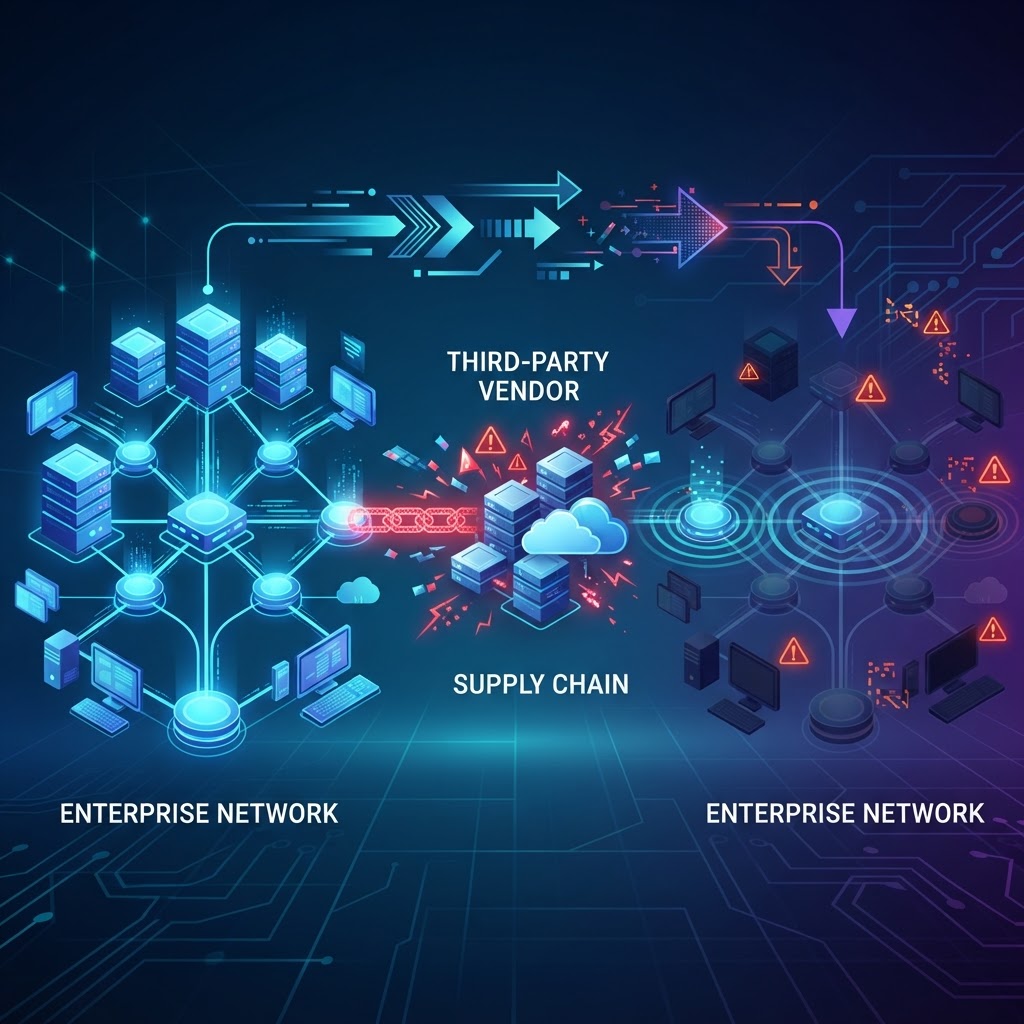
    The fragility of the modern digital supply chain is rooted in consolidation and hyper-dependency. As organizations strive for efficiency, they have consolidated their infrastructure into a handful of major cloud service providers and niche SaaS solutions. This centralization creates a “single point of failure” phenomenon. When a major cloud provider experiences an outage, thousands of dependent businesses go offline simultaneously. This is the definition of digital supply chain risk: the systemic threat that an incident in one node of the network will trigger a cascade of failures across the entire ecosystem.

    The complexity of these interdependencies often remains hidden until a crisis occurs. A manufacturing firm might know its cloud server provider, but it may not fully account for the cybersecurity posture of the platform that handles its automated supply chain logistics. If that platform is compromised, the manufacturing firm cannot receive orders or dispatch shipments, even if its own internal servers are perfectly secure. The attacker does not need to bypass the manufacturer’s firewall; they only need to compromise the weaker link in the chain.

    Furthermore, the threat landscape has evolved to target the supply chain intentionally. Ransomware syndicates and state-sponsored actors have recognized that attacking a single software vendor can provide them with access to hundreds or thousands of that vendor’s clients. This is often referred to as a “one-to-many” attack vector. By embedding malicious code into a widely used software update, a threat actor can distribute their impact instantly. This shift toward targeting vendors rather than end-users has left many businesses vulnerable, as they lack the visibility or the leverage to audit the security practices of every vendor they engage with.

    The vulnerability is compounded by the “black box” nature of modern software. Businesses integrate APIs and third-party tools daily, often without deep technical due diligence on the security architecture of those tools. This reliance on “black box” dependencies means that firms are essentially outsourcing their risk without having the insurance or contractual protections in place to mitigate that risk. When a vendor suffers a data breach or an operational outage, the ripple effect is immediate, and the financial impact on the dependent business can be catastrophic, often exceeding the firm’s available cash reserves if the outage lasts for an extended period.

    Approach Key Focus Best For
    Traditional BI Extension Physical assets/Standard operations Small businesses with low digital integration
    Standalone Cyber CBI Policy Digital outages and service interruptions Enterprise firms with high cloud dependency
    Vendor Risk Management Program Contractual security requirements Regulated industries and high-growth startups

    How CBI Coverage Differs From Standard Business Interruption

    It is a common misconception among business leaders that a standard commercial property or general business interruption (BI) policy will provide protection against a cyber-induced shutdown. Standard BI insurance is historically predicated on the concept of “physical damage.” To trigger a standard policy, a company typically needs to demonstrate that property has been destroyed or rendered unusable by a physical peril, such as fire, flood, or a structural collapse. In the eyes of many traditional insurers, a software glitch or a server outage does not meet the “physical loss” threshold unless it is directly linked to hardware destruction.

    CBI coverage is fundamentally different because it is designed for the intangible nature of modern cyber risk. A CBI policy is triggered by the impairment of digital services, regardless of whether a physical asset was actually damaged. This distinction is crucial in 2026, where the most damaging attacks—such as ransomware, data exfiltration, or cloud service outages—rarely involve the actual smashing of hardware. Instead, they involve the encryption of data, the disruption of network traffic, or the compromise of access credentials.

    Furthermore, standard BI policies often include specific “cyber exclusions” that explicitly strip away coverage for anything related to digital systems. If your facility loses power because a storm destroyed a transformer, your standard BI policy likely covers the resulting downtime. If your facility loses access to its mission-critical CRM because of a widespread cyber attack on your cloud provider, your standard BI policy will almost certainly deny the claim. CBI fills this void by specifically defining “cyber incidents” as a legitimate peril for triggering business interruption.

    Another key difference lies in the breadth of the geographical and relational scope. While standard BI might cover you for a loss occurring at a nearby utility supplier (such as a local power grid failure), CBI is global. Because digital supply chains transcend borders, CBI coverage is designed to follow the data, not just the physical location of the assets. This global reach is essential for modern businesses, as their service providers may be located in diverse jurisdictions, each with different legal and regulatory environments regarding data security and uptime commitments.

    Finally, the calculation of loss is often more complex in a CBI context. Standard BI calculates losses based on historical physical performance—how many units did you produce, or how many customers did you serve before the fire? CBI calculation involves a digital baseline: what was the expected transactional throughput, and how far did it dip during the service failure? Insurers have had to develop new actuarial models that account for the non-linear way in which digital service outages unfold. Recognizing the differences between these two types of coverage is not just an insurance exercise; it is an exercise in identifying the true threats to your business model.

    Identifying Your Critical Digital Supply Chain Dependencies

    Before you can purchase appropriate insurance, you must map the geography of your digital dependencies. You cannot insure what you cannot identify. This mapping process, often referred to as “Digital Supply Chain Mapping,” is the foundational task for any organization looking to leverage cyber insurance for vendors effectively. Start by conducting a comprehensive audit of your IT stack. Identify every third-party service that your business cannot operate without for more than four hours. These dependencies generally fall into three categories: Cloud Service Providers (CSPs), Managed Service Providers (MSPs), and niche software or SaaS tools.

    Once you have identified these providers, you must determine their “criticality level.” Not all vendors are created equal. If a marketing analytics tool goes down, you might experience a minor inconvenience. If your primary cloud hosting provider experiences a region-wide outage, your entire business might go dark. Prioritize your list based on the potential revenue impact of a 24-hour, 72-hour, and one-week outage. This tiered approach helps in setting appropriate coverage limits for your CBI policy, as you may decide that only your most critical “Tier 1” vendors need to be explicitly listed or considered in your policy’s scope.

    The identification process should also involve the legal and procurement departments. Review your service level agreements (SLAs) with these providers. What are their liabilities in the event of a breach? Do they offer service credits? Understanding the contractual landscape helps you determine what the insurance needs to cover and what is already addressed by your vendor contracts. Be wary of “contractual blind spots” where a vendor’s liability is capped at a fraction of your actual potential loss. This is exactly the gap that your CBI insurance should be structured to cover.

    Another often-overlooked aspect of mapping is “fourth-party” risk. Your direct vendor (a SaaS company) is likely hosted on a major cloud provider (e.g., AWS, Azure, GCP). If your SaaS vendor is secure, but the cloud provider they rely on has an outage, you are still affected. While you may not be able to list every fourth-party provider, your risk assessment should account for the fact that a large portion of your digital supply chain ultimately rests on a small number of hyperscale cloud providers. Assessing your concentration risk—where too many of your critical dependencies rely on the same underlying infrastructure—is a key step in both risk mitigation and insurance purchasing.

    By treating the digital supply chain as a map of potential failure points, you can move away from vague, blanket coverage towards a strategy that is data-driven and actionable. When you sit down with your broker, being able to present a clear, documented map of your critical dependencies will not only help you secure better pricing and terms but will also dramatically simplify the claims process should an incident occur. It shows the insurer that you are a sophisticated risk manager who understands where your vulnerabilities lie.

    Common Triggers for a Contingent Business Interruption Claim

    A CBI coverage claim is not automatic. It relies on a specific sequence of events, known as “triggers,” that must be met for the insurer to accept liability for the loss. In the current 2026 market, these triggers are more precise than ever. The most common trigger is a “failure of a dependent service.” For this to apply, the third-party service provider must have experienced an actual failure of their systems—typically caused by a cyber event—which leads directly to the inability of the insured to conduct their own business activities. It is important to note that a mere degradation in performance, such as a slow network connection, may not satisfy this trigger unless it results in a total or near-total stoppage of operations.

    A second common trigger involves “denial of service” attacks. If a critical vendor is hit by a massive DDoS attack that prevents their legitimate clients from accessing their tools, this usually counts as a valid CBI event. However, coverage often hinges on the “authorized access” requirement. Some older or more restrictive policies might only trigger if the incident resulted from a malicious breach, such as a hacker infiltrating the vendor’s database. If the outage was caused by an “accidental” cyber event—such as a botched software patch update—there may be a dispute over whether the policy covers it. Ensure your policy language is broad enough to cover both malicious attacks and operational cyber failures.

    A third trigger often found in modern policies is the “security failure” or “data breach at a third party.” In this scenario, you do not necessarily need to be taken offline. Instead, if a third party suffers a breach that compromises your data, your business might be forced to cease operations for a period to perform forensic investigations, reset credentials, or migrate to new systems. This is an increasingly common trigger as companies become more risk-averse regarding their own cybersecurity posture. If your vendor tells you to stop using their service until they can prove the breach is contained, that is a trigger for a claim.

    It is also vital to understand the “waiting period” or “deductible” trigger. Almost all CBI policies include a time-based deductible, commonly referred to as the “waiting period.” This might be 8, 12, or 24 hours. The insurance does not kick in until the service interruption exceeds this duration. This means that if your most critical vendor has an outage that lasts for 10 hours and you have a 12-hour waiting period, you absorb the entirety of that loss. Negotiating a shorter waiting period can be a high-value strategy for businesses with extremely low tolerance for downtime.

    Finally, geographic triggers and naming requirements are common. Some policies require that the vendors be “scheduled” or specifically named in the policy document. Others offer “blanket” coverage for any service provider that meets certain criteria. If your policy requires you to name your vendors, you must be disciplined about updating that list whenever you onboard a new critical supplier. Failing to update this schedule is a common reason for claims being denied. Always verify with your broker whether your policy provides blanket or scheduled coverage and what the implications are for your supply chain management process.

    Coverage Limits and Sublimits in 2026 Cyber Policies

    As the cyber threat landscape matures, the architecture of cyber insurance policies has become increasingly nuanced. By 2026, underwriters have largely moved away from blanket, all-encompassing limits for Contingent Business Interruption (CBI). Instead, they are utilizing granular sublimits to manage the systemic risk inherent in digital supply chains. Understanding these distinctions is critical for risk managers seeking to avoid unexpected out-of-pocket expenses during a major disruption.

    Typically, a policy will feature a primary aggregate limit—the total amount the insurer will pay for all claims under the policy. However, CBI often resides within a sublimit, which caps the maximum payout for losses originating from a third-party vendor rather than your own internal network. Because a single cloud service provider outage can impact thousands of policyholders simultaneously, insurers are cautious. They often set these sublimits lower than the aggregate limit to protect their own balance sheets against correlated, catastrophic losses.

    Furthermore, insurers now commonly apply “waiting periods” or “deductible hours” specifically to CBI claims. Unlike your primary business interruption coverage, which might trigger after 8 to 12 hours of downtime, a CBI clause might necessitate a 24, 48, or even 72-hour waiting period before coverage commences. In a fast-paced digital environment, a 48-hour delay can lead to massive revenue loss that remains entirely uninsured.

    Policyholders must also watch for “named vs. unnamed” vendor clauses. Some policies offer broader coverage if the disruption occurs at a vendor specifically named in the policy schedule, whereas unnamed vendors—even if critical—may be subject to much tighter sublimits. The evolution of 2026 cyber policies emphasizes the “vendor mapping” process. If your policy language is too vague, you may find that a cloud software provider you rely on daily is not technically classified as a “covered vendor” under your specific policy terms.

    Evaluating Your Vendors’ Cybersecurity Posture

    In the modern era of interconnected commerce, your security is only as strong as the weakest link in your digital ecosystem. Evaluating third-party risk is no longer a peripheral task handled solely by IT departments; it is a core business necessity that influences your insurance eligibility and premiums. When a supply chain cyber attack occurs, the ripple effects can be catastrophic, and insurers are increasingly requiring proof of “vendor due diligence” before they will honor a CBI claim.

    To evaluate your vendors effectively, consider adopting a standardized framework. Do not simply rely on a vendor’s verbal assurance that they are “secure.” Request their latest SOC 2 Type II report, which provides independent verification of their internal controls. Furthermore, look for evidence of continuous monitoring. Static annual assessments are rapidly becoming obsolete; today’s best-in-class vendors use automated security ratings platforms to track their partners’ vulnerabilities in real-time.

    Key areas to scrutinize during your evaluation include:

    • Incident Response Capability: Do they have a documented, tested plan for responding to a breach? How quickly can they notify you?
    • Geographic Risk: Where are their data centers located? Are they subject to conflicting international data privacy regulations that might impede recovery efforts?
    • Dependency Mapping: Do they use fourth-party vendors? A major security lapse at a cloud infrastructure provider may cascade through your software vendor and eventually hit your operations.
    • Access Management: Do they utilize robust multi-factor authentication (MFA) and the principle of least privilege when accessing your systems or data?

    By conducting these evaluations, you not only improve your operational resilience but also provide your insurance carrier with the documentation needed to justify your coverage. In many cases, demonstrating a rigorous vendor management program can lead to more favorable negotiation of sublimits or even a reduction in the waiting periods associated with your CBI coverage.

    Assessment Tool/Strategy Primary Focus Best For
    SOC 2 Type II Reports Historical operational effectiveness of controls. Verifying long-term compliance and security hygiene.
    Security Rating Platforms External attack surface visibility and real-time scanning. Monitoring large vendor pools for new, active vulnerabilities.
    Direct Security Questionnaires Specific business process risks and internal policy adherence. Deep-dive audits of mission-critical partners.
    Penetration Test Summaries Active detection of exploitable weaknesses. Validating the efficacy of vendor-specific security patches.

    Steps to Take Before a Contingent Cyber Outage Occurs

    Proactive preparation is the single most effective way to minimize the damage of a digital supply chain disruption. While you cannot prevent an attack on a third-party vendor, you can control the speed and efficacy of your business’s reaction. The following steps should be institutionalized as part of your comprehensive business continuity plan:

    1. Develop a Vendor Dependency Inventory: You cannot protect what you haven’t identified. Create a comprehensive list of all third-party software, hardware, and service providers. Classify them by criticality: Tier 1 (business-critical), Tier 2 (supporting), and Tier 3 (ancillary). Your insurance focus should be entirely on Tier 1 providers.

    2. Negotiate “Right-to-Audit” Clauses: Ensure that your contracts with key suppliers include a “right-to-audit” or at least a requirement for them to share their annual security assessment summaries. This ensures you are not flying blind regarding their security maturity.

    3. Establish Manual Workarounds: If your cloud-based CRM or ERP system goes offline for three days, does your business grind to a halt? Develop offline, manual processes for essential operations, such as manual inventory tracking or paper-based invoicing, to ensure the business stays solvent during a digital blackout.

    4. Test Your Incident Response Plan with Supply Chain Scenarios: Many organizations practice “tabletop exercises” for ransomware affecting their own network. You must also include scenarios where a key vendor is the source of the breach. Simulate the communication channels you will use if email is compromised, and ensure key leadership knows exactly when to trigger the notification process for your insurance provider.

    5. Maintain Financial Reserves: Even with insurance, the payout can take months to process. Ensure you have sufficient liquidity to cover the “waiting period” and the potential gap between your loss and the final claim settlement.

    How to Properly Calculate Your CBI Coverage Requirements

    Calculating the correct amount of CBI coverage is an exercise in financial modeling rather than mere guessing. Start by reviewing your financial statements to identify your “dependent revenue streams.” If you rely on a specific logistics platform to ship your products, your revenue is directly tied to the uptime of that platform. If that platform goes down, how much does your daily net income drop?

    Consider the “Maximum Tolerable Downtime” (MTD) for each major vendor. If a vendor is out for 48 hours, what is the dollar impact on your operations? If they are out for a week? Often, the loss is not just direct revenue; it includes customer churn, potential contractual penalties for missing service-level agreements (SLAs), and the cost of expedited shipping or manual intervention required to keep operations moving.

    To reach an accurate CBI limit recommendation, follow this formula:

    1. Estimate Daily Loss per Tier 1 Vendor: Calculate the gross profit contribution for each business process dependent on that vendor.
    2. Apply a Duration Multiplier: In 2026, many experts recommend planning for at least a 14-day outage, given the complexity of remediating supply chain attacks. Multiply your daily loss by 14.
    3. Add Extra Expenses: Include the cost of temporary IT personnel, forensic auditors, and communication specialists required to manage the crisis.
    4. Review against Policy Terms: Ensure that the sublimits offered by your insurer cover the highest probable loss identified in your model, rather than just an arbitrary round number.

    It is also vital to engage your CFO and your legal counsel in this process. Their perspective on contractual liabilities and cash flow constraints will refine your coverage needs far more accurately than IT metrics alone.

    Frequently Asked Questions

    Does standard business interruption insurance cover cyber-related supply chain issues?

    No. Standard business interruption insurance is typically triggered by physical damage to property, such as fire or flood. It usually excludes cyber events entirely. To protect against losses from digital supply chain outages, you must purchase a dedicated cyber insurance policy that explicitly includes Contingent Business Interruption (CBI) coverage.

    What exactly is a “digital supply chain risk”?

    Digital supply chain risk refers to the possibility that your organization will suffer financial or operational losses due to a security breach, system failure, or outage at a third-party vendor you rely on. Because your systems are connected to these vendors via API, cloud integration, or shared infrastructure, their security vulnerabilities effectively become your own.

    Are cloud service providers (CSPs) automatically covered under CBI policies?

    Most policies provide coverage for major cloud service providers, but the scope can vary. Some policies apply a broad definition that includes any “cloud service provider,” while others may limit coverage to a pre-defined list of vendors. It is essential to review your specific policy schedule to confirm which providers are included and if any are specifically excluded.

    What is the difference between Business Interruption and Contingent Business Interruption?

    Business Interruption (BI) coverage applies to losses resulting from a cyber attack on your own network and IT systems. Contingent Business Interruption (CBI) coverage applies specifically to losses resulting from a cyber attack on a third-party vendor or supplier that prevents you from conducting your normal business activities.

    How do insurance companies verify my claim during a CBI event?

    Insurers will require detailed forensic reporting to verify that the vendor’s outage was indeed the proximate cause of your financial loss. They will typically look for documentation such as the vendor’s public incident disclosures, your internal logs showing a loss of connectivity, and financial records correlating the duration of the outage with your specific revenue decline.

    Can I increase my CBI sublimits if my business relies heavily on one vendor?

    Yes. If your vendor due diligence indicates a high concentration of risk with a single provider, you should discuss this with your broker. While the insurer may be hesitant to offer high limits due to systemic risk, they may agree to higher sublimits if you can demonstrate superior security protocols, such as redundant backup systems or a well-documented failover plan that mitigates the potential severity of the outage.

    Conclusion

    The digital supply chain is the backbone of the modern economy, yet it remains the most significant, often overlooked, vulnerability in the enterprise risk portfolio. As we look toward the ongoing developments in 2026 and beyond, it is clear that reliance on third-party vendors will only intensify. This shift demands a sophisticated approach to insurance—one that moves beyond basic policy acquisition and into the realm of strategic risk management.

    Contingent Business Interruption coverage is no longer an optional add-on; it is a fundamental safeguard against the unpredictable nature of our interconnected world. By meticulously mapping your dependencies, vetting your vendors, and modeling your potential financial exposure, you transform your cyber insurance from a mere expense into a resilient pillar of your business continuity strategy. Do not wait for a third-party failure to expose gaps in your protection. Contact your risk advisor today to audit your current CBI limits and ensure your organization is prepared for the inevitable challenges of the digital age.

    By insureiqguru Editorial Team

  • Cyber Insurance Coinsurance: How It Affects Your Payouts in 2026

    Cyber Insurance Coinsurance: How It Affects Your Payouts in 2026

    Key Takeaways

    • Coinsurance is a contractual requirement mandating that policyholders maintain a specific level of coverage relative to the total value of their digital assets.
    • Failure to meet the coinsurance percentage can lead to a significant reduction in a cyber claim payout during a loss event.
    • Insurers use coinsurance to prevent underinsurance and to ensure that premium levels accurately reflect the aggregate risk of a company’s data footprint.
    • Calculating your coinsurance requirement necessitates a deep dive into business interruption estimates and total data asset valuation.
    • Underinsuring your organization is a high-stakes gamble that often creates a dangerous cyber coverage gap during catastrophic breaches.

    As the digital landscape of 2026 continues to evolve, the complexities of protecting enterprise assets have moved beyond simple perimeter defense. For business leaders and risk managers, the fine print of a commercial policy is now just as critical as the firewall settings themselves. Among the most misunderstood and financially impactful components of modern policies is the cyber insurance coinsurance clause. While many organizations focus primarily on the policy limit or the deductible, the coinsurance requirement often dictates whether a business recovers fully from a ransomware attack or suffers a catastrophic financial shortfall. Navigating these commercial insurance terms is no longer a task relegated to the back office; it is a fundamental pillar of modern cyber risk management that requires precision, foresight, and a clear understanding of how insurers calculate their financial exposure.

    What Is a Coinsurance Clause in Cyber Insurance?

    At its core, insurance coinsurance explained in the context of cyber risk serves as a risk-sharing mechanism between the policyholder and the insurer. When an insurance provider includes a coinsurance clause, they are essentially requiring the insured entity to carry a specific amount of coverage—usually expressed as a percentage of the total insurable value—relative to the potential magnitude of a cyber loss. If a business falls below this threshold, the insurer reserves the right to apply a penalty during the claims adjustment process. This mechanism is designed to prevent policyholders from purchasing “bare-bones” coverage for a massive risk, which would artificially lower premiums while leaving the insurer exposed to a disproportionate level of liability.

    Understanding this clause requires viewing the cyber insurance policy not as a static bank account, but as a dynamic contract based on the value of the digital assets at stake. For instance, if a company is required to maintain 80% coinsurance on a total data and business interruption exposure of $10 million, they must carry at least $8 million in coverage. If the organization decides to carry only $4 million in coverage to save on premiums, they are effectively choosing to self-insure a portion of the risk. When a claim arises, the insurer looks at this shortfall. The coinsurance clause stipulates that because the business did not carry the agreed-upon amount of coverage, the insurer will only pay a portion of the claim, forcing the business to cover the remaining percentage out of pocket.

    This requirement is often misunderstood as a deductible, but they are fundamentally different. A deductible is a fixed dollar amount that a business pays before the insurance kicks in. Coinsurance, however, is a proportional tool. It functions as a warning to businesses that their policy limits must scale with their digital infrastructure. As a business expands its cloud footprint, integrates more IoT devices, or increases its reliance on proprietary data, the “total insurable value” changes. If the organization fails to update its policy limits to keep pace with this growth, the coinsurance clause triggers a reduction in payout, even if the policy limit itself appears to be high. In the fast-paced climate of 2026, where data-driven business models are the norm, this clause acts as a catalyst for frequent and rigorous valuation exercises.

    How Coinsurance Affects Your Cyber Claim Payouts

    The impact of a coinsurance clause becomes painfully clear only when a breach occurs. When an organization experiences a cyber event, the insurance carrier performs a standard loss adjustment. Part of this process involves verifying whether the policyholder was in compliance with the coinsurance requirement at the time of the loss. If the organization is found to be underinsured, the resulting cyber claim payout is reduced proportionately. This is often calculated by taking the ratio of the amount of insurance carried to the amount of insurance that should have been carried, and applying that fraction to the actual loss amount.

    Consider a hypothetical scenario where a mid-sized e-commerce firm suffers a ransomware attack that halts operations for ten days, resulting in $2 million in lost revenue and recovery costs. The policy dictates a 90% coinsurance requirement, and the total insurable value of their digital operations is determined to be $5 million. Therefore, the firm was required to carry $4.5 million in coverage. However, the firm had only purchased $2.25 million in coverage. Because they carried only 50% of the required coverage (2.25 million out of 4.5 million), the insurer will only pay 50% of the $2 million loss, minus any applicable deductible. In this instance, the business ends up with a $1 million payout rather than the $2 million they might have expected, creating a massive coverage gap that could potentially threaten the company’s solvency.

    This mechanism is inherently punitive for businesses that have not properly assessed their digital risks. It shifts the burden of underinsurance directly onto the policyholder. Even if the policy limit is high enough to cover the total loss, the coinsurance clause acts as a secondary filter. The payout is not simply determined by the damage sustained or the policy limits; it is determined by the mathematical relationship between your current coverage and your total exposure. This makes the claim process significantly more complex, as businesses must often undergo forensic financial audits to prove their total insurable value at the time of the breach. The uncertainty surrounding these calculations can delay payouts and complicate liquidity planning during the most critical days of incident recovery.

    Strategy Approach Mechanism Best For
    Agreed Value Policy Pre-negotiated coverage limit based on total risk assessment. Enterprises with predictable revenue and static digital assets.
    Standard Coinsurance Variable payout based on coverage-to-value ratio. Companies undergoing rapid growth or scaling digital operations.
    Blanket Coverage Broad coverage across multiple sites or business units. Distributed global organizations with diverse asset classes.

    Why Insurers Include Coinsurance Clauses in Cyber Policies

    Insurance providers utilize coinsurance clauses to maintain the mathematical integrity of their risk pools. Cyber insurance is a highly volatile product. Unlike property insurance, where the value of a physical building is relatively easy to appraise, the value of data, system uptime, and brand reputation is notoriously difficult to quantify. If insurers did not include a cyber policy coinsurance clause, businesses might be tempted to purchase the smallest amount of coverage possible, knowing that the likelihood of a total, “limit-exhausting” loss is statistically smaller than a partial loss. While this might seem rational for the individual business, it creates an imbalance in the premium pool. If everyone bought minimal coverage but expected full payouts for minor incidents, insurers would be unable to generate the necessary revenue to cover the massive, industry-wide losses caused by systemic cyber events.

    From the insurer’s perspective, coinsurance is an enforcement mechanism for proper cyber risk management. It forces the policyholder to perform periodic valuations of their digital assets. When a company is required to calculate its total insurable value to satisfy a coinsurance requirement, it is essentially being forced to map its own cyber risk profile. This identification of critical data, dependencies on third-party service providers, and business interruption vulnerabilities is, in itself, a beneficial outcome of the insurance procurement process. The insurer wants the policyholder to be an active participant in their own risk mitigation, rather than treating the insurance policy as an unconditional safety net.

    Furthermore, coinsurance helps protect the stability of the entire insurance market. Cyber risks are interconnected; a single zero-day vulnerability in a popular piece of software can affect thousands of policyholders simultaneously. By mandating appropriate coverage levels, insurers ensure that their capital reserves are adequately prepared for aggregate losses. Without these clauses, the insurance market might see a rush toward under-capitalized policies, which would eventually lead to higher premiums for all participants or a systemic failure to pay claims during a global cyber crisis. By including these requirements, insurers create a standard of financial accountability, ensuring that premiums are proportional to the actual potential damage an organization could face, which preserves the viability of the entire cyber insurance product class for the long term.

    Calculating Your Coinsurance Requirement Correctly

    Accurately determining your coinsurance requirement is a critical task that demands a multi-disciplinary approach within the organization. This is not a calculation that should be left solely to the IT department or the finance team in isolation; it requires a synthesis of data from legal, operations, and cybersecurity leaders. To start, you must define the scope of your total insurable value. This includes, but is not limited to, the cost of forensic investigations, legal counsel fees, public relations management, data restoration costs, and perhaps most importantly, the lost revenue associated with business interruption during the downtime caused by a cyber event.

    To perform this calculation in 2026, companies often utilize sophisticated risk modeling software that evaluates the potential impact of various attack vectors—such as ransomware, business email compromise, and supply chain attacks—on their specific business model. A common framework involves calculating the “Maximum Foreseeable Loss” (MFL). The MFL should estimate the worst-case scenario where systems are down for an extended duration, critical data is compromised, and the business faces regulatory fines and litigation. Once you have a firm grasp on the MFL, you apply the percentage stipulated in your coinsurance clause. If your policy requires 90% coinsurance, your coverage limit must be equal to or greater than 90% of this calculated MFL.

    The process of calculating these figures should be treated as an annual or semi-annual rhythm. Given the rapid pace of digital transformation, a company’s cyber exposure is rarely static. New software deployments, entering new geographic markets, or changes in how the organization stores customer data all fundamentally alter the risk profile. Many companies benefit from working with specialized insurance brokers who have access to actuarial tools that benchmark their risk against similar organizations in the same industry. By reviewing your coverage-to-value ratio at every renewal period, you can adjust your policy limits to remain compliant with the coinsurance clause. This proactive behavior not only keeps you in compliance but also provides a clear roadmap for where to invest in cyber security hardening measures, effectively reducing the risk of a claim occurring in the first place.

    Common Risks of Underinsuring Your Cyber Exposure

    The risks of failing to meet a coinsurance requirement extend far beyond the immediate financial hit of a reduced claim payout. When an organization consciously or inadvertently underinsures its cyber risk, it creates a persistent cyber coverage gap that can undermine the entire corporate strategy. The most immediate danger is, of course, the “co-insurance penalty.” As demonstrated in our previous analysis, this penalty can turn a manageable financial loss into a catastrophic event. However, beyond the arithmetic of the payout, there are strategic risks that can permanently damage a business.

    A primary risk is liquidity volatility. If a business assumes that their $5 million policy limit will cover a $5 million loss, they may not set aside cash reserves to handle the unexpected portion of the claim that gets rejected due to coinsurance penalties. This lack of liquidity can force a business to halt growth initiatives, delay critical R&D, or, in extreme cases, liquidate assets under duress to cover the shortfall. The inability to respond quickly after a breach because of a funding shortfall can turn a temporary disruption into a permanent loss of competitive advantage. Customers and partners lose confidence when a company struggles to recover, and this reputational damage often exceeds the actual dollar value of the insurance gap.

    Additionally, underinsurance can complicate compliance and legal obligations. In many industries, businesses are required to maintain specific levels of financial stability or insurance to satisfy contract requirements with vendors, clients, or regulators. If a cyber breach occurs and the organization finds that their insurance payout is insufficient due to a failure to meet coinsurance requirements, they may be found in breach of their own service-level agreements (SLAs) or data protection regulations. This invites a cascade of legal actions, potential fines, and contractual penalties that are not covered by the original, already insufficient, cyber insurance payout. Ultimately, underinsuring is a form of “phantom risk” that is rarely seen until it is too late. It is a strategic blind spot that effectively transforms the insurance policy from a reliable shield into a fragile and uncertain tool, leaving the business vulnerable to the very volatility they intended to manage.

    Difference Between Deductibles and Coinsurance

    To master your cyber risk management strategy, you must distinguish between two fundamental cost-sharing mechanisms: deductibles and coinsurance. While both are designed to keep the insured party invested in risk mitigation, they function in mathematically distinct ways that drastically alter the outcome of a cyber claim payout.

    A deductible is a fixed, flat-dollar amount that you, the policyholder, are responsible for paying out-of-pocket before the insurance carrier begins to cover any loss. Think of it as a barrier to entry for a claim. If your cyber policy has a 50,000-dollar deductible and you suffer a data breach costing 200,000 dollars, you pay the first 50,000, and the insurer covers the remaining 150,000 (up to your policy limit). This is a static threshold; it does not change regardless of how large the total loss becomes, provided the loss exceeds that initial amount.

    Coinsurance, by contrast, is a percentage-based split of the loss. Once the deductible is satisfied, the insurer does not necessarily cover the full remaining balance. Instead, the coinsurance clause dictates that you remain responsible for a specific percentage of the total claim value, while the insurer covers the rest. This creates a variable impact on your finances; the larger the claim, the more you stand to pay if your coinsurance percentage is high.

    Feature Deductible Coinsurance Best For
    Calculation Fixed Dollar Amount Percentage of Total Loss Predictable Risk
    Impact on Claim Flat reduction Proportional reduction Catastrophic Risk
    Frequency Per occurrence Per loss (often capped) High-Severity Events

    Understanding these commercial insurance terms is vital because they often work in tandem. You may find that your policy applies a deductible first, and then applies coinsurance to the remaining balance. If you are unprepared for this “double-hit” structure, a major ransomware event could create a significant cyber coverage gap, leaving your business to shoulder a portion of the financial burden that you had not accounted for in your annual budget. Experts generally agree that businesses should prioritize lower deductibles for frequent, smaller incidents while carefully analyzing coinsurance percentages to ensure they do not become prohibitive during a large-scale enterprise disaster.

    How to Negotiate Better Coinsurance Terms with Your Broker

    Negotiating your cyber policy coinsurance clause is not about demanding the impossible; it is about demonstrating superior cyber risk management. Insurance underwriters are more likely to offer favorable terms—lower coinsurance percentages or higher thresholds—when they perceive a business as a “well-defended risk.”

    Start by conducting a comprehensive internal audit of your security posture. When approaching your broker, provide them with objective evidence of your defensive maturity. This should include documentation of MFA (Multi-Factor Authentication) implementation, regular penetration testing, and immutable backup systems. If you can prove that your network segmentation is robust and your incident response plan has been stress-tested, your broker has a stronger case to advocate for a reduction in your coinsurance exposure.

    Transparency is your greatest asset. Do not hide past incidents or existing vulnerabilities. Instead, explain the mitigation strategies you have deployed to prevent a recurrence. When a broker presents a granular, high-quality risk profile to an underwriter, the insurance carrier is often more willing to treat you as a partner rather than a liability. Ask your broker to solicit quotes from multiple carriers that specialize in your specific industry vertical. Different insurers have different appetites for risk; some may be willing to trade a slightly higher premium for a lower coinsurance requirement, while others may prefer the opposite. Aligning your insurance structure with your company’s cash flow needs is the core of effective negotiation.

    Furthermore, ask your broker to explain the “Coinsurance Waiver” or “Coinsurance Caps.” Some policies include language that limits the coinsurance obligation after a certain dollar amount is reached. Negotiating for these caps can protect your business from the “tail risk” of a massive, business-ending cyber event. Ensure your broker is also checking for “Agreed Value” options, which can sometimes circumvent the need for complex coinsurance calculations during a claim payout.

    Steps to Evaluate Your Business Interruption Values

    Business Interruption (BI) is frequently the most expensive component of a modern cyber claim. Since coinsurance often applies to the entirety of a loss—including the lost income during downtime—it is imperative that your valuation of this risk is accurate. If you undervalue your BI, you are not just underinsured; you are leaving yourself vulnerable to severe financial strain when the claim payout is curtailed by a coinsurance penalty.

    To accurately evaluate your Business Interruption values, follow these logical steps:

    1. Analyze Revenue Streams: Identify exactly which systems generate revenue and how much they contribute on a daily, weekly, and monthly basis. If your e-commerce platform goes down, what is the exact hourly revenue loss?
    2. Factor in Variable Costs: BI coverage generally covers “gross profit,” not total revenue. Subtract your variable expenses—costs you would avoid if the business were not operating—from your revenue projections. This is the figure that actually needs to be insured.
    3. Calculate Recovery Time Objectives (RTO): Estimate the “worst-case” scenario for system restoration. If it takes your IT team 14 days to fully recover from a ransomware event, your BI value must reflect two full weeks of profit loss plus extra expenses incurred to expedite restoration.
    4. Account for Extra Expenses: Beyond lost profits, factor in the cost of temporary workarounds, overtime pay for staff, and public relations efforts required to regain client trust. These are often lumped into the BI/Extra Expense limit.
    5. Review Quarterly: Business valuation is not static. If you have launched a new digital product or expanded into a new market, your BI exposure has increased. Re-evaluate these numbers every quarter or after any significant infrastructure change.

    By conducting a rigorous analysis, you prevent the common error of “under-insuring to save on premiums.” While lower limits might seem like a bargain, a major incident will expose the discrepancy, and the coinsurance clause will essentially penalize you for not carrying enough coverage for your actual risk profile.

    Avoiding Penalties During a Major Cyber Incident

    The moment a breach is identified, the clock begins to tick on both your recovery and your insurance claim. Avoiding penalties—specifically those related to policy compliance and the correct application of coinsurance—requires strict adherence to your insurer’s reporting guidelines.

    First and foremost, notify your carrier immediately. Most cyber policies have a “duty to notify” clause. If you wait 48 hours to inform your insurer while you “investigate on your own,” you may inadvertently invalidate portions of your coverage. Professional insurers have panels of forensic experts and legal counsel who know how to document a claim to minimize disputes. By bypassing them, you risk mishandling evidence, which could result in a lower payout because you cannot prove the full extent of the loss.

    Second, prioritize the preservation of data and logs. If your internal IT team deletes logs while trying to “fix” the system, you may find that the insurance adjuster refuses to cover specific damages because they lack the requisite proof of the incident’s scope. Follow the instructions of your cyber incident response plan precisely. If your policy mandates that you use an approved vendor from their panel, do not attempt to use a third-party consultant unless you have prior authorization.

    Finally, document every cost associated with the incident. Keep a dedicated ledger for “extra expenses” caused by the breach. This includes everything from the cost of credit monitoring for affected customers to the fees paid for data recovery services. When it comes time to calculate the final payout, having clear, documented evidence makes it much harder for an insurer to dispute your claim or apply arbitrary coinsurance deductions. Communication is key; keep your broker in the loop throughout the entire incident lifecycle to ensure that your recovery actions remain in compliance with your policy’s terms.

    Frequently Asked Questions

    What is the difference between a cyber insurance deductible and a coinsurance percentage?

    A deductible is a fixed amount you pay before the insurer covers any loss. Coinsurance is a percentage of the total loss that you are responsible for paying after the deductible is met. While the deductible is a constant cost, the coinsurance amount increases as the total value of the loss grows.

    Can I negotiate the coinsurance percentage in my cyber policy?

    Yes, coinsurance percentages are often negotiable, particularly for businesses that can demonstrate high-level security maturity. By providing your broker with detailed reports on your security controls, such as MFA implementation and regular vulnerability testing, you can leverage your risk profile to request more favorable terms.

    Why does a cyber insurance policy apply coinsurance to business interruption claims?

    Coinsurance is applied to business interruption to ensure that the policyholder remains partially responsible for the financial success of their recovery efforts. It prevents “over-insuring” and encourages businesses to maintain accurate valuations of their true revenue exposure, preventing moral hazard.

    What is a “coinsurance penalty” and how can I avoid it?

    A coinsurance penalty occurs when you fail to insure your business up to the required percentage of its actual total value (often called the “coinsurance clause requirement”). If you are underinsured, the insurer will only pay a proportional share of the loss. You avoid this by performing frequent, accurate valuations of your business assets and revenue exposure.

    Does cyber insurance cover the cost of ransomware payments?

    Many cyber insurance policies include coverage for ransomware payments, but this is subject to specific sub-limits, deductibles, and coinsurance requirements. It is essential to verify if your specific policy includes “extortion coverage” and whether that coverage is subject to a different coinsurance structure than standard data breach claims.

    Why should I hire a broker to assist with my cyber insurance renewal?

    A specialized insurance broker acts as your advocate during negotiations and claim disputes. They understand the nuances of commercial insurance terms and can help you interpret complex coinsurance clauses, ensuring you do not sign on to restrictive terms that could jeopardize your payout during a real-world incident.

    Conclusion

    Navigating the world of cyber insurance requires more than just signing a document; it demands a granular understanding of how your policy responds when the worst-case scenario occurs. Cyber insurance coinsurance is a powerful financial mechanism designed to share risk, but without proper planning, it can become a source of significant, unexpected costs. By understanding the distinction between deductibles and coinsurance, maintaining accurate business interruption valuations, and fostering a collaborative relationship with your insurance broker, you can ensure your business remains resilient in the face of evolving digital threats.

    Cyber risk management is not a one-time project—it is an ongoing process of assessment, negotiation, and preparation. As we move further into 2026, the complexity of cyber incidents will only increase, making it more vital than ever to audit your insurance coverage and confirm that your protection is robust enough to survive the aftermath of a breach. Do not wait for a ransomware event to discover your coverage gaps. Contact your insurance broker today to review your current coinsurance terms and ensure your business is truly protected for the road ahead.

    By insureiqguru Editorial Team

  • Choosing Cyber Insurance Retention: How to Balance Risk and Cost

    Choosing Cyber Insurance Retention: How to Balance Risk and Cost

    Key Takeaways

    • Cyber insurance retention is the self-insured portion of a loss that a business must pay before insurance coverage begins.
    • While often used interchangeably with “deductible,” retention functions as a legal barrier that alters the administration of claims.
    • Choosing a higher retention level is a common strategy for businesses seeking to reduce their annual cyber liability insurance cost.
    • An optimal retention strategy balances a company’s cash flow availability against its projected risk exposure and historical incident data.
    • Determining the right retention level requires an honest assessment of your business’s risk appetite and its ability to absorb immediate financial shocks.

    In the digital age, cyber threats are no longer a matter of “if” but “when.” As ransomware attacks, data breaches, and business email compromises continue to proliferate, organizations of all sizes are turning to specialized insurance products to safeguard their bottom lines. However, purchasing a policy is only the first step in a robust risk management strategy. A critical, yet often overlooked, component of your coverage is the cyber insurance retention. Understanding how this financial mechanism works is essential for any decision-maker tasked with optimizing their company’s resilience. By strategically selecting your retention levels, you can effectively manage the total cost of risk, ensuring that your business remains protected without unnecessarily inflating your premiums. In this guide, the insureiqguru Editorial Team explores how to navigate these complexities, providing the insights needed to align your insurance program with your broader corporate financial goals.

    What Is Cyber Insurance Retention and How Does It Work?

    At its core, cyber insurance retention represents the amount of a loss that an insured entity agrees to cover out-of-pocket before the insurance carrier assumes responsibility for the remaining costs. Think of it as your “skin in the game.” When a covered cyber incident occurs—such as a network intrusion, data theft, or system outage—your business is responsible for the expenses incurred up to the specified retention amount. Once this threshold is surpassed, the insurance policy triggers, and the carrier provides coverage for the loss, subject to the policy’s overall limits and sub-limits.

    The mechanics of retention are vital to understanding your cyber insurance policy basics. Unlike traditional property insurance, where a claim might be relatively straightforward to quantify, cyber claims often involve a complex array of immediate expenses, including digital forensics, incident response coordination, legal fees, and regulatory notification costs. When a policy includes a retention, your organization is essentially acting as its own primary insurer for the initial phase of the incident.

    In practice, how this works can vary depending on the structure of your policy. For example, if you have a retention of $25,000 and a ransomware incident results in $100,000 in total costs, your organization must pay the first $25,000, and the insurer will cover the remaining $75,000. However, it is important to note that the retention amount applies to the specific costs outlined in the policy coverage grant. If your business incurs expenses that are excluded from coverage entirely, those costs fall outside of the retention calculation and remain the sole responsibility of the company.

    There is also the concept of a “Self-Insured Retention” (SIR), which is frequently utilized in cyber policies. Under an SIR structure, the insured is typically responsible for the administration and payment of the covered costs up to the retention limit. This means the business may be required to pay legal counsel or forensic investigators directly during the early stages of a breach. Some carriers offer a “disappearing retention” or other flexible structures, but standard retention generally mandates that the business effectively manages the initial outflow of capital before the insurer’s claims department takes over the management of the incident and subsequent payments. This structure serves a dual purpose: it encourages the insured to maintain high standards of cybersecurity hygiene—since they bear the immediate burden of smaller, more frequent losses—and it reduces the administrative burden on the insurance carrier for minor incidents that might otherwise involve time-consuming claim processing.

    Retention vs Deductible: Understanding the Key Differences

    In the world of insurance jargon, “deductible” and “retention” are often treated as synonyms, but they carry distinct legal and operational differences that can significantly impact how your claim is handled. For businesses navigating cyber liability insurance, recognizing these nuances is part of being an informed insurance consumer.

    A deductible is typically integrated into the limit of the policy. In many traditional insurance contracts, a deductible reduces the total limit of liability available. For instance, if you have a $1 million policy with a $25,000 deductible, the insurer might only pay a maximum of $975,000. Essentially, the deductible is subtracted from the insurer’s obligation, making it a “subtraction” from the total potential payout. This structure is common in straightforward liability lines and is often easily understood by risk managers.

    A Self-Insured Retention (SIR), by contrast, generally exists as a layer of coverage that sits alongside or below the insurance policy without necessarily reducing the total limit of the policy itself. Using the same $1 million policy example, an SIR of $25,000 means that once you have paid your $25,000, the insurer provides the full $1 million in coverage for the loss. In this scenario, the insurer’s total limit remains intact. This is a critical distinction when assessing your true exposure in the event of a catastrophic breach, as it preserves the maximum coverage available to you during a large-scale event.

    Furthermore, the administration of these two approaches differs. With a deductible, the insurer is often involved in the claim process from the very first dollar. They handle the legal defense or incident response, and you are simply billed for the deductible portion. With an SIR, the burden of handling the claim—and potentially the duty to defend—may initially reside with the insured entity. You may be required to settle smaller invoices for forensics or breach notification services yourself, which can be an operational advantage if your company prefers to maintain control over initial incident response vendors or legal counsel. However, this also requires your organization to have the internal resources and cash liquidity to handle those immediate payments without causing a strain on your daily operations.

    Feature Deductible Self-Insured Retention (SIR) Best For
    Policy Limit Impact Usually reduces total limit Typically does not reduce limit Preservation of total coverage
    Claims Control Insurer typically leads Insured may lead initial response Organizations with internal teams
    Complexity Lower administrative effort Higher administrative effort Smaller vs Larger Enterprises

    Factors That Influence Your Cyber Insurance Retention Levels

    Choosing the right retention level is not a one-size-fits-all exercise. It is a balancing act influenced by your industry, the sophistication of your IT infrastructure, and your company’s fiscal reality. To make an informed decision, it is helpful to look at the specific variables that underwriters assess when proposing retention structures for your business.

    Your industry vertical is often the first factor considered. Organizations in highly regulated sectors, such as healthcare or finance, face different risks than those in e-commerce or manufacturing. If your business routinely handles high volumes of sensitive PII (Personally Identifiable Information) or PHI (Protected Health Information), a breach may involve significant regulatory notification costs and potential legal penalties. In these cases, your risk profile is naturally higher, and your retention level may be adjusted accordingly. An underwriter will evaluate how many records you store and the potential severity of a breach to determine an appropriate threshold.

    Your cybersecurity maturity level is equally paramount. The strength of your security controls—such as Multi-Factor Authentication (MFA), regular vulnerability scanning, and robust endpoint protection—is a major determinant in insurance pricing. If your organization demonstrates a strong security posture, you may be viewed as a “preferred” risk, which can provide you with more leverage when negotiating your retention. Conversely, if your security controls are lacking, carriers may insist on higher retention levels to ensure that your business remains incentivized to improve its defensive measures. Cybersecurity insurance tips often emphasize that the goal should be to show the insurer you are proactively managing risk rather than relying solely on the insurance policy as a safety net.

    Historical incident data is another piece of the puzzle. If your company has previously experienced cyber incidents, underwriters will examine the costs associated with those events. This data helps them establish a baseline for your “expected” annual losses. If your firm has a history of frequent, low-cost events, you might find it more cost-effective to set a higher retention, as you are essentially “self-insuring” against the types of incidents you know are likely to occur. This helps prevent your policy from being triggered by every minor security hiccup, which can eventually lead to premium hikes or even policy non-renewal.

    Finally, the size of your organization and your annual revenue play a significant role. A $50,000 retention for a small startup might be ruinous, whereas for a large multinational, it is a manageable operational expense. Your capacity to absorb an immediate financial loss—known as your “liquidity cushion”—should dictate your retention selection. As you review your business’s financial statements, consider what amount of cash could be deployed quickly for an incident without disrupting your core business operations. This figure serves as an excellent starting point for discussing retention options with your broker.

    How Higher Retention Can Lower Your Annual Insurance Premiums

    The relationship between retention and premiums is essentially an exercise in risk transfer. When you choose a higher retention, you are agreeing to shoulder more of the initial financial burden of a potential cyber event. Because the insurance carrier is on the hook for less money and is less likely to be involved in the management of smaller, routine claims, they are often willing to offer a reduced premium in exchange for that increased self-insured layer.

    This is a classic risk-reward trade-off. By accepting a higher retention, you are essentially gambling that you will not experience frequent enough incidents to justify the extra premiums required for a lower retention policy. For many businesses, particularly those that have invested heavily in robust preventative cybersecurity tools, this is a winning strategy. When an organization has strong detection capabilities, they can often contain threats early, preventing them from escalating into the massive, high-dollar claims that insurance policies are primarily designed to cover.

    From the insurer’s perspective, lowering the frequency of small claims is a win-win. Processing a claim for a relatively minor data breach can be just as labor-intensive as processing a massive one. If your business takes on the financial responsibility for these “nuisance” claims, the insurer reduces its administrative expenses. These savings are often passed back to you in the form of a lower annual cyber liability insurance cost.

    However, it is crucial to avoid the trap of being “penny-wise and pound-foolish.” Choosing a high retention just to shave a few percentage points off your premium is a dangerous move if your company lacks the financial reserves to back it up. If a significant incident occurs and you have selected a retention level that exceeds your available cash, you could face a crisis that extends beyond the cyber event itself, potentially leading to cash flow problems or operational paralysis. It is recommended that you work closely with your financial team to model several different retention scenarios against your worst-case loss projections. Often, there is a “sweet spot” where the premium savings are significant enough to be attractive, but the retention level remains well within your organization’s risk tolerance and capital availability.

    Another strategic consideration is the use of captive insurance or other risk-sharing arrangements. If your organization is large enough, you might consider using a higher retention layer as part of a more complex risk financing strategy. Regardless of the size of your business, the key takeaway is that retention is a lever. By adjusting it, you are not just changing your insurance cost; you are actively defining the boundary between the risk you manage internally and the risk you transfer to the insurance market.

    Determining Your Business’s Risk Appetite for Cyber Incidents

    Determining your business’s risk appetite is the most subjective, yet critical, step in designing an insurance strategy. It requires a clear-eyed assessment of what your organization can tolerate in terms of financial disruption and operational downtime. Before settling on a retention amount, leadership teams must ask themselves difficult questions about their financial resilience and their threshold for uncertainty.

    Start by quantifying the impact of a total loss. What would happen to your company’s cash flow if a major ransomware event required an immediate payment of $50,000, $100,000, or even $500,000 in incident response fees and legal costs? If such an event would jeopardize your ability to meet payroll or satisfy debt obligations, your risk appetite is low. In this scenario, paying a higher annual premium for a lower retention is the more prudent course of action. It is better to treat the insurance premium as a fixed, predictable operating expense rather than leaving the company exposed to a volatile, unpredictable lump-sum cost that could strike at any time.

    Consider your operational reliance on digital infrastructure. If your business is a purely digital entity, such as a SaaS provider or an online retailer, your risk appetite for downtime is likely very low. You cannot afford to wait for insurance claims processes to move at their own pace; you need immediate access to funds for incident remediation. A lower retention, while more expensive, may provide you with faster, more streamlined access to insurer-backed incident response vendors who are incentivized to get you back online as quickly as possible.

    On the other hand, if your business is more traditional—where a digital incident might cause a temporary headache but not a total cessation of revenue-generating activities—you may have a higher risk appetite. In these cases, you might be comfortable with a higher retention, as you have more “breathing room” to handle a cyber event at a pace that doesn’t necessarily require an immediate insurance trigger. This allows you to deploy your internal IT and legal resources to manage the incident and potentially avoid a formal insurance claim altogether for smaller issues.

    Beyond the raw math, consider the “cultural” risk appetite. Some companies operate with a “safety first” mentality, prioritizing certainty and minimizing exposure at almost any cost. Others are more comfortable with self-insuring and taking calculated risks to improve short-term profitability. Your cyber insurance retention strategy should align with this broader corporate philosophy. If your leadership team is highly risk-averse, pushing for a high retention will likely cause friction and anxiety during the annual policy renewal process. By explicitly defining your risk appetite with input from the C-suite, legal, IT, and finance departments, you can arrive at a consensus that serves the best interest of the entire organization.

    Common Pitfalls When Selecting Retention for Cyber Policies

    Selecting the appropriate cyber insurance retention—often referred to as your deductible—is a delicate balancing act that many organizations approach with incomplete data. A common pitfall is the “set it and forget it” mentality. Business leaders often default to the lowest possible retention to avoid immediate out-of-pocket costs, failing to realize that this choice significantly inflates the overall cyber liability insurance cost. Conversely, choosing an artificially high retention to lower premiums can leave a company dangerously exposed if a breach occurs that is catastrophic in nature but falls just short of the policy limits.

    Another frequent mistake is failing to align the retention amount with the organization’s actual cash flow availability. Some firms select a retention level based on an idealized “best-case scenario” without stress-testing their liquidity. If an incident triggers a complex forensics investigation, legal fees, and system restoration costs, the company must be prepared to pay the retention amount immediately to unlock the insurer’s support services. If the cash is tied up in long-term investments or unavailable, the organization may find itself paralyzed during the critical first hours of an incident.

    There is also the pitfall of ignoring “soft costs” in the retention calculation. Many policies define retention in a way that excludes certain types of expenditures, such as internal employee labor hours spent responding to an attack. Relying on an incorrect understanding of how the retention applies can lead to significant budgetary surprises. It is essential to work closely with your broker to understand the specific wording—does the retention apply to all covered losses, or does it exclude specific categories like data breach notification costs or regulatory fines?

    Finally, companies often fail to account for the impact of aggregated claims. If you suffer multiple smaller incidents throughout a policy year, multiple retentions may apply. Many business owners assume they will only pay their retention once per policy period, but depending on the policy structure, a company could be on the hook for multiple retentions if several independent events occur. This oversight can turn a manageable financial burden into a recurring operational strain.

    How Incident Response Planning Impacts Your Retention Strategy

    Your cyber insurance retention strategy should not exist in a vacuum; it is inextricably linked to the maturity of your Incident Response (IR) plan. A robust IR plan acts as a primary control that mitigates the severity of a breach, which in turn influences how you might structure your retention. If your organization has invested heavily in proactive cybersecurity insurance tips and internal response capabilities, you may find that you can comfortably absorb a higher retention because you are effectively “self-insuring” the low-level, high-frequency events.

    When you have a well-rehearsed IR team, you can contain threats faster, reducing the total bill for forensic investigations and business interruption. If your response plan includes pre-vetted vendors, such as legal counsel, PR firms, and IT forensic experts, you may be able to negotiate more favorable policy terms. Some insurers are willing to offer lower premiums or permit higher, more flexible retention structures for companies that demonstrate a documented, actionable IR strategy that meets industry standards.

    However, if your IR plan is merely a static document sitting in a drawer, selecting a high retention is a high-risk gamble. Without the ability to detect, isolate, and remediate a breach rapidly, the costs will likely spiral, quickly surpassing any retention amount you set. In this scenario, the insurance policy is intended to function as your primary safety net, and a lower retention is a prudent choice while the organization builds its internal resiliency. The goal is to reach a point where your internal capabilities handle the “noise”—the minor alerts and incidents—allowing the insurance policy to cover only the true “catastrophes” that threaten the business’s existence.

    Analyzing the Financial Impact of High vs Low Retention

    Deciding between high and low retention requires a comprehensive financial analysis. The following table provides a breakdown of how different retention strategies influence organizational risk and budgetary considerations.

    Retention Level Financial Impact Risk Profile Best For
    Low Retention Higher annual premiums, lower immediate out-of-pocket costs during a claim. Lower exposure to cash flow volatility; predictable budgeting. Small to mid-sized businesses with limited cash reserves.
    High Retention Lower annual premiums, higher immediate out-of-pocket costs during a claim. Higher exposure; requires strong balance sheet liquidity. Large enterprises with significant risk-transfer appetite and deep reserves.
    Adjustable/Tiered Customized premium-to-retention ratio based on risk appetite. Balanced; allows for dynamic risk management. Mid-to-large organizations seeking to optimize insurance spend.

    For many companies, the decision comes down to the concept of “Total Cost of Risk” (TCOR). TCOR includes not only the insurance premium but also the retention costs, the administrative expenses of managing a claim, and the uninsured costs—such as loss of reputation or customer churn. By choosing a high retention, you are essentially betting that your organization will not face a large number of claims. If you are right, the savings in premiums accumulate over several years. If you are wrong, and you suffer multiple incidents, the cumulative cost of the high retentions may far exceed the premiums you would have paid under a low-retention policy.

    Another aspect of the financial impact is the “coinsurance” factor. Some policies incorporate a coinsurance percentage alongside the retention. This means that even after you meet your retention, you are responsible for a certain percentage of the remaining loss. It is critical to model these scenarios. If your CFO asks, “What is our maximum exposure for a $1M breach?” you should be able to account for the deductible, the coinsurance, and the sub-limits that might apply to specific costs like ransomware payments or social engineering losses.

    Best Practices for Reviewing Your Cyber Coverage Annually

    Cybersecurity insurance tips often emphasize the importance of constant monitoring, and your annual policy review is the most critical checkpoint for your risk strategy. The cyber landscape changes far faster than traditional insurance markets, meaning a policy that was perfect for your business last year may be woefully inadequate today.

    The first step in an annual review is a “Business Impact Analysis Update.” Have you added new cloud services, moved to a remote-first work environment, or expanded your digital footprint? Each of these changes alters your risk surface, and potentially, your retention capacity. If your company has grown significantly, your ability to absorb a larger retention might have increased, allowing you to optimize your premiums.

    Second, review your claim history—not just your actual claims, but your “near misses.” If your internal logs show that your organization is regularly fending off phishing attempts or DDoS attacks, your risk profile has evolved. Discuss this with your broker. They can provide market benchmarking to see how your retention choices compare to industry peers of similar size and risk profile. It is also the ideal time to ensure your policy language regarding “silent cyber” and “business interruption” covers your current operational dependencies.

    Third, verify that your cybersecurity controls are still in alignment with your insurer’s requirements. If you have improved your multi-factor authentication (MFA) implementation or upgraded your endpoint detection and response (EDR) systems, inform your insurer. These upgrades are often viewed as positive risk-mitigation factors that could potentially allow for more favorable policy terms or higher retention thresholds, as the likelihood of a catastrophic event has been reduced.

    Frequently Asked Questions

    What is the difference between a deductible and a retention in cyber insurance?

    While often used interchangeably, in many professional liability and cyber policies, a “retention” typically means the insured is responsible for paying that amount before the insurer’s coverage kicks in, and often the insured manages the defense or costs directly up to that amount. A “deductible” usually implies the insurer handles the claim from the beginning and subtracts the deductible from the total payout. Always check your specific policy definition.

    Can I adjust my cyber insurance retention mid-policy?

    Generally, retentions are set at the inception of the policy and remain fixed until the renewal date. However, if your business undergoes a massive structural change, such as a merger or acquisition, you might be able to negotiate an endorsement to adjust your terms. Contact your broker immediately if your risk profile changes significantly.

    How do I determine the right retention amount for my company?

    The right amount is determined by evaluating your liquid cash reserves, your risk tolerance, and the projected financial impact of various breach scenarios. A common rule of thumb is to set your retention at an amount that would be manageable as an unexpected expense without disrupting your operational stability or ability to pay staff and vendors.

    Does a higher retention always mean a lower premium?

    In almost all cases, yes. Insurance carriers provide a “premium credit” for taking on more of the risk yourself. By agreeing to pay a larger share of the initial costs of a claim, you decrease the likelihood that the insurer will have to make a payout, which they reward with a lower annual premium cost.

    Are ransomware payments covered under all cyber insurance policies?

    No. Ransomware coverage is often a sub-limit or a specific endorsement. Furthermore, some policies have specific requirements for ransomware coverage, such as needing to comply with certain security protocols. Always verify if your policy includes “Extortion” coverage and if that coverage is subject to a different, higher retention than a standard data breach.

    How often should I re-evaluate my cyber insurance coverage?

    You should review your coverage at least annually, coinciding with your policy renewal. However, you should also perform a mini-review whenever your company undergoes a significant change, such as implementing a new enterprise software platform, migrating to the cloud, or expanding into a new geographic market with different regulatory requirements.

    Conclusion

    Navigating the complexities of cyber insurance retention is an essential component of modern enterprise risk management. By carefully balancing your retention levels against your financial liquidity and your internal incident response maturity, you can protect your organization from both minor operational disruptions and potentially devastating catastrophic events. Remember that cyber insurance is not a substitute for sound security; it is a vital layer of protection that works best when supported by strong, proactive cybersecurity practices.

    Take the time to audit your current policy, engage with your insurance broker, and ensure your leadership team understands the financial implications of your chosen retention. The effort you invest today in understanding your coverage basics and risk transfer strategies will pay dividends when you need your policy the most. Stay vigilant, stay updated, and ensure your business is as resilient as it is protected.

    Ready to optimize your cyber risk strategy? Contact our expert consultants today to conduct a thorough review of your current coverage and discover how you can better align your insurance program with your business objectives.

    By insureiqguru Editorial Team

  • How Cyber Insurance Premiums Are Calculated in 2026

    How Cyber Insurance Premiums Are Calculated in 2026

    Key Takeaways

    • Cyber insurance premiums in 2026 are increasingly driven by verifiable technical controls rather than just revenue figures.
    • Underwriters now demand granular data regarding identity management and recovery capabilities to assess risk.
    • Your cybersecurity maturity score acts as a primary multiplier for both premium costs and coverage limits.
    • Historical claims data and incident response preparedness have become the most significant predictors of future insurability.
    • Industry-specific threat landscapes play a dominant role in determining the base rate for your cyber insurance policy.

    As the digital threat landscape continues to shift at an unprecedented pace, business leaders are finding that securing a policy is no longer a simple transactional process. In 2026, the complexity behind how cyber insurance is priced has reached a new level of sophistication, moving far beyond the rudimentary questionnaires of the previous decade. Today, the underwriting process is a deep dive into the operational DNA of an organization. Understanding these cost drivers is essential for any business leader looking to optimize their risk transfer strategy while managing their bottom line. The insureiqguru Editorial Team has compiled this comprehensive guide to demystify the underwriting landscape and provide a roadmap for navigating the evolving requirements set by modern carriers.

    Understanding the Cyber Insurance Underwriting Process

    The contemporary underwriting process for cyber insurance has evolved into a highly technical, data-centric evaluation. Gone are the days when a simple application concerning revenue and employee count would suffice for obtaining a quote. In 2026, underwriters function much like forensic analysts, utilizing automated external scanning tools, proprietary threat intelligence feeds, and granular security documentation to build a risk profile. When you apply for coverage, the insurer is not just asking if you have security; they are verifying how that security performs under the pressure of a simulated or real-world attack.

    At the heart of the underwriting process lies the risk assessment, which serves as the foundation for all subsequent pricing models. Underwriters categorize risks into two distinct buckets: “inherent” risks, which are related to your industry and scale, and “residual” risks, which represent the gaps remaining after your specific cybersecurity controls are applied. The primary goal of the underwriter is to determine your organization’s resilience against the most common threats: ransomware, business email compromise, and supply chain vulnerabilities. To do this, they review your recent third-party security audits, your incident response plans, and your technical configuration logs. Many carriers now utilize “outside-in” scanning, where they treat your public-facing infrastructure—such as your web portals, cloud storage configurations, and email servers—as a hacker would, identifying vulnerabilities before you even submit your application.

    Furthermore, the underwriting process now requires a significant degree of transparency regarding your supply chain. You are often expected to provide a map of your critical vendors and explain how you vet the cyber risk of your third-party providers. If a vendor has a weak security posture, it is no longer just their problem; it is seen as an extension of your own risk footprint. This shift toward holistic risk visibility means that the modern application process requires coordination between your IT, legal, and financial departments. The insurers are looking for documented governance, such as board-level oversight of cyber risks, which signals to them that cyber hygiene is prioritized as a business-critical objective rather than a secondary technical issue. Understanding that this process is a partnership in risk mitigation, rather than an adversarial interrogation, can help business owners provide the necessary documentation to secure more favorable rates and terms.

    How Your Industry and Size Affect Premium Costs

    While technical controls are the “what” of your cyber insurance policy, your industry and business size are the “where” and “who” that define the baseline. Insurance carriers group businesses into risk pools based on the likelihood and potential severity of a breach in that specific vertical. For instance, a healthcare entity handling electronic protected health information (ePHI) faces a vastly different regulatory risk profile—and therefore a higher risk of punitive damages or fines—compared to a small retail boutique. Similarly, financial institutions are perpetual targets for advanced persistent threats looking to manipulate transactions or exfiltrate high-value data, leading to higher base rates for businesses in these sectors.

    The size of your organization acts as a multiplier for these risks. Premium calculations generally account for total revenue, but increasingly, they also consider the number of sensitive data records you manage. A company with 50 employees that processes millions of credit card transactions is often viewed as a higher risk than a company with 500 employees that does not collect any personally identifiable information (PII). Underwriters look at the “blast radius” of a potential incident. They evaluate how much business interruption your firm could sustain and how quickly you could restore operations based on your revenue stream. The higher your revenue, the larger the potential loss from a 48-hour system outage, which drives up the cost of business interruption coverage.

    Another factor within this dynamic is the geographic distribution of your employees and customers. If your business operates across multiple jurisdictions with varying privacy laws, your cyber insurance premiums will reflect the cost of legal counsel and regulatory response in each of those regions. A business that is highly centralized may find their risk easier to quantify, whereas a globally distributed organization with a hybrid workforce requires a more complex policy structure. When considering your insurance budget, it is helpful to visualize how your industry and operational scale intersect to create your unique risk exposure, as this will dictate the base premiums before your specific security controls are even factored in.

    Coverage Approach Key Focus Best For
    Comprehensive Multi-Layered Policy Full-spectrum liability, business interruption, and cyber-extortion. Large enterprises and high-revenue firms.
    Stand-alone Cyber Policy Focused strictly on data breach remediation and legal defense. Mid-sized businesses with specific high-risk data.
    Embedded Package Policy Basic cyber protections wrapped into general liability. Small businesses with minimal digital footprints.

    The Role of Multi-Factor Authentication in Pricing

    If there is one technical control that has transcended “optional” to become an absolute prerequisite in 2026, it is Multi-Factor Authentication (MFA). Underwriters view MFA as the most effective barrier against unauthorized access to critical systems and accounts. The absence of robust, phishing-resistant MFA is, for many major carriers, a deal-breaker. If you cannot demonstrate that you have implemented MFA across your entire administrative environment—including remote access portals, cloud email, and privileged system accounts—you may find yourself unable to qualify for standard market rates, or even denied coverage entirely.

    The nuance in how MFA is evaluated has shifted from “do you have it?” to “how is it configured?” Underwriters now examine whether your MFA implementation is bypass-resistant. Traditional SMS-based or voice-call-based MFA is often viewed with skepticism, as these methods have proven susceptible to sophisticated SIM-swapping or social engineering tactics. Modern premiums are heavily influenced by the use of hardware tokens, biometrics, or push-based mobile app authentication that requires an authenticated device handshake. If your business relies on legacy software that does not support modern MFA protocols, you are essentially signaling an increased risk of account takeover to the insurer, which will be reflected in your final quote.

    Beyond simple login protection, underwriters look for “privileged access management” (PAM). This means they want to see that MFA is not just applied to end-user logins, but is strictly enforced for system administrators, engineers, and anyone with access to the “crown jewels” of your data infrastructure. The rationale is clear: a compromised administrator account provides a gateway to ransomware deployment, whereas a compromised general user account is usually contained within a single workstation. When presenting your security posture to an insurer, demonstrating that you have a comprehensive MFA strategy that covers the entire lifecycle of access—from remote VPN connections to internal cloud-based application access—will almost certainly lead to better underwriting outcomes. It is a signal of maturity that differentiates high-effort organizations from those applying a “check-the-box” mentality to security.

    Why Your Current Cybersecurity Maturity Score Matters

    Your cybersecurity maturity score—a quantifiable measure of your security program’s sophistication, consistency, and efficacy—has become the primary driver for premium discounts in 2026. Rather than assessing your security as a binary “secure or insecure” state, carriers now utilize maturity models that look at the integration of people, processes, and technology. A mature organization is one that does not just have a firewall, but one that regularly tests that firewall, updates its rules based on threat intelligence, and maintains a documented log of all changes. This level of rigor reduces the uncertainty for the insurer, and in the insurance world, reduced uncertainty equals reduced premiums.

    Underwriters use maturity assessments to evaluate how effectively you can detect, contain, and recover from an attack. They look for evidence of continuous monitoring, such as an Endpoint Detection and Response (EDR) system that is actively managed and monitored, preferably 24/7. They want to see that your backup strategy is immutable—meaning it cannot be encrypted or deleted by a ransomware variant—and that you have conducted successful restore drills. If your company can provide documentation showing that you have performed a tabletop exercise with your executive team, you are demonstrating a level of maturity that suggests you can manage the “human” side of a crisis, which is just as important as the technical side.

    This maturity score also influences the carrier’s willingness to provide higher sub-limits for specific types of claims, such as forensic expenses or social engineering losses. A higher score effectively acts as a credit rating for your security. If you are struggling with a low maturity score, it is often wise to invest in specific areas that underwriters value highly, such as automated patch management or structured security awareness training. These are not merely cost centers; they are capital investments that lower your risk profile and lead to tangible reductions in your recurring cyber insurance costs. By striving for a documented, high-maturity posture, you shift from being a reactive target to a proactive partner in risk reduction, and insurers reward this behavior with lower deductibles and more favorable policy terms.

    The Impact of Past Claims on Insurance Rates

    In the insurance industry, past behavior is almost always the strongest predictor of future outcomes, and cyber insurance is no exception. A history of claims, particularly those involving ransomware payments or significant data breaches, will inevitably lead to higher premiums and often more restrictive policy endorsements. Underwriters are essentially performing a trend analysis on your history. They want to understand the “root cause” of previous incidents and, more importantly, they want to see the specific changes you implemented to prevent a recurrence of those exact failures. If you had a breach caused by a lack of network segmentation, the underwriter will be looking for proof that your current architecture has been radically restructured.

    When an organization has a history of losses, underwriters often require a “remediation audit.” This is an independent review, sometimes performed by a security firm appointed by the insurer, which verifies that your weaknesses have been addressed. This process can be intensive and costly, but it is often the only path toward securing competitive premiums after a loss event. It is important to remember that claims don’t just affect the cost of your current policy; they can influence your insurability for three to five years, which is the typical look-back period for many carriers. Transparency is your greatest ally here; attempting to downplay past security incidents can lead to coverage disputes or the outright denial of future claims if an insurer discovers undisclosed risks.

    However, having a past claim does not necessarily mean you are uninsurable. In fact, many businesses find that they emerge from an incident with a significantly improved security posture, as the event often provides the impetus to secure budget and executive buy-in for long-overdue security upgrades. If you have had a claim, your strategy for lowering premiums should focus on proving that your organization has learned, adapted, and hardened its infrastructure. Highlighting the installation of new controls, the adoption of a new security framework like NIST or ISO, and the completion of regular security testing can mitigate the “claims penalty” over time. By demonstrating a trajectory of continuous improvement, you show the insurer that you are a lower-risk candidate despite your history, allowing you to gradually negotiate your way back to standard market pricing.

    Evaluating Your Data Handling and Encryption Standards

    In the landscape of 2026, data handling practices have shifted from a “check-the-box” compliance exercise to the foundational pillar of cyber insurance underwriting. Underwriters no longer merely ask if you encrypt data; they perform deep-dive assessments on how that encryption is managed, stored, and rotated. When determining your cyber insurance premiums, the insurer is essentially evaluating the “blast radius” of a potential breach. If you handle high volumes of PII (Personally Identifiable Information) or PHI (Protected Health Information), your encryption protocols must meet the gold standard to avoid punitive pricing tiers.

    The primary concern for modern carriers is the ubiquity of “data at rest” versus “data in transit.” While basic TLS 1.3 encryption for data in transit is considered the bare minimum, underwriters are now heavily scrutinizing the lifecycle of data at rest. They want to see that organizations are implementing AES-256 encryption across all storage volumes, including cloud buckets and off-site backups. Furthermore, they examine your key management strategy. If you store your encryption keys in the same environment as your data, the encryption is functionally useless in the eyes of an underwriter. The use of Hardware Security Modules (HSMs) or robust cloud-native Key Management Services (KMS) is viewed as a significant risk-mitigation factor, often leading to favorable adjustments in your premium quote.

    Another critical element in this evaluation is your data classification policy. A business that treats all data with the same security rigor is often viewed as less mature than one that segments data based on sensitivity. Carriers look for automated data discovery tools that can identify, tag, and isolate high-value data assets. If your organization can prove that it limits the “dwell time” of sensitive data—that is, deleting or anonymizing data as soon as it is no longer required for business operations—you demonstrate a lower risk profile. This reduced data footprint naturally translates into lower insurance costs, as the potential liability of a catastrophic data leak is minimized through proactive data hygiene.

    How Third-Party Vendor Risk Influences Your Quote

    The interconnectivity of modern business ecosystems means that your security posture is only as strong as your weakest vendor. By 2026, “supply chain attacks” have become a primary driver of insurance claims, causing underwriters to pivot their focus from internal network security to the perimeter of your vendor ecosystem. When an underwriter calculates how cyber insurance is priced for your firm, they are looking at your vendor risk management (VRM) framework as an extension of your own attack surface.

    The scrutiny begins with your vendor onboarding process. Do you have a standardized security questionnaire? Do you require SOC 2 Type II reports from your critical SaaS providers? If your organization allows vendors to access your production environment without robust Identity and Access Management (IAM) controls, or if you do not conduct periodic audits of third-party permissions, your premiums will reflect the heightened risk. Underwriters often categorize vendors into tiers; a cloud infrastructure provider that powers your entire backend is assessed far more rigorously than an office supplies platform. If you cannot provide a comprehensive inventory of who has access to your sensitive data, the insurance carrier will likely bake in a “vendor opacity” risk premium to cover the uncertainty of your downstream exposure.

    Vendor Risk Management Tool Core Capability Best For
    Security Rating Platforms External scanning of vendor security posture Small to mid-sized firms with limited security teams
    Automated Questionnaire Portals Streamlines compliance data collection Enterprises managing hundreds of vendor relationships
    GRC Software Suites Centralized tracking of compliance and risk audits High-growth businesses requiring audit-ready documentation
    Supply Chain Threat Intelligence Real-time alerts on vendor vulnerabilities Critical infrastructure and high-security sectors

    Furthermore, insurers now pay close attention to your contract stipulations regarding “right to audit” and mandatory breach notification timelines. If your contracts with vendors do not mandate that they inform you of a breach within a specific, short timeframe, the insurer considers your response capabilities impaired. A robust vendor risk policy that requires cyber insurance certificates from your own suppliers—ensuring they are sufficiently insured to cover their own potential errors—is viewed by underwriters as a mature risk-transfer strategy. This proactive approach to managing the “fourth party” risk can differentiate your business during the underwriting process, moving you from a “high risk” category to a “preferred” tier.

    Strategic Steps to Lower Your Cyber Insurance Premiums

    Lowering your cyber insurance costs is not about finding the cheapest provider; it is about building a business profile that underwriters find inherently “un-hackable.” Since cyber insurance premiums are based on the probability of a claim, any step you take to harden your environment serves as a direct negotiation lever for your insurance broker.

    1. Implement Immutable Backups: Ransomware is the most expensive type of claim in the modern market. If you can prove that you maintain immutable, offline, or air-gapped backups, you significantly reduce the risk of a total business shutdown. Underwriters view this as a primary defense against extortion, often leading to immediate premium discounts.

    2. Mandatory Multi-Factor Authentication (MFA): By 2026, MFA is no longer an “option”—it is the baseline. However, to lower your premiums, move toward phishing-resistant MFA, such as hardware security keys or FIDO2-compliant authentication. Carriers often penalize businesses that still rely on SMS or app-based push notifications, as these are increasingly vulnerable to sophisticated social engineering.

    3. Adopt a “Zero Trust” Architecture: This is arguably the most influential factor in modern risk assessment. A Zero Trust approach—where no user or device is trusted by default, even inside the corporate network—significantly limits lateral movement during a breach. By demonstrating that you have implemented granular micro-segmentation and least-privilege access, you provide concrete evidence that your risk profile is significantly lower than your industry peers.

    4. Consistent Employee Security Awareness Training: Human error remains a leading cause of security incidents. Many insurers require regular, simulated phishing exercises. If you can provide documentation showing high engagement and low failure rates among employees, you demonstrate a culture of security, which is a major factor in lowering premiums.

    5. Maintain an Active Incident Response Plan (IRP): A static document that sits on a server is not an IRP. Underwriters want to see proof of tabletop exercises conducted by executive leadership. Proving that your team understands their roles during a crisis—and that you have pre-vetted legal counsel and forensic experts on retainer—shows that you are prepared to mitigate the impact of a breach, which keeps costs down for the insurance carrier.

    The Influence of Emerging Threats on 2026 Market Pricing

    The cyber insurance market is exceptionally sensitive to systemic risk. In 2026, underwriters are grappling with the rapid integration of Generative AI (GenAI) into both defensive and offensive operations. This has introduced a new layer of uncertainty that influences how cyber insurance is priced across the board. For example, the emergence of AI-driven deepfake attacks, which can bypass traditional identity verification, has forced insurers to reconsider the pricing of “social engineering fraud” coverage. Businesses that cannot demonstrate secondary verification layers for wire transfers and executive communications are finding these specific coverage areas either significantly more expensive or difficult to obtain.

    Another major driver of 2026 pricing is the volatility of the cloud landscape. As businesses migrate more services to multi-cloud and edge environments, insurers are facing difficulties in “accumulation risk”—the possibility that a single cloud outage could trigger thousands of insurance claims simultaneously. To hedge against this, underwriters are increasingly deploying aggregate exposure limits. Businesses that rely heavily on a single cloud provider without a robust disaster recovery plan for that provider’s total failure may see their premiums rise to account for this systemic vulnerability.

    Finally, the evolution of “as-a-service” cybercrime—where entry-level attackers use highly sophisticated, AI-optimized tools—means that even small businesses are being targeted with precision previously reserved for large corporations. Insurers are compensating for this by moving toward dynamic, continuous risk monitoring. Some carriers are now offering “bundled” premiums that include ongoing vulnerability scanning as part of the policy. While this increases the upfront cost, it effectively serves as a long-term premium stabilizer by preventing claims before they occur. Recognizing these macro-level market pressures is essential for business leaders who want to anticipate future premium fluctuations and stay ahead of the curve.

    Frequently Asked Questions

    Why does my cyber insurance premium fluctuate every year?

    Cyber insurance premiums are highly dynamic because the threat landscape changes almost daily. Unlike traditional property insurance, which relies on historical data about structures, cyber risk is dictated by evolving attacker tactics, software vulnerabilities, and regulatory shifts. Each year, your insurer reassesses your risk profile based on your current security measures, the latest cybersecurity threats, and the overall loss experience within your specific industry.

    What happens if I refuse to perform a recommended security upgrade?

    If an insurer identifies a critical security gap—such as the lack of MFA or outdated legacy software—and you choose not to remediate it, the insurer may decline to offer coverage, apply a significant premium surcharge, or place specific exclusions on your policy. If a breach occurs related to that unpatched vulnerability, you may find that your claim is denied, leaving your business to cover the entirety of the losses.

    Is cyber insurance more expensive for larger businesses?

    Generally, larger businesses pay more because they have a higher “exposure volume,” including more records, higher revenues, and a larger digital attack surface. However, premiums are not strictly linear. A smaller firm with poor security controls can sometimes pay more than a larger firm with world-class security protocols, as risk management maturity is often weighted more heavily than simple company size during the underwriting process.

    Do industry-specific regulations affect my insurance pricing?

    Absolutely. Businesses in highly regulated sectors, such as healthcare (HIPAA) or finance (GLBA/NYDFS), often see higher premiums due to the severe legal and financial consequences of a data breach. Furthermore, your ability to demonstrate compliance with these regulations serves as evidence to the insurer that you have established, repeatable security processes, which can actually help moderate your costs compared to non-compliant peers.

    Does using cloud providers like AWS or Azure make my insurance cheaper?

    Using reputable cloud providers is generally viewed favorably by insurers, as these platforms provide robust security infrastructure. However, you are still responsible for the “shared responsibility model.” If your organization misconfigures your cloud settings or fails to implement proper access controls, the insurer will view that as your liability, regardless of who owns the physical servers. Moving to the cloud does not automatically lower your premiums; you must demonstrate that you have managed the cloud environment securely.

    What is the role of a “Cyber Risk Assessment” in the quoting process?

    The cyber risk assessment is the foundation of the underwriting process. It is a comprehensive diagnostic tool used to determine your technical security posture, your business resiliency, and your organizational culture toward security. By conducting this assessment, the insurer gains a clear picture of your actual risk level, allowing them to provide a tailored quote that reflects your business’s specific strengths and weaknesses, rather than applying a “one-size-fits-all” industry rate.

    Conclusion

    As we navigate the complexities of 2026, cyber insurance has matured into an essential component of corporate governance. It is no longer a peripheral financial product but a strategic partner in your business’s digital resilience. The cost of your cyber insurance is a reflection of your organizational maturity—the better your data hygiene, the more robust your vendor management, and the more rigorous your security controls, the more competitive your premium will be. While the threat landscape remains volatile and emerging risks continue to reshape the market, the path to lower premiums is clear: invest in proactive defense, foster a culture of vigilance, and maintain a constant, transparent dialogue with your insurance underwriters.

    Do not view the underwriting process as an obstacle; view it as a free, professional audit of your greatest operational weaknesses. By addressing the gaps your insurer identifies, you are not just saving on premiums—you are protecting your revenue, your reputation, and your future. Take the initiative today to perform a comprehensive security review and ensure your business is positioned as a low-risk asset in the eyes of the global insurance market.

    Are you ready to optimize your cyber insurance strategy? Contact your risk advisor today to schedule a pre-renewal risk assessment and identify the specific security improvements that will yield the highest return on your insurance investment.

    By insureiqguru Editorial Team

  • Cyber Insurance Sublimits: How They Impact Your Coverage in 2026

    Cyber Insurance Sublimits: How They Impact Your Coverage in 2026

    Key Takeaways

    • Cyber insurance sublimits act as “caps within a cap,” restricting the maximum payout for specific high-risk incident types regardless of your total policy limit.
    • Commonly sublimited areas include social engineering fraud, ransomware negotiation, and forensic investigation expenses, often leaving businesses underinsured.
    • Insurers utilize sublimits to maintain underwriting profitability and mitigate exposure to systemic, unpredictable digital threats.
    • Failure to audit these sublimits is one of the most common cyber insurance mistakes, frequently resulting in catastrophic out-of-pocket expenses during a breach.
    • Effective business cyber risk management requires aligning your specific digital threat profile with the sublimits defined in your policy language.

    As the digital landscape evolves, so too do the sophisticated mechanisms insurers use to manage risk. For business leaders and risk managers, navigating the complexities of cyber security insurance has become a critical operational task. While many organizations focus primarily on their aggregate policy limit—the headline figure often touted in sales brochures—the real story of financial protection often lies deep within the policy language. Understanding cyber insurance sublimits is no longer optional; it is a fundamental requirement for any company looking to safeguard its balance sheet against the rising tide of digital extortion and data breaches in 2026. This guide, prepared by the insureiqguru Editorial Team, aims to demystify these restrictive caps and help you identify potential blind spots before a crisis occurs.

    What Are Cyber Insurance Sublimits and How Do They Work?

    At its core, a sublimit is a contractual constraint within an insurance policy that limits the amount an insurer will pay for a specific type of loss, even if the total policy limit remains untouched. To understand cyber insurance sublimits, one must first distinguish them from the primary aggregate limit. If your business holds a policy with a five-million-dollar aggregate limit, you might assume you have five million dollars of protection for any given incident. However, if that same policy contains a two-hundred-fifty-thousand-dollar sublimit for social engineering fraud, your coverage for that specific threat category is effectively capped at the lower amount. This “cap within a cap” structure is a standard industry practice, but its implications for business cyber risk management are profound.

    Cyber policy sublimits explained in plain terms are effectively risk-partitioning tools. When an insurer underwrites a policy, they evaluate the probability of various cyber events. Because events like ransomware or regulatory fines carry a high degree of volatility, insurers seek to limit their maximum possible loss for these categories. They do this by embedding specific riders or endorsements that curtail coverage to a fraction of the primary limit. These sublimits apply to various facets of an incident, including legal fees, notification costs, and crisis management services. Consequently, a policyholder might believe they are fully covered for a total system wipe, only to discover that the coverage for the technical recovery services required to rebuild their infrastructure is significantly lower than the cost of the actual labor.

    In practice, these limits work by triggering upon the classification of a claim. If you suffer a data breach, your policy may have a high sublimit for general legal counsel, but a very narrow sublimit for forensic accounting and data restoration. Your insurer’s adjusters will categorize your costs into these specific “buckets.” If the costs in one bucket exceed the defined sublimit, the insurer’s financial obligation ends at that cap, and the remaining costs shift directly to your business’s balance sheet. This is why cyber insurance mistakes often center on a lack of granular analysis; decision-makers frequently overlook the internal sublimit architecture, leading to a false sense of security that evaporates the moment a claim is filed.

    The operational reality of sublimits also means that a business must track its spending during an active incident against multiple different “clocks.” For instance, you may have one sublimit for cyber extortion and a separate, smaller sublimit for regulatory penalties. As you engage crisis response teams, you are essentially juggling multiple budget caps simultaneously. If you exhaust your forensic sublimit while your investigation is still ongoing, you face the difficult choice of stopping critical security work or funding it entirely out-of-pocket. This nuance is why expert risk managers suggest that business owners treat sublimits as the true “effective limit” of their policy, rather than the headline number presented on the declaration page.

    Commonly Sublimited Cyber Coverage Areas to Watch

    Not all cyber risks are treated equally by underwriters. Insurers are particularly sensitive to areas where losses are systemic, hard to quantify, or prone to rapid escalation. Consequently, they tend to cluster sublimits around these high-volatility categories. Recognizing these areas is the first step toward effective business cyber risk management. Below is a comparison table outlining how various categories are typically approached in a comprehensive policy structure.

    Coverage Category Risk Profile Best For
    Social Engineering Fraud High Frequency, Targeted Small-to-mid size firms with active wire transfer protocols
    Regulatory Fines & Penalties High Severity, Uncertain Data-heavy industries (Healthcare, Finance, E-commerce)
    Ransomware Extortion Extreme Volatility Organizations with significant OT/IT integration
    Data Restoration Expenses Operational Dependence Businesses with high uptime requirements (SaaS, Logistics)

    Social engineering and business email compromise (BEC) are arguably the most frequently sublimited areas. Because these attacks often rely on human error rather than technical system failures, they are notoriously difficult to predict or prevent entirely through software patches. Many insurers offer a sublimit for social engineering that covers only a small percentage of the total policy limit. This is often an intentional barrier, designed to encourage policyholders to implement better internal controls, such as dual-authorization for wire transfers. If a business fails to demonstrate that these controls were in place, the existence of a sublimit can turn a manageable financial hiccup into a firm-ending event.

    Regulatory fines and penalties also represent a significant sublimit concern. As global data privacy regulations continue to expand and harden, the potential for multi-jurisdictional fines has grown exponentially. However, because these fines are often subject to individual legal interpretations—and sometimes even public policy restrictions regarding whether they can be insured at all—insurers cap their exposure. A business that handles sensitive medical or financial records may have a headline limit of ten million dollars, but their regulatory sublimit might be capped at one million. If a breach triggers a major government investigation, that million-dollar cap could be depleted by legal fees alone, leaving nothing for the actual penalties themselves.

    Data restoration and business interruption represent a third, critical category. In a 2026 climate where ransomware is the norm, the cost to restore data is not just about the technical labor; it involves the loss of revenue during downtime. This is where many businesses fail to account for the “co-dependency” of sublimits. You may have a sublimit for “restoration labor” and a separate sublimit for “business interruption loss.” If your recovery takes longer than anticipated—a common scenario in large-scale encryption events—the interruption sublimit may cap your ability to recover lost income, even if the forensic team is still technically under their own separate sublimit. Monitoring these cross-dependencies is essential for any modern enterprise.

    Why Insurers Use Sublimits in Cyber Policies

    To the layperson, sublimits can feel like an insurance “trick,” a way for companies to collect premiums while avoiding big payouts. In reality, the insurance industry views sublimits as a necessary tool for maintaining the stability of the entire cyber insurance market. The digital risk landscape is characterized by “aggregation risk”—the danger that a single vulnerability could cause a cascade of claims across thousands of policyholders simultaneously. If a flaw in a ubiquitous software provider were discovered, the sheer volume of claims could theoretically bankrupt an insurer if they had provided uncapped, aggregate limits for every possible facet of recovery.

    Insurers use sublimits to control their “probabilistic exposure.” By segmenting the policy into distinct categories, they can apply different underwriting criteria to each. For example, they might be comfortable offering high limits for data breaches (where losses are somewhat predictable based on historical data) but remain extremely wary of providing high limits for ransomware extortion. By keeping the ransom sublimit low, the insurer is not just protecting their capital; they are essentially enforcing a discipline of risk management. They are incentivizing the business to adopt stronger backups and offline storage because they know that, should a payment be required, the company will have to bear a portion of that cost themselves.

    Furthermore, sublimits serve as a defense against moral hazard. If an organization had unlimited coverage for every conceivable type of cyber loss, the incentive to invest in internal cybersecurity infrastructure, staff training, and robust IT governance would arguably diminish. By placing caps on specific areas, insurers effectively create “skin in the game” for the policyholder. This approach forces businesses to confront their own vulnerabilities. If a company sees a very low sublimit for social engineering, it acts as a signal from the insurer: “We view your current procedures as risky, and we are unwilling to take on that risk fully.” This feedback loop, while sometimes frustrating, is intended to drive better defensive behavior across the industry.

    Complexity in sublimits also reflects the reality that not all losses are created equal. The cost of hiring a public relations firm to manage brand reputation after a breach is fundamentally different from the cost of hiring a cybersecurity forensic expert to conduct a root-cause analysis. These services operate in different markets with different pricing structures. By using sublimits, insurers are able to provide specialized coverage packages that reflect these unique costs. An insurer might prefer to cap PR spending at a reasonable amount to avoid spiraling boutique firm costs, while keeping the technical restoration budget more flexible. This allows insurers to price policies more accurately, theoretically keeping premiums lower than they would be if every policy were a “one-size-fits-all” uncapped agreement.

    Finally, the rapid pace of change in the digital world requires insurers to have a mechanism to adjust their risk exposure without needing to rewrite every single policy document. Sublimits allow carriers to recalibrate their risk appetite in response to new trends, such as the emergence of AI-driven phishing or new forms of deepfake fraud. Instead of refusing to provide coverage for these emerging threats, they can provide it with a relatively low sublimit while they collect more data on the potential loss frequency. This agility keeps the insurance market functioning in an environment that is otherwise incredibly volatile and prone to rapid, unexpected shifts in threat vectors.

    How Sublimits Can Create Gaps in Your Incident Response

    When a cyber incident occurs, the response is often a frantic, high-pressure environment. Having a policy is supposed to provide a sense of calm, but when you begin to hit the caps defined by your sublimits, the mood shifts from collaborative to adversarial. One of the most significant risks of sublimits is the creation of “coverage gaps”—situations where the costs incurred for a successful response exceed the available insurance, leaving the business responsible for the remainder. This is rarely a simple arithmetic error; it is usually a failure to understand how different clauses interact during a multi-stage crisis.

    Consider a standard data breach that involves both a ransomware event and a potential regulatory investigation. Your incident response plan triggers. You call your breach counsel, your forensic firm, and your PR team. Each of these service providers has a different cost structure. If your policy has a strict sublimit for “Legal and Professional Fees,” you might find that the costs of your lawyers preparing for a class-action lawsuit quickly consume that budget. If you then discover that you need additional legal support for a regulatory audit, you are faced with a shortfall. Your insurer has effectively said they will cover your legal fees, but only up to a point, forcing you to choose which legal threats to prioritize with your limited remaining funds.

    These gaps often emerge during the “remediation phase” of an incident. Many businesses operate under the assumption that “cyber insurance covers the cost of fixing the mess.” However, policies often distinguish between “data recovery” (getting your files back) and “system restoration” (rebuilding your servers to a more secure state). If your sublimit for data recovery is generous, you might be covered for the decryption keys and the initial file restore. But if the incident reveals that your entire network architecture was flawed and requires a redesign to prevent a re-infection, you might find that “restoration” costs are not covered at all, or are subject to a much smaller, secondary sublimit. This gap leaves the business with a system that is functional but still vulnerable, as there is no funding to perform the necessary security upgrades.

    Another dangerous gap relates to the “time-based” nature of many sublimits. Some sublimits are tied to specific time windows—for example, a sublimit on business interruption that only covers lost income for the first 90 days following an incident. If your systems are so damaged that you remain offline for six months, you face a catastrophic revenue loss that your insurance policy was never designed to handle. A common mistake here is looking at the overall policy limit as a lump sum, rather than modeling out the timeline of a worst-case scenario. When the sublimit window closes, the insurer’s responsibility ends, and your company is left to absorb the daily burn rate of an idle business.

    Finally, there is the risk of “sublimit dilution” across multiple related incidents. If your business experiences a string of minor attacks rather than one massive breach, you might find your sublimits being whittled away over the course of the policy year. If you have an aggregate sublimit for social engineering, it does not replenish with each claim. If you have a two-hundred-thousand-dollar limit for social engineering and you hit it after three smaller incidents, you are left with zero coverage for the rest of the year. This requires a level of incident tracking that few businesses are prepared to handle, and it highlights why policy wording regarding “aggregate” vs. “per-claim” sublimits is so crucial to monitor.

    The Danger of Low Sublimits for Ransomware and Extortion

    In the current threat landscape, ransomware has moved from a nuisance to a central pillar of digital risk. As of 2026, the complexity of ransomware—often involving data exfiltration, double extortion, and demands for cryptocurrency—has made it the most scrutinized area of cyber insurance. Because the cost of these incidents can reach into the tens of millions for even mid-sized companies, insurers have become increasingly conservative. The result is that ransomware and extortion sublimits are often among the lowest and most strictly enforced limits in a modern policy. For a business, this creates a dangerous mismatch between their perceived protection and their actual liability.

    Low sublimits for ransomware create a specific vulnerability in negotiation. When a company is hit with a ransom demand, the decision-making process is fraught with ethical and financial pressure. You have to decide if paying is the right move, how to engage with threat actors, and how to verify that your data will actually be returned. If your policy has a low sublimit for extortion payments, you effectively have less leverage. An insurer might be willing to pay only 50% of a demand, based on the policy language, leaving the company to scramble for the remaining balance. Worse, some policies mandate that the insurer must approve the ransom amount before it is paid; if the insurer refuses to acknowledge the legitimacy of the demand or disputes the amount, you could be left entirely without coverage if you proceed on your own.

    The danger is exacerbated when you consider the “indirect” costs of ransomware that aren’t always covered by the ransom sublimit itself. The ransom demand is just the beginning. You have the cost of the forensic investigation, the cost of specialized legal counsel for extortion, the cost of informing regulators of a data breach (the “exfiltration” part of the attack), and the cost of notifying all affected customers. If the sublimit for “ransom payment” is separate from the sublimit for “forensic investigation,” you might have the funds to pay the ransom but not the funds to pay the people who have to perform the technical work to verify the data is clean. These silos can paralyze a decision-making team during the heat of an attack.

    Furthermore, many ransomware attacks now involve “triple extortion”—the threat to leak data, the threat to disrupt services, and the threat to contact the victim’s clients directly. Each of these facets can trigger different clauses in a policy. If your ransomware sublimit covers the payment to stop the encryption, does it also cover the cost of the PR campaign needed to manage the fallout from the leaked data? Often, the answer is no, and these costs fall into separate, often smaller, sublimits. Businesses that fail to understand this segmentation often believe they have a total amount of protection that simply does not exist in the fine print.

    In the face of these low sublimits, many organizations are turning toward “ransomware sublimit buy-backs” or negotiating for higher endorsements. However, these come at a cost. The risk-management strategy here shouldn’t just be about buying more insurance; it should be about acknowledging that insurance is a partial safety net. By keeping these sublimits low, the market is essentially signaling that the financial responsibility for ransomware must be a shared burden between the policyholder and the carrier. If your organization relies heavily on its digital infrastructure, you must conduct a formal stress test of your ransomware sublimits. Ask yourself: “If our ransomware sublimit is fully exhausted, does our company have the liquidity to handle the recovery costs, the potential legal fines, and the loss of revenue?” If the answer is no, you are not adequately insured, regardless of what your primary aggregate policy limit states.

    Calculating Your Risk: Are Your Sublimits High Enough?

    Determining whether your cyber insurance sublimits are sufficient is perhaps the most complex task in modern business cyber risk management. Unlike primary policy limits, which are designed to cover the totality of a catastrophic breach, sublimits are granular caps applied to specific, high-frequency incident types—such as social engineering, ransomware extortion payments, or regulatory fines. To assess if your current limits are adequate, you must shift from a general “worst-case scenario” mindset to an actuarial approach that models the economic impact of distinct attack vectors.

    Start by conducting a thorough audit of your data architecture. Where is your most sensitive PII (Personally Identifiable Information) stored? If you are a healthcare provider or a fintech firm, the regulatory sublimits for notification costs and fines may be your greatest vulnerability. If you are a manufacturing firm, a sublimit on business interruption (BI) or contingent business interruption (CBI) could prove fatal if your supply chain is frozen by a ransomware event. Calculate the average cost per record for a breach in your specific industry—taking into account notification requirements, credit monitoring services, and legal fees—and compare that product against your existing policy caps.

    Furthermore, do not rely on static calculations. The threat landscape in 2026 is defined by rapid inflation in cyber extortion demands. If you set your ransomware sublimit two years ago, it likely no longer covers the median ransom demand or the secondary costs of incident response, such as digital forensics and legal counsel specialized in extortion negotiation. A robust risk calculation should include:

    • Incident Response Retainers: Does your sublimit cover the hourly costs of specialized breach coaches and forensic investigators?
    • Regulatory Exposure: Does your limit account for potential multi-jurisdictional fines, especially if your operations cross international borders?
    • Reputational Rehabilitation: Many sublimits for public relations and crisis management are deceptively low. Consider whether your company could manage a major PR crisis with the current allocation.
    • System Restoration: Ensure that the sublimit for data restoration covers not just the raw data recovery, but the actual reconstruction of software environments and proprietary codebases.

    To assist in evaluating these structures, we have compiled a comparison of common sublimit categories and how their adequacy should be measured based on business characteristics.

    Sublimit Category Primary Focus Best for
    Social Engineering/Funds Transfer Direct financial loss due to deception Finance departments and HR handling wire transfers
    Ransomware Extortion Cryptocurrency payments and negotiation costs Operations-heavy firms with low downtime tolerance
    Business Interruption Lost revenue during system downtime E-commerce platforms and SaaS providers
    Regulatory Fines/Penalties Civil penalties from government oversight Healthcare, legal, and financial services
    System Failure (Non-Cyber) Errors in maintenance or accidental outages Businesses relying on complex legacy infrastructure

    Strategies for Negotiating Better Sublimits with Your Broker

    Negotiating cyber insurance sublimits is not a matter of simply asking for higher numbers; it is a demonstration of maturity in your risk posture. Insurers in the 2026 market are increasingly data-driven, often requiring rigorous security evidence before they will consider lifting restrictive sublimits. Your goal is to move from being viewed as a “high-risk prospect” to a “managed-risk partner.”

    Begin by consolidating your security documentation. Before meeting with your broker, ensure you have documented evidence of Multi-Factor Authentication (MFA) implementation across all systems, the frequency of your off-site and air-gapped backups, and the results of your most recent third-party penetration test. When you present this data to your broker, you provide them with the ammunition they need to push back against the carrier’s underwriters. If you can prove that your recovery time objective (RTO) for a ransomware event is under 24 hours, you have a strong basis to request a higher Business Interruption sublimit or a lower retention on that specific category.

    Another effective strategy is to bundle your requests. Rather than asking to increase every sublimit—which can flag your policy for a higher-level underwriting review—prioritize based on your specific threat model. If your company operates with a lean IT staff, focus on increasing the sublimit for third-party Incident Response (IR) services. This shows the insurer that you have a plan to bring in experts, which reduces the chance of the breach spiraling into a catastrophic total-limit claim.

    Finally, engage in “transparency-based negotiation.” If you know your industry faces a specific, looming regulatory threat, communicate this to your broker. Explain how this change in the external environment justifies a higher cap on your regulatory fine sublimit. Brokers often appreciate this proactive approach because it helps them build a more defensible file for their underwriters, making them more likely to secure the concessions you require.

    Avoiding the Pitfalls of Blanket Cyber Insurance Assumptions

    One of the most frequent cyber insurance mistakes is the assumption that a “comprehensive” policy covers every aspect of a digital disruption. Businesses often fall into the trap of reading only the aggregate limit—the “headline” number—and assuming that this figure applies to everything from software restoration to legal liabilities. This is rarely the case.

    A critical pitfall involves the “co-insurance” clause hidden within many sublimits. Some policies state that while they provide a sublimit of, say, $500,000 for social engineering, the insured party is responsible for a 20% co-insurance payment on any loss up to that limit. Businesses often neglect to model how this percentage impacts their cash flow during a crisis. If you have $500,000 in damages and a 20% co-insurance requirement, you are out $100,000 in cash, which can be a significant liquidity event for a mid-sized enterprise.

    Additionally, avoid the trap of “fallback coverage” assumptions. Many businesses mistakenly believe that their General Liability (GL) policy will cover data breaches if their cyber policy sublimit is exhausted. In the 2026 insurance market, almost all modern GL policies contain explicit “Cyber Exclusions.” These exclusions are designed to prevent “silent cyber” claims, meaning that if you run out of funds under your cyber policy, you are effectively self-insured for any remaining liabilities. Always insist on a “Full-Form” review, where your internal legal team or a specialized insurance consultant examines the intersection of your different policy types to ensure there are no gaps where coverage “falls through the cracks.”

    Reviewing Your Policy: How to Identify Hidden Coverage Caps

    Identifying hidden coverage caps requires a forensic approach to policy documents. Most of these caps are not listed on the declarations page, which usually only displays the major policy limits and the aggregate annual limit. You must dig into the “Coverage Extensions” or “Sub-limits of Liability” section of the policy form, which is often dozens of pages deep.

    When reviewing your document, look for “inner limits” or “aggregate sublimits.” An inner limit applies to each occurrence, while an aggregate sublimit acts as a total cap for the policy period. For example, you might have a $1,000,000 sublimit for ransomware, but if it is an aggregate sublimit, and you suffer two minor ransomware events that consume that $1,000,000, you have zero coverage for the remainder of the year. This is a common point of failure for firms that experience recurring, low-level attacks.

    Pay close attention to “conditions precedent” attached to sublimits. These are specific requirements you must meet to receive the full benefit of the sublimit. For instance, a policy might offer a $1,000,000 sublimit for data breach notification costs, but only if you use a pre-approved panel of vendors listed in the policy. If you engage your own forensic firm without prior approval, the policy may automatically downgrade your coverage to a drastically lower amount. Always map your incident response plan to these vendor lists to ensure you don’t void your coverage by choosing the “wrong” partners in the heat of a crisis.

    Frequently Asked Questions

    What is the difference between a policy limit and a sublimit in cyber insurance?

    The policy limit represents the maximum amount the insurance company will pay for all covered losses throughout the policy period. A sublimit is a smaller, restricted cap applied to specific types of losses, such as social engineering, extortion payments, or regulatory fines. Think of the policy limit as your total bucket of money and sublimits as smaller, designated cups within that bucket.

    Can I increase my sublimits without increasing my overall policy limit?

    Yes, you can often negotiate for “buy-backs” or increased sublimits for specific risk categories. While this may increase your premium slightly, it allows you to better align your coverage with your specific risk profile without necessarily paying for the higher aggregate limits that you may not believe are required for your business model.

    What happens if my losses exceed a specific sublimit but are well below my overall policy limit?

    If you hit a sublimit, the insurer’s obligation to pay for that specific type of loss ceases. Any remaining costs are considered “out-of-pocket” expenses for your business. Because these losses do not count toward your total policy limit, you cannot “roll over” unused capacity from other coverage areas to cover a shortfall in a sub-limited category.

    Why do insurers impose sublimits on ransomware and social engineering?

    Insurers use sublimits to manage their own risk exposure to high-frequency and high-severity “black swan” events. Because cyberattacks like ransomware are often systemic and affect many policyholders simultaneously, sublimits protect the insurance carrier from insolvency and prevent them from having to pay out the full policy limit for every minor incident.

    Are sublimits negotiable at the time of renewal?

    Absolutely. Renewal is the optimal time to reassess your cyber security insurance strategy. By demonstrating improvements in your internal security controls, such as implementing zero-trust architecture or enhanced endpoint detection, you provide the underwriter with evidence that the probability of a claim has decreased, making them more willing to offer higher sublimits.

    How do I know if my cyber insurance sublimits are “industry standard”?

    Industry standards for sublimits vary wildly based on your sector, revenue, and data volume. There is no “one size fits all” figure. Instead of focusing on arbitrary industry averages, work with a specialized broker to perform a benchmarking analysis against peers of similar size and risk profile. This provides a more accurate picture of whether your coverage is competitive and adequate.

    Conclusion

    Navigating the labyrinth of cyber insurance sublimits is a fundamental aspect of modern business cyber risk management. In 2026, the difference between a minor operational hiccup and a business-ending event often boils down to how well your insurance policy is tuned to your specific vulnerabilities. By moving beyond a surface-level understanding of your policy, conducting rigorous risk calculations, and engaging in proactive, evidence-based negotiations with your broker, you can ensure that your coverage is a bridge over troubled water rather than an empty promise.

    Do not wait for a breach to discover the hidden caps in your documentation. Take the time today to review your policy, identify your most critical sublimits, and assess whether they meet the current reality of your threat environment. If you require further guidance on structuring your cyber security insurance or want to ensure your risk management strategy remains ahead of the curve, reach out to our advisory team for a comprehensive policy audit.

    By insureiqguru Editorial Team

  • Cyber Insurance vs E&O Insurance: What Does Your Business Need?

    Cyber Insurance vs E&O Insurance: What Does Your Business Need?

    Key Takeaways

    • Cyber insurance focuses on data security failures, while E&O insurance addresses failures in professional service delivery.
    • Many businesses mistakenly believe their general liability policy covers both cyber risks and professional negligence.
    • The distinction between E&O vs cyber liability is rooted in whether the financial loss stemmed from a data breach or a quality-of-work issue.
    • A comprehensive risk management strategy often requires both policies to eliminate dangerous coverage gaps.
    • Determining your business insurance coverage differences requires auditing whether your risk is primarily digital infrastructure or service-based outcomes.

    In an increasingly digitized economy, the line between a software glitch and a professional oversight has blurred, leading to significant confusion among business owners regarding their protection. When a client sues because a project failed to deliver expected results, or when a massive data breach exposes private customer records, the financial fallout can threaten the survival of your organization. Understanding the nuances of cyber insurance vs errors and omissions (E&O) is no longer a niche task for legal teams; it is a fundamental requirement for any leader responsible for managing enterprise risk. This guide breaks down these critical policies to ensure your business remains resilient against both modern digital threats and traditional professional liabilities.

    Defining Cyber Insurance: Protecting Against Data Breaches

    Cyber insurance, often referred to as cyber liability insurance, is designed specifically to mitigate the costs associated with data breaches and other digital-based threats. Unlike policies that deal with physical damage or professional incompetence, cyber insurance coverage is primarily concerned with the security of information assets. In an era where businesses of all sizes store sensitive client data—ranging from payment details to personally identifiable information (PII)—the risk of a malicious actor or an accidental leak is a constant shadow hanging over operations.

    The core of cyber insurance is two-fold: first-party coverage and third-party coverage. First-party coverage addresses the direct costs your business incurs during a cyber incident. This includes expenses related to data forensic investigations to determine how a breach occurred, legal fees for regulatory compliance, and the massive undertaking of notifying affected customers. Furthermore, many policies cover the costs of public relations campaigns to restore your brand’s reputation and business interruption insurance, which replaces income lost while your digital systems were offline.

    Third-party coverage, on the other hand, deals with the fallout from being sued by those whose data was compromised. If your company is held liable for failing to protect a customer’s financial information, third-party cyber insurance helps cover the legal defense costs and settlements. It is essential to recognize that cyber insurance is not a catch-all for every technological issue; it specifically targets the security posture of your systems.

    Experts generally agree that the frequency and severity of cyber incidents have increased, making this policy a foundational element of modern tech liability insurance. Many carriers now offer additional services within these policies, such as credit monitoring for impacted individuals or ransom negotiation services in the event of a ransomware attack. However, it is vital to note that this insurance is not intended to cover the loss of a client project due to poor execution or a failure to meet contract specifications. Instead, it acts as a digital insurance policy, shielding your business from the unique, volatile costs associated with the internet and storage-based infrastructure.

    Understanding E&O Insurance: Managing Professional Mistakes

    Errors and Omissions (E&O) insurance, often known as professional liability insurance, serves as the primary safeguard against claims that your professional services caused financial loss to a client. While cyber insurance focuses on the integrity of your data, E&O is focused on the integrity of your work. It addresses the “did you do what you promised?” aspect of your business contracts. Whether you are a consultant, software developer, engineer, or financial advisor, clients rely on your professional expertise. If that expertise fails or produces an outcome that falls short of expectations, E&O is the safety net that prevents a single project failure from resulting in corporate insolvency.

    Common triggers for an E&O claim include allegations of negligence, failure to perform a task as described in a contract, misrepresentation, or simple errors in professional judgment. For instance, if a software company builds a platform for a client that crashes continuously or does not meet the specified functionality, the client may sue for lost revenue or the cost of hiring another vendor to rectify the work. This is a classic E&O scenario.

    Unlike general liability, which covers physical bodily injury or property damage, professional liability for businesses is strictly about economic loss resulting from a failure in service. The policy typically covers the costs of legal defense, court fees, and settlements or judgments. Because legal defense costs can accrue rapidly—even if your company is ultimately found not liable—having E&O coverage provides the financial stability to defend your reputation in court without draining your working capital.

    The scope of E&O insurance is highly dependent on your industry. For technology firms, this is often packaged as “Tech E&O,” which bridges the gap between professional advice and software-based outcomes. It is important to emphasize that E&O insurance does not cover the intentional wrongdoing of an employee or criminal acts. It is designed to cover the honest mistakes that occur in the regular course of conducting business. By providing this buffer, E&O enables businesses to take on complex, high-stakes contracts with confidence, knowing that a professional error does not have to spell the end of the enterprise.

    Policy Type Core Focus Trigger Event Best For
    Cyber Insurance Data Security & Privacy Data breach, ransomware, hacking Businesses holding PII, PHI, or card data
    E&O Insurance Professional Conduct Negligence, failed delivery, misrepresentation Service-based companies & consultants

    Why Businesses Often Confuse These Two Policies

    The confusion regarding E&O vs cyber liability is understandable, particularly because the modern business environment forces these two domains to overlap. Most professional services today involve the use of technology, software, and digital communication, which creates a “gray zone” where a mistake in service might trigger a cyber incident. This intersection leads many business owners to assume that one policy acts as a comprehensive solution for both, creating a dangerous false sense of security.

    One primary reason for this confusion is the way insurance is marketed. Many “packaged” business insurance products—often marketed to startups or small businesses as a “Business Owner’s Policy” or “Technology Package”—bundle various coverages together. While bundling is often cost-effective and convenient, it can obscure the specific definitions and exclusions of each coverage type. A business owner might see “professional liability” and “data protection” on their policy summary and assume they are fully covered for everything that could possibly go wrong in a project involving software.

    Another factor is the shifting nature of litigation. If a software company delivers a faulty piece of code that subsequently leads to a data breach for the client, the client may sue the software company on multiple grounds: professional negligence (E&O) and breach of security obligations (Cyber). Because the same event—the coding error—led to the loss, it feels to the business owner like a single incident. However, insurance carriers often evaluate the root cause through the lens of their specific policy language. The carrier might argue that the damage resulted from a security failure, shifting the claim to the cyber policy, or conversely, that the loss was due to a service failure, shifting it to the E&O policy.

    Finally, industry terminology is inconsistent. Some insurers use the terms interchangeably in sales collateral, or use proprietary names for policies that merge features of both. This lack of standardization makes it difficult for non-experts to distinguish between the two. When businesses fail to perform a detailed audit of their business insurance coverage differences, they often find that they have been paying for “overlap” that provides no additional value, or worse, they discover a gap in coverage that exists exactly where these two policies are supposed to meet. Navigating these distinctions requires a deliberate look at your business model: do you serve clients by delivering professional advice, or by managing and protecting their digital infrastructure?

    Critical Coverage Overlaps and How to Avoid Gaps

    While the distinct nature of cyber insurance and E&O insurance is clear on paper, the practical application often results in significant “gray areas.” For example, consider the liability associated with a “failure to perform” that is caused by a system outage. If your consulting firm provides software that is supposed to handle client logistics, and that software crashes due to a lack of updates, the resulting business loss to the client could be argued as a failure in service (E&O) or a failure in security management (Cyber). If your policies are not carefully aligned, you risk an insurer denying the claim by stating it falls under the “other” category, leaving you to pay out of pocket.

    To avoid these gaps, the first step is to seek a “blend” or an “integrated” insurance policy. Many professional liability insurers now offer policies that include a cyber component, ensuring that the same carrier manages both lines of defense. When both policies are written by the same insurer, they are often designed to work in tandem. If a claim is submitted that could be construed as either cyber or E&O, the insurer is less likely to deny coverage based on a technicality of which policy “should” have covered it.

    Another critical strategy is reviewing your policy exclusions. Many E&O policies contain specific exclusions for “cyber-related acts.” If you simply purchase an E&O policy and assume you are covered, you might find that the very digital risks inherent in your business are specifically excluded. Conversely, many cyber insurance policies exclude “professional service failure.” A clear, written dialogue with your broker or agent is essential. Ask them to simulate a claim: “If our software causes X financial loss to a client due to Y technical failure, which policy responds, and what are the specific coverage triggers?”

    Finally, do not overlook the importance of your contractual obligations. Many clients will demand specific limits for both E&O and cyber liability in their master service agreements. Ensuring that your insurance limits match these requirements—without relying on the assumption that they provide the same coverage—is a vital part of risk management. By explicitly addressing these potential overlaps in your risk planning, you can ensure that you are not paying double for the same risk, nor are you left vulnerable to a situation where two insurers point fingers at each other while you are left with the legal bill.

    Scenarios Where You Need Cyber Insurance but Not E&O

    There are distinct business environments where the profile of risk is heavily weighted toward digital threats, making cyber insurance a mandatory requirement while E&O coverage might be seen as less critical or even redundant depending on the nature of the business model. This is especially true for companies that hold massive amounts of data but offer very little in the way of “professional advice” or long-term consulting.

    Consider a standard e-commerce retailer. A company that sells physical goods online, holds credit card numbers for thousands of customers, and relies on a third-party cloud hosting provider to run its website is a prime candidate for cyber insurance. Their primary risk is not that they will provide “bad advice” to a customer; their primary risk is that their database will be compromised. If a hacker steals the credit card information stored in their servers, the retailer faces massive regulatory fines, legal costs for customer notification, and brand damage. In this case, E&O insurance would provide minimal value, as the business is not providing a professional service in the traditional sense; they are providing a retail service. The exposure is almost entirely digital.

    Similarly, consider a digital storage or data archiving company. Their business model is built around the security and longevity of digital records. While they technically provide a “service,” their contract is primarily focused on the preservation of data. If a breach occurs, it is a catastrophic failure of their core value proposition. Here, cyber insurance is the absolute priority. Because they are not providing professional counsel or high-level strategic advice, the likelihood of a lawsuit alleging “professional negligence” in the vein of a consultant or architect is significantly lower.

    However, it is vital to exercise caution. Even in these seemingly “cyber-only” businesses, there can be subtle professional liability risks. For instance, if the same e-commerce retailer offers custom branding advice or marketing services as an add-on, they have suddenly entered the territory where E&O is necessary. Furthermore, as businesses evolve, their risk profile rarely stays static. A company that begins as a simple data storage firm might pivot to provide analytics services, suddenly needing both cyber and E&O coverage. The key is to assess your daily operations: if your primary interaction with customers is the handling, storage, and transaction of sensitive information, your risk landscape is definitively leaning toward the cyber domain, but the absence of professional service delivery must be consistent across all your client contracts for cyber to be sufficient on its own.

    Instances Where E&O Coverage Is Essential Over Cyber

    While the digital threat landscape dominates headlines, the reality for many service-oriented businesses is that their greatest financial exposure stems from service failure rather than data theft. Errors and Omissions (E&O) insurance, often categorized as professional liability, serves as the primary shield against allegations of negligence, failure to perform, or the delivery of substandard work. While cyber insurance focuses on the digital environment, E&O focuses on the professional duty of care.

    Consider a software development firm that delivers a platform to a retail client. If the software is buggy and causes the retailer to lose sales during a peak holiday season, the retailer may sue for breach of contract or professional negligence. In this scenario, cyber insurance—which is typically triggered by malicious intrusions, data breaches, or ransomware—would likely deny the claim because the damages resulted from a functional error in code development, not a security failure or a cyber attack. This is where E&O coverage is non-negotiable.

    Furthermore, E&O is essential for consultants, accountants, architects, and marketing agencies. For an accountant, an E&O claim might arise from a simple clerical error that results in a tax penalty for a client. For an architect, it could be a miscalculation in a structural drawing. None of these scenarios involve the loss of data or a cyber breach, yet the potential for costly litigation and settlements is extreme. If your business model involves providing professional advice or specialized services where a client’s financial loss is a direct outcome of your performance, E&O is the foundational coverage required to stay in business.

    There are also instances where clients mandate E&O coverage via contractual requirements. Many B2B contracts specifically outline the type of professional liability coverage a vendor must hold before they are allowed to bid on a project. Failing to have this in place could result in the disqualification of your firm. Because E&O is designed to cover the “human” element of business—the mistakes, oversights, and professional lapses—it provides a specific protection that cyber policies are fundamentally built to exclude.

    Do You Need a Hybrid Policy or Separate Coverage?

    The market for business insurance has evolved to accommodate the convergence of technology and professional services. Many insurers now offer “tech package” policies or endorsements that bundle E&O and cyber liability together. Deciding between a hybrid policy and separate, standalone policies depends entirely on the size of your organization and the complexity of your risk profile.

    A hybrid policy, often referred to as an “all-in-one” or “integrated” policy, can simplify the administrative burden. By having one renewal date, one premium payment, and a unified set of general provisions, businesses save time and often experience fewer gaps in coverage. However, the downside to a hybrid approach is the potential for shared limits. If your policy has a $2 million aggregate limit for both cyber and E&O, a massive, multi-million dollar data breach could exhaust the entire limit, leaving nothing for a potential E&O professional liability claim that happens later in the policy term.

    Standalone policies offer superior customization and protection. By separating the two, you can secure higher, dedicated limits for each risk. For a large enterprise or a firm handling sensitive consumer data, having a standalone cyber policy ensures that the specific nuances of digital forensics, business interruption, and ransomware extortion are covered by experts who specialize in cyber risk, rather than generalist underwriters. Standalone E&O policies also allow for more specific policy wording that aligns with the professional standards of your specific industry.

    If you are a startup or a smaller business with limited budget, a hybrid policy may be the most cost-effective entry point. As you scale and your professional liabilities become more complex, transitioning to separate, robust policies is often the recommended path. It is vital to review your policy language for “silent cyber” exclusions—some traditional E&O policies might inadvertently exclude any losses that result from the use of technology, which could leave you without any coverage at all if a cyber event leads to an E&O claim.

    Assessing Your Risk Profile: Which Policy Comes First?

    Determining which policy takes precedence in your insurance portfolio requires a candid assessment of your business activities. Not every business faces the same threat distribution. To begin, map out the primary ways you interact with your clients and where you are most likely to face a financial claim.

    If you generate the majority of your revenue from services where “failure to perform” is a significant risk—such as financial consulting, legal services, or structural engineering—your primary focus should be E&O insurance. Without it, you are exposed to the direct financial losses of your clients. Cyber insurance, in this specific case, becomes a secondary, though still important, layer of protection.

    Conversely, if you handle large volumes of PII (Personally Identifiable Information), operate an e-commerce storefront, or host cloud-based infrastructure for others, your risk profile is heavily weighted toward cyber liability. In this environment, a ransomware attack or a data breach is the “existential threat.” For these businesses, the cyber policy is the priority.

    Business Type Primary Need Secondary Need Best For
    Management Consultants E&O Cyber Mitigating lawsuits for bad advice.
    E-commerce Retailers Cyber E&O Securing customer data and transactions.
    Managed IT Service Providers Cyber & E&O N/A Protecting against system failures & hacks.
    Independent Creatives E&O Cyber Intellectual property and work quality.

    To assess your specific path, perform a “what-if” exercise. If your system goes down for 48 hours, what is the most likely claim? If it is clients suing for lost productivity, that is an E&O issue. If the primary damage is a breach of sensitive health records, that is a cyber issue. By understanding the source of your most likely litigation, you can determine which policy needs higher limits and stronger endorsements.

    Common Mistakes When Buying Cyber and E&O Insurance

    Purchasing professional insurance is complex, and even well-meaning business owners often fall into traps that result in inadequate protection. The most common mistake is assuming that “General Liability” (GL) covers these risks. General Liability is designed for physical bodily injury and property damage—it rarely covers digital harm or professional services negligence. Relying on GL for cyber or E&O risk is a recipe for a denied claim.

    Another major error is failing to read the “Definition of Services” in an E&O policy. Many businesses undergo a “mission creep” where they start offering new products or services but fail to update their insurance policy. If your E&O policy defines your business as “Software Consulting,” but you have pivoted to “Cloud Hosting Services,” the insurer may deny a claim based on the fact that the services being provided were not disclosed during the underwriting process.

    Regarding cyber insurance, a frequent mistake is ignoring the sub-limits for specific events, such as ransomware payments or social engineering (phishing). You might have a $1 million total cyber policy, but if the policy has a $50,000 sub-limit for social engineering, you are essentially self-insuring for the majority of a phishing attack. Always drill down into the sub-limits to ensure they match your expected level of exposure.

    Finally, businesses often neglect to include “Prior Acts” coverage. When switching insurers or buying a policy for the first time, you need to ensure that the policy covers claims arising from work performed *before* the policy inception date, provided you were not aware of the claim. Without “Full Prior Acts,” you leave yourself exposed to lawsuits regarding old projects that you finished months or years ago.

    Frequently Asked Questions

    Does E&O insurance cover me if I get hacked?

    Generally, no. E&O insurance is designed to cover financial losses caused by professional negligence or a failure to deliver agreed-upon services. If a hack occurs, that falls under the purview of cyber insurance, which covers data recovery, extortion payments, and notification costs. An E&O policy would only be involved if the hack resulted in a client suing you for a failure to provide the promised level of security.

    Is cyber insurance legally required for my business?

    In most jurisdictions, cyber insurance is not legally mandated for private businesses. However, specific industries—such as those dealing with HIPAA-protected health data or PCI-DSS credit card processing—may face stiff regulatory penalties for data breaches. While not “required” as a policy, having cyber insurance is often a functional requirement to satisfy contractual obligations with vendors and partners.

    How are premiums determined for these policies?

    Premiums for both E&O and cyber insurance are based on several factors, including your industry, annual revenue, the sensitivity of the data you handle, your history of claims, and the security measures you have in place. For cyber insurance, insurers will specifically evaluate your use of multi-factor authentication, encryption, and regular data backups.

    Can I just buy one policy to cover everything?

    While some insurers offer “packaged” policies that include both cyber and E&O coverage, these are not universal. Depending on the size of your business and your risk exposure, it may be better to hold separate, standalone policies to ensure you have adequate limits and specific language tailored to each risk rather than sharing a single, smaller limit.

    What happens if I change my business services mid-policy?

    You must notify your insurance broker immediately. Insurance policies are underwritten based on a specific description of your business activities. If you begin offering services outside of that scope, any resulting claims could be denied. Your broker can help you update your “statement of values” or professional profile to ensure your coverage remains active and comprehensive.

    What does “consent to settle” mean in these policies?

    In many E&O and cyber policies, a “consent to settle” clause ensures that the insurer cannot force you to settle a claim without your approval. This is important for professional reputation, as a settlement can sometimes be perceived as an admission of guilt. Conversely, some policies include a “hammer clause,” which may limit the insurer’s liability if you refuse to accept a settlement they believe is reasonable.

    Conclusion

    Navigating the nuances of cyber insurance and Errors and Omissions coverage is an essential exercise for any modern business. While the former protects your organization from the volatile and often invisible threats of the digital world, the latter shields you from the financial and reputational fallout of professional performance failures. Because these risks are distinct, they require a thoughtful, tailored approach to your insurance strategy.

    Do not wait for a security breach or a lawsuit to discover gaps in your coverage. By assessing your risk profile today, understanding the difference between professional negligence and digital threats, and ensuring your policy limits are sufficient, you can build a resilient foundation for your business. Whether you opt for a comprehensive hybrid package or standalone policies, the goal remains the same: ensuring that an unexpected event does not derail your company’s long-term success.

    Ready to secure your business against unforeseen liabilities? Start by auditing your current coverage and speaking with a licensed insurance expert who specializes in your industry. Protecting your future begins with the decisions you make today.

    By insureiqguru Editorial Team

  • Cyber Insurance for Remote Teams: Best Practices for 2026

    Cyber Insurance for Remote Teams: Best Practices for 2026

    Key Takeaways

    • Remote work environments expand the digital perimeter, requiring specialized insurance beyond traditional general liability.
    • Standard business policies rarely cover modern cyber threats like social engineering or ransomware attacks on home networks.
    • Cyber insurance for remote workers is a critical safety net that covers incident response, legal fees, and regulatory fines.
    • Assessing risk requires auditing endpoint security, home network configurations, and the strength of multifactor authentication protocols.
    • Proactive risk mitigation, such as employee training, is a prerequisite for favorable premiums and reliable policy coverage.

    The transition toward decentralized work environments has transformed the global corporate landscape, offering unprecedented flexibility for talent acquisition while simultaneously creating a complex web of vulnerabilities. As businesses abandon the safety of centralized, IT-managed office networks, the burden of data protection has shifted squarely onto individual devices and home network infrastructures. For small to mid-sized enterprises, this shift represents a significant escalation in operational risk, often leaving traditional business insurance policies woefully inadequate. Navigating the nuances of cyber insurance for remote workers is no longer a luxury for tech-heavy firms; it is a fundamental pillar of business continuity in 2026. This guide explores the critical intersection of remote operations and liability protection, providing the insights you need to fortify your business against an evolving threat landscape.

    1. Why Remote Work Increases Your Cyber Liability Exposure

    The traditional office model offered a degree of security through simplicity: the network perimeter was clearly defined by physical firewalls, monitored servers, and restricted physical access. In contrast, the modern distributed team operates from a constellation of personal residences, co-working spaces, and transit hubs. Each endpoint—a laptop, a smartphone, or even a home router—now functions as a potential gateway for malicious actors. When an employee connects from an unsecured public Wi-Fi network or a compromised home internet connection, they effectively bridge the gap between your sensitive company data and the public internet, bypassing traditional corporate safeguards.

    The increase in exposure is not merely technical; it is behavioral. In a remote work environment, employees are often managing both professional and personal tasks on the same devices. This convergence of environments increases the likelihood of accidental exposure, such as clicking on a phishing link hidden in a personal email, or downloading unauthorized software that may harbor malware. Because remote work cybersecurity insurance must account for these human-centric risks, the underwriting process is inherently more complex than that of a brick-and-mortar business. Insurers look closely at the “human firewall,” evaluating how distributed teams interact with sensitive information.

    Furthermore, the physical dispersal of equipment makes asset management a logistical challenge. If a device is lost, stolen, or damaged while in transit between a home office and a business hub, the company remains liable for the data stored on that device. Remote work exposes the enterprise to “shadow IT” risks, where employees utilize third-party applications for productivity that have not been vetted by the security department. These applications often lack the robust encryption or privacy standards mandated for enterprise use, creating hidden vulnerabilities. Cyber liability for small business is particularly nuanced here because smaller teams may lack the dedicated IT staff required to monitor every endpoint in real-time. Consequently, the reliance on insurance to mitigate the aftermath of a breach becomes a vital component of the overall risk management strategy. By acknowledging that the “workplace” is now anywhere, businesses can better appreciate why their liability exposure has expanded exponentially, necessitating a specialized approach to digital asset protection.

    2. Common Cybersecurity Threats Facing Distributed Teams

    Distributed teams operate in a landscape where traditional threats are amplified by the lack of direct oversight. Phishing and social engineering remain the most prevalent risks. Since remote workers may lack the immediate ability to verify a suspicious request with a colleague across the desk, they are often more susceptible to sophisticated “CEO fraud” or business email compromise (BEC). These attacks target the human element, tricking employees into transferring funds or revealing credentials under the guise of an urgent internal request. Without the face-to-face check-and-balance systems of an office, these attacks can cause significant financial damage before the business even realizes a breach has occurred.

    Ransomware is another critical threat that has evolved to target remote endpoints. Attackers often exploit vulnerabilities in home routers or outdated software on employee laptops to encrypt local files, which may then propagate through cloud-based file-sharing services, potentially infecting the entire company’s server infrastructure. Once a system is locked, the operational downtime can be paralyzing. Data breach protection remote strategies must therefore account for both the prevention of encryption and the ability to restore operations through secure, immutable backups. If your business is relying on cloud-based collaboration tools without adequate endpoint security, you are essentially leaving the door open to ransomware actors who scan for precisely these types of entry points.

    Man-in-the-Middle (MitM) attacks are also particularly dangerous for distributed teams. When employees work from public Wi-Fi in cafes or airports, they are prone to interception if they do not consistently utilize secured VPNs. An attacker sitting on the same network can capture data packets, potentially harvesting sensitive credentials or company secrets. Additionally, the proliferation of Internet of Things (IoT) devices in residential areas adds a new layer of risk. A compromised smart thermostat or security camera on an employee’s home network can act as a bridge into their professional laptop. Cybersecurity for distributed teams must account for these peripherals, ensuring that work-related hardware is segmented and protected from the broader residential network ecosystem. Understanding these threats allows management to move from a reactive stance to a preventative one, ensuring that remote office insurance risks are minimized through technical control and employee vigilance.

    Threat Category Remote Vulnerability Best For
    Social Engineering Isolation from colleagues leads to verification failure Comprehensive Security Training Policies
    Ransomware Encryption of cloud-synced local drives Immutable Backup & Endpoint Detection (EDR)
    Public Wi-Fi Interception Unencrypted data transmission on open networks Mandatory VPN & Zero-Trust Architecture
    IoT/Peripheral Risks Weakly secured home smart devices acting as proxies Hardware Network Segmentation

    3. What Cyber Insurance for Remote Teams Actually Covers

    Many business owners mistakenly assume that their existing professional liability or general commercial insurance covers digital catastrophes. In reality, cyber insurance for remote workers is a distinct product designed to address the specific financial and operational costs associated with data breaches and digital compromises. A robust policy typically covers two main areas: first-party costs and third-party liabilities. First-party coverage is focused on the direct impact to your business, such as the costs of investigating a breach, recovering lost or corrupted data, and restoring compromised systems to their pre-incident state. This can include hiring forensics experts to determine how an attacker gained entry and whether they exfiltrated sensitive customer information.

    Furthermore, first-party coverage often extends to business interruption losses. If a ransomware attack renders your cloud-based tools inaccessible, your insurance may reimburse the business for lost income during the period of downtime. This is particularly vital for companies that rely on a distributed workforce, as even a few days of inaccessibility can lead to missed deadlines, damaged client relationships, and significant revenue degradation. Additionally, many policies provide coverage for the cost of cyber extortion payments, though this is subject to strict regulatory and legal considerations. Modern policies also include “notification expenses,” covering the mandatory costs of alerting customers if their personal identifiable information (PII) has been compromised, as well as the cost of providing credit monitoring services for affected individuals.

    Third-party coverage addresses the legal and regulatory fallout. If your distributed team suffers a breach that results in the leakage of client data, you may face lawsuits for negligence or privacy violations. Cybersecurity for distributed teams becomes a defense mechanism here; the insurance policy helps cover the costs of legal defense, settlement payments, and potential regulatory fines imposed by government bodies. In the context of remote work, these regulatory requirements are increasingly global, as you may have employees or customers in jurisdictions with strict data privacy laws. Having a dedicated insurance policy that accounts for these international legal obligations is a form of risk management that protects the balance sheet of a small business from being decimated by a single security incident. By understanding these coverage pillars, organizations can select a policy that provides genuine peace of mind rather than just a false sense of security.

    4. Identifying Gaps in Standard Liability Policies

    A frequent error made by decision-makers is the assumption that standard commercial general liability (CGL) policies are sufficient for modern threats. CGL policies are historically designed to cover physical injury or property damage. They were not architected to handle the ephemeral nature of digital data or the intangible losses associated with cyberattacks. If you rely solely on standard liability coverage, you will likely find massive “gaps” that expose your business to ruin. One of the most significant gaps is the “tangible property” requirement. Many older policies specifically exclude electronic data, software, and intellectual property from the definition of “property.” If your files are deleted or encrypted, a standard policy may provide zero recourse for the restoration of that data.

    Another major gap involves social engineering. Many standard policies explicitly exclude coverage for voluntary payments or transfers made by employees, even if those employees were tricked into doing so by a sophisticated scam. Because social engineering is one of the most common ways that attackers infiltrate remote teams, this exclusion can be devastating. Furthermore, standard policies often lack coverage for the “event response” phase. The initial hours and days following the discovery of a breach are critical; you need legal counsel, specialized IT forensic investigators, and public relations experts to navigate the crisis. A typical general liability policy does not include these specialized resources, leaving your business to scramble to find and fund these experts on short notice.

    Regulatory fines and penalties are another area where standard policies usually fall short. When a remote employee inadvertently leaks customer data, you may be liable under various data protection regulations. Most standard commercial policies do not provide coverage for fines or penalties assessed by government regulators, nor do they cover the costs of defending against regulatory inquiries. Additionally, “cyber liability for small business” is often overlooked in favor of general liability, leading to a false sense of protection. Businesses must perform a gap analysis—reviewing their existing contracts with insurance providers to see where the terminology excludes cyber incidents. In many cases, these gaps are so significant that the only viable solution is to procure a standalone cyber insurance policy that explicitly covers the nuances of a remote, distributed workforce. Relying on an “all-in-one” package that hasn’t been updated since the pre-remote era is akin to using a padlock to secure a digital vault.

    5. How to Assess Your Remote Work Security Risks

    Assessing risk in a remote work environment requires moving beyond a simple checklist to a comprehensive audit of your digital ecosystem. The first step in this assessment is a thorough “endpoint inventory.” You must identify every device that touches company data, whether it is company-provided hardware or a personal device used under a “Bring Your Own Device” (BYOD) policy. You need to know which operating systems are running, whether they are patched, and if they have endpoint protection software installed. If an employee is using a legacy laptop that no longer receives security updates, that is a high-risk liability that should be addressed immediately before it can be insured.

    The second stage of assessment involves mapping data flow. How is data transmitted between team members? Are they using encrypted messaging platforms, or are they sending sensitive documents via unencrypted email attachments? Understanding the lifecycle of your data—from creation to storage in the cloud—is essential for identifying where leaks are most likely to occur. This is where you test your “remote office insurance risks.” If your team relies heavily on SaaS platforms, you should assess the security posture of those providers as well, as a breach at a third-party vendor can be just as damaging as a breach in your own infrastructure. Evaluate their authentication protocols, backup frequencies, and whether they offer role-based access controls.

    Finally, engage in a “threat simulation” or tabletop exercise. This involves gathering your leadership and IT team to walk through a hypothetical scenario—such as a ransomware attack on a key employee’s home office. Ask yourself: who is contacted first? How do we verify the identity of an IT responder? Do we have an off-site, immutable backup that isn’t connected to the home network? These simulations often reveal glaring weaknesses in your incident response plan that would never appear on a formal document audit. The process of assessing risk is inherently iterative; it must be updated as your remote team grows or as your workflows evolve. By documenting this rigorous assessment process, you not only improve your actual security posture but also demonstrate to your cyber insurance carrier that you are a “low-risk” insured party, which can often lead to more favorable premiums and better coverage terms. Taking a proactive approach to risk assessment is the hallmark of a resilient business in the remote-first era.

    Essential Security Requirements for Policy Approval

    Insurance carriers in 2026 have shifted from asking if a business is secure to verifying specific, demonstrable technical safeguards. For distributed teams, underwriters view the home network as a direct extension of the corporate perimeter. To gain approval for comprehensive cyber liability insurance for remote workers, your organization must move beyond basic password requirements and demonstrate a layered security architecture.

    The primary prerequisite for modern cyber insurance is the universal enforcement of Multi-Factor Authentication (MFA). Underwriters now expect MFA to be applied not just to email and primary business applications, but to all remote access points, including Virtual Private Networks (VPNs) and cloud-based file storage. If your team members are using personal devices—a practice often discouraged but frequently tolerated—insurers will require evidence of Mobile Device Management (MDM) software to partition company data from personal files.

    Furthermore, businesses must demonstrate active patch management protocols. Since remote employees may neglect software updates, insurers prefer automated systems that push patches to endpoints regardless of the user’s location. Endpoint Detection and Response (EDR) solutions have also become a standard requirement. Unlike traditional antivirus, EDR provides behavioral analysis, which is crucial for identifying malicious activity occurring on home networks that lack enterprise-grade firewalls.

    Finally, insurance carriers scrutinize your backup strategy. For remote businesses, the standard is the 3-2-1 rule: three copies of data, on two different media, with one copy stored off-site. In the context of remote teams, this off-site copy must be cloud-based and immutable—meaning it cannot be altered or deleted by ransomware, even if the primary local network is compromised. Demonstrating these controls during the application process significantly improves your chances of securing favorable terms.

    Evaluating Coverage Limits for Home Office Equipment

    Determining the right coverage limits for a distributed workforce requires a granular analysis of how your team handles data versus the physical cost of hardware. Many small business owners make the mistake of conflating property insurance with cyber liability. While property insurance might cover the theft of a laptop, it does not cover the legal fees, forensic investigations, or data notification requirements triggered if that stolen laptop contains unencrypted sensitive client information.

    To evaluate your limits, conduct a data valuation assessment. Ask the following: If every employee’s laptop was suddenly encrypted by ransomware, what would the cost be to restore operations? This includes the business interruption losses caused by downtime, the cost of paying forensic experts to decrypt or wipe systems, and the legal obligations to inform clients if their personal identifiable information (PII) was accessed.

    The following table provides a framework for evaluating which coverage components are most critical based on your team’s specific remote work setup:

    Coverage Component Criticality for Remote Teams Best For
    Data Breach Response High Companies storing customer PII or health data
    Business Interruption High Teams reliant on real-time cloud accessibility
    Social Engineering/Fraud Medium Businesses with high-volume wire transfers
    Laptop/Device Theft Low Organizations using cloud-based data storage

    When calculating limits, consider the “distributed risk” factor. Unlike a centralized office, where one breach affects one network, a remote team operates on dozens of heterogeneous networks. This increases the surface area for a breach. Experts generally suggest that businesses calculate limits based on the highest-value data set an employee can access from their home, rather than the average value of a workstation.

    Mitigating Social Engineering Risks in Remote Environments

    Social engineering is perhaps the most significant threat to remote work cybersecurity insurance policies. Because remote employees cannot quickly walk to a colleague’s desk to verify an unusual request, they are more susceptible to Business Email Compromise (BEC) and sophisticated phishing attempts. Insurers are increasingly looking for proactive training programs as a condition of coverage.

    Phishing simulations should be treated as a routine operational requirement rather than a one-time check-box. By conducting monthly simulated attacks, you build a baseline of team resilience. Underwriters view these metrics favorably, often offering premium discounts for companies that can document high participation and low click-through rates.

    Beyond training, implement technical friction. For example, mandate that all wire transfer requests—even those seemingly originating from the CEO—must be verified through a secondary, authenticated communication channel, such as a secure internal messaging app or a quick video call. This “two-person rule” is a standard recommendation by cyber insurance providers to mitigate the risk of financial fraud.

    Another common risk in remote settings is “shadow IT.” When employees use unauthorized messaging tools or file-sharing platforms to increase their own productivity, they bypass corporate security controls. Establish a policy that explicitly defines approved software and provides a clear process for employees to request new tools. By providing secure alternatives, you minimize the temptation for employees to utilize insecure platforms that could lead to a data breach and subsequent insurance claim denial.

    Steps to Filing a Cyber Claim for Remote Employees

    When a security event occurs in a remote environment, the clock starts ticking immediately. The first step, regardless of the perceived scale of the incident, is to consult your cyber liability insurance policy. Most policies include a “Breach Coach” or a dedicated incident response hotline. Do not attempt to remediate the incident entirely on your own, as unauthorized actions can sometimes inadvertently damage forensic evidence required for an insurance claim.

    Once you have notified your carrier, document every aspect of the incident. In a remote environment, this is inherently more difficult because the scene of the “crime” is the employee’s home office. Request that the affected employee preserves their logs, keeps their device powered off (to avoid overwriting volatile memory), and logs the exact timeline of when they noticed the anomaly. Do not wipe or attempt to factory reset any devices until instructed to do so by the forensic team assigned by your insurer.

    The claims process will typically involve a forensic investigation to determine the point of entry and the scope of data exposure. You will be expected to cooperate fully by providing access to the affected remote systems. Throughout this process, maintain clear communication with your insurance provider. If you choose to engage your own legal counsel or IT forensic firm instead of the one provided by your insurer, ensure you have prior authorization from the carrier, otherwise, you may risk having those costs excluded from your claim.

    Finally, be prepared for the notification phase. If the incident involves the loss of customer data, legal obligations usually mandate that you notify the affected individuals within a specific timeframe. Your cyber insurance policy often covers the administrative costs of this notification, including call centers and credit monitoring services for those affected. Keeping detailed receipts and documentation of these costs is essential for reimbursement.

    How to Choose the Best Cyber Policy for Your Remote Business

    Selecting the right policy involves looking past the headline premium. Start by scrutinizing the policy’s definition of “computer system.” Some older or less comprehensive policies define the system strictly as equipment owned or controlled by the insured. Ensure your policy includes language that covers “third-party systems,” which is vital if your team relies heavily on SaaS platforms like cloud CRM, file hosting, or collaborative project management tools.

    Consider the retroactivity of the policy. Ideally, you want a policy with “full prior acts” coverage. This ensures that if a breach occurred in the past but is only discovered after you purchase your new policy, you are still protected. Without this, you could be left with a coverage gap for incidents that were lurking in your system before your current policy took effect.

    Evaluate the quality of the insurance carrier’s incident response team. In a crisis, you want a team that is accustomed to working with remote workforces. Ask prospective insurers about their experience handling incidents that involve home network breaches and personal mobile devices. A carrier that specializes in digital-first organizations will be better equipped to handle the unique nuances of a distributed team than a generalist insurer.

    Finally, review the exclusions. Common exclusions that can trip up remote businesses include “failure to follow security protocols.” If your policy stipulates that you must maintain MFA, and you fail to do so, a claim could be denied. Ensure that your internal IT practices are not only aligned with the policy language but are also realistically sustainable for your remote team to maintain.

    Frequently Asked Questions

    Does my general liability insurance cover cyber attacks on remote workers?

    Generally, no. Standard general liability insurance is designed to cover physical injury or property damage. Cyber events, such as ransomware, data breaches, or phishing-induced financial loss, require a specific cyber liability insurance policy to provide adequate protection.

    Is it necessary to buy cyber insurance if my team uses cloud services?

    Yes. While cloud providers have their own security measures, the “shared responsibility model” dictates that the client is still responsible for managing access, configuring settings, and protecting the data stored within those cloud applications. If an employee’s weak password leads to a breach of your cloud data, your business remains legally and financially liable.

    Can I be denied a claim if an employee was working from a public coffee shop?

    It depends on the policy language. Some insurers mandate the use of a secure, company-approved VPN for any non-home internet connection. If your policy has a “negligent security” exclusion and you cannot prove that security protocols were followed, you may face challenges in the claims process. Always review your policy’s “conditions of coverage.”

    How does remote work impact the cost of cyber insurance premiums?

    Insurers assess risk based on the security maturity of your organization. A company with a distributed workforce that employs rigorous EDR tools, consistent MFA, and regular training may find that their premiums are comparable to, or even lower than, those of a company with a lax physical office security posture. Risk transparency is key to managing premium costs.

    Do I need separate cyber insurance for each remote employee?

    No. Cyber liability insurance is written for the business entity as a whole. The policy covers the risks associated with the entire workforce, regardless of their geographical location. You do not need individual policies for each employee, but you must report the total number of remote workers accurately to ensure your coverage limits remain appropriate.

    What is “social engineering” and why is it specifically covered?

    Social engineering refers to deceptive techniques—such as email phishing or voice scams—used to manipulate employees into divulging sensitive information or transferring funds. This is a top-tier threat for remote teams who lack in-person oversight. Specialized cyber policies include coverage for these events because standard “hacker” insurance often excludes fraud where an employee was tricked into initiating the transfer.

    Conclusion

    As the workplace continues to evolve, the distinction between “office work” and “remote work” becomes increasingly irrelevant in the eyes of cybersecurity threat actors. Your business is only as secure as its most remote endpoint. Investing in a robust cyber liability insurance policy is not merely a defensive measure; it is a strategic business decision that protects your organization’s reputation, financial health, and long-term viability in a digital-first economy.

    By implementing the security requirements discussed here, accurately assessing your coverage limits, and fostering a culture of cybersecurity awareness, you can transform your distributed team from a potential liability into a resilient, secure force. The cyber threat landscape is dynamic, and your insurance coverage must remain just as adaptable. Do not wait for an incident to occur before testing the strength of your protections.

    If you are ready to secure your business, start by auditing your current security posture against the standards mentioned in this guide, and consult with a broker who specializes in digital operations. Your peace of mind—and your customers’ data—depend on the preparations you make today.

    By insureiqguru Editorial Team

  • Cyber Claims-Made vs Occurrence Insurance: Which Policy is Best?

    Cyber Claims-Made vs Occurrence Insurance: Which Policy is Best?

    Key Takeaways

    • Cyber liability insurance types are primarily divided into occurrence-based and claims-made forms, each impacting how incidents are reported and covered.
    • Claims-made policies are the industry standard for cyber risks due to the evolving, long-tail nature of data breaches.
    • Retroactive dates act as a critical safeguard to ensure coverage for events occurring before the policy inception date.
    • Extended Reporting Periods (ERP) provide necessary coverage for claims brought after a policy has been canceled or expired.
    • Effective cyber risk management in 2026 requires balancing cost-efficiency with comprehensive coverage triggers that align with your business’s digital footprint.

    In the digital-first business landscape of 2026, a cyberattack is no longer a matter of “if” but “when.” As organizations increasingly rely on complex cloud infrastructures, remote workforces, and AI-driven data processing, the financial fallout of a security breach can be catastrophic. Navigating the nuances of business cyber security insurance requires more than just checking a box; it demands a deep understanding of the policy architecture. Two of the most critical structural choices in a cyber insurance policy comparison are the “claims-made” and “occurrence” triggers. Choosing the right coverage is not merely a budgetary decision; it is a fundamental pillar of long-term cyber risk management 2026, as it dictates exactly which insurance contract will respond when a vulnerability is finally exploited, even years after the initial breach.

    1. Understanding the Basics of Cyber Liability Insurance

    At its core, cyber liability insurance is a specialized contract designed to mitigate the financial impact of digital threats, including data breaches, ransomware attacks, business interruption, and regulatory fines. Unlike traditional property insurance, which deals with tangible assets, cyber insurance addresses the intangible, often volatile nature of digital risk. When businesses evaluate cyber liability insurance types, they are essentially determining how they will transfer the unpredictable risk of network failure or data theft to an insurance carrier. The importance of this choice cannot be overstated because cyber incidents often follow a “long-tail” progression. A hacker might gain access to a server months or even years before the organization detects the intrusion or a customer files a lawsuit.

    Because the gap between the act of a hack and the discovery of that hack is frequently significant, insurers have developed specific methodologies to define “when” a loss occurs. This is the crux of the claims-made vs occurrence debate. In a professional liability or cyber environment, the primary goal is to ensure that there is no “coverage gap”—a period where a business is left unprotected because the policy in place at the time of the event no longer applies, and the policy in place at the time of the claim has not yet been triggered. Understanding these basics involves recognizing that cyber insurance is not a static product; it is a dynamic agreement that must be carefully mapped against the digital architecture of the firm.

    Experts generally agree that businesses must conduct a comprehensive assessment of their data workflows before settling on a policy type. For instance, a firm that stores sensitive consumer biometric data faces a different risk profile than a manufacturing plant relying on IoT-connected operational technology. The former may face years of potential litigation following a breach, whereas the latter faces immediate operational downtime. Therefore, the chosen policy trigger must be flexible enough to handle the lifecycle of these threats. When comparing options, business leaders should look at the intent of the policy: is it to cover the actual physical incident, or is it to cover the financial and legal fallout that results from that incident whenever it happens to come to light? By distinguishing between these two, organizations can effectively align their cyber risk management 2026 strategy with their broader corporate governance goals.

    2. Defining Occurrence-Based Cyber Coverage

    Occurrence-based coverage is the more traditional structure, commonly seen in general liability policies. In an occurrence-based cyber policy, coverage is triggered by the date on which the actual “occurrence”—or the act of the cyber incident—takes place. If your business sustains a ransomware attack on June 15, 2026, while your occurrence-based policy is active, the policy remains responsible for that claim, regardless of when the claim is eventually filed against your company. Even if you choose to switch insurance carriers or cancel your policy in 2028, the carrier that was on the hook during the 2026 incident remains obligated to provide a defense and indemnity, provided the act itself occurred within the policy period.

    On the surface, this structure sounds highly attractive because it offers a sense of “set it and forget it” security. Business owners appreciate the idea that once they have purchased a policy, the obligation of the insurer is locked in for the life of that specific period, effectively shielding the business from future surprises related to past events. However, occurrence-based cyber coverage is extremely rare in the modern marketplace. Insurers generally avoid this model for cyber risks because of the inherent difficulty in pinning down the exact “date of occurrence.”

    Consider a persistent threat actor who manages to linger within a network for eighteen months before executing an encryption event. Is the “occurrence” the moment of initial infiltration, the moment of data exfiltration, or the moment the ransomware note appears on the screen? Because cyber events are often multi-stage processes that evolve over time, defining a single point of “occurrence” is legally and technically fraught with complexity. This ambiguity often leads to disputes between policyholders and carriers regarding which policy year should respond. Consequently, while occurrence-based coverage is conceptually simple, its application in the high-stakes world of modern cyber threats is functionally limited. Most businesses will find that this coverage type is virtually unavailable in the current commercial insurance market, forcing them to look closely at the claims-made model as the standard, if not the only, viable alternative.

    Policy Type Trigger Basis Best For
    Occurrence Date the incident/breach occurred Stable businesses with predictable, low-complexity liability risk
    Claims-Made Date the claim is formally made Modern enterprises with evolving digital threats and latent risks

    3. Defining Claims-Made Cyber Coverage

    The claims-made model is the industry standard for virtually all professional liability and cyber insurance products. Unlike the occurrence-based model, which focuses on when the harm was done, a claims-made policy is triggered by the date when the claim is first brought against the insured, provided the incident occurred after the retroactive date. If a hacker steals customer records in 2026, but the breach is not discovered and a class-action lawsuit is not filed until 2028, the policy that is active in 2028 will respond to the claim, rather than the policy that was active in 2026. This structure aligns perfectly with the nature of cyber risk, where the timeline between “incident” and “realization of harm” is often extended and highly uncertain.

    For the insurer, the claims-made format provides essential predictability. It allows the carrier to assess the risks of the current year without the looming liability of unknown events from the distant past that were tied to previous policy years. This helps in underwriting and pricing premiums more accurately in a fluctuating cyber market. For the business, the advantage lies in the fact that the policy in force at the time of the claim is usually equipped with the most modern coverage endorsements, which are more likely to address current threats like sophisticated AI-driven social engineering or evolving state-sponsored ransomware tactics.

    However, the claims-made model requires diligent management by the policyholder. Because the policy must be active at the time the claim is made, there is a risk of a coverage gap if the policy is allowed to lapse or is canceled before the claim is reported. Business owners must ensure that they maintain a continuous stream of insurance coverage. If a business decides to switch insurance providers, it must be careful to properly transition the retroactive date to the new policy. A failure to do so could result in a scenario where the new insurer refuses to cover a claim because it originated before the new policy’s start date, and the old insurer refuses because the policy was canceled. Choosing cyber liability coverage requires an ongoing commitment to the policy’s continuity, transforming insurance from a one-time purchase into a strategic asset that must be monitored throughout the life of the business.

    4. The Importance of Retroactive Dates in Cyber Policies

    Within a claims-made policy, the “retroactive date” is perhaps the most significant provision. It acts as a backstop, defining the point in time from which the insurer will begin covering incidents. If your retroactive date is January 1, 2024, the insurer agrees to cover any claims arising from a breach that occurred on or after that date. Even if you only purchased the policy in 2026, the inclusion of an earlier retroactive date provides you with protection for incidents that happened during the period when you were perhaps uninsured or under-insured. It effectively bridges the gap between your history and your future, ensuring that the transition to a robust insurance plan does not leave you vulnerable to past vulnerabilities that have yet to surface.

    Managing the retroactive date is a cornerstone of professional cyber risk management 2026. When switching carriers, it is common for the new insurer to match your previous retroactive date—a practice known as “full prior acts coverage.” However, if your company has experienced significant growth, changed its data storage procedures, or gone through a merger or acquisition, the insurer might be hesitant to provide full prior acts coverage. They may instead insist on a “hard” retroactive date that coincides with the start of the new policy, effectively leaving you exposed to liabilities from your prior period. This is where expert guidance is vital. Negotiating for the maintenance of an existing retroactive date is often a priority for risk managers who understand that the threat landscape is not neatly segmented by the year you sign your contract.

    To avoid dangerous coverage gaps, businesses should keep a meticulous record of their insurance history. This includes keeping copies of all previous policy declarations pages, which list the retroactive dates for each period. In the event of an audit or a claim, these documents act as proof of continuous coverage. If a company fails to secure a retroactive date that covers its past activities, it may find itself in a “no-man’s-land” where a latent cyber incident finally hits, but neither the current nor the past insurer is willing to provide a defense. This specific detail of cyber insurance policy comparison is often overlooked by business owners, yet it is frequently the difference between a fully covered incident and a devastating, out-of-pocket financial catastrophe.

    5. Understanding Extended Reporting Periods (ERP)

    What happens if you decide to cancel your cyber insurance policy, retire your business, or merge with a larger company? In a claims-made environment, once your policy ends, your coverage ends. However, because cyber threats are characterized by a long tail, a claim related to your business’s actions could still be filed months or even years after you cease operations. This is where an Extended Reporting Period (ERP), often referred to as “tail coverage,” becomes essential. An ERP is an endorsement that allows you to report claims made after the policy expiration date, provided the incident occurred before the policy ended.

    Think of the ERP as a safety net for the sunsetting of your business or the winding down of a specific insurance relationship. Without an ERP, you would be strictly limited to reporting claims while the policy is active. If a breach is discovered only after you have closed up shop and allowed your policy to lapse, you would be personally or corporately liable for the defense costs and potential settlements, which could be ruinous. ERPs are particularly critical for businesses in sectors with high data sensitivity or those subject to strict regulatory oversight, such as healthcare or financial services, where the window for litigation can be exceptionally long.

    Most insurers offer ERP options ranging from one year to several years, or even “unlimited” tail coverage in some cases. While purchasing an ERP involves an additional premium—often a multiple of your final annual premium—the peace of mind it provides is invaluable. It effectively freezes your liability window, allowing you to walk away from a business entity without looking over your shoulder for potential cyber lawsuits. When conducting your cyber insurance policy comparison, it is wise to inquire about the terms of the ERP at the outset. Do not wait until the day you decide to sell your business or change carriers to negotiate these terms. Understanding how your insurer handles the “tail” is an essential part of a mature cyber risk management 2026 strategy, ensuring that your financial protection is as enduring as the digital footprint your company leaves behind.

    Why Claims-Made Is the Industry Standard for Cyber

    In the evolving landscape of business cyber security insurance, the “Claims-Made” policy structure has become the dominant standard. This preference is not arbitrary; it is fundamentally tied to the volatile and rapidly changing nature of digital threats. Unlike general liability or property insurance, which deals with tangible events like physical injuries or fire damage, cyber insurance must contend with threats that shift from month to month.

    The primary reason for the industry-wide adoption of claims-made policies lies in the “latency period” of cyber breaches. In many instances, a malicious actor may infiltrate a corporate network months or even years before the organization becomes aware of the intrusion. If a business were covered by an occurrence policy, the insurer would be on the hook for the policy terms that were active at the exact moment the breach began. Because cyber security protocols, encryption standards, and threat landscapes change so rapidly, underwriters find it nearly impossible to price the long-term risk of an event that occurred years ago but is only now being discovered.

    Claims-made policies allow insurers to reset their underwriting criteria annually. This ensures that the policyholder is protected against current, contemporary threats rather than legacy exposures that might no longer be relevant. Furthermore, because cyber liability insurance types are designed to cover costs like forensic investigations, notification requirements, and legal defense, these costs are usually incurred at the time the breach is discovered—not when the initial security failure occurred. By aligning the coverage trigger with the date of the claim, insurers can offer more comprehensive protection that reflects the modern severity of data breach remediation.

    Additionally, the claims-made format provides a mechanism for “retroactive dates.” This allows businesses to switch insurers or update policies while maintaining continuous protection for prior acts, provided they have maintained uninterrupted coverage. This structure creates a dynamic partnership between the insurer and the policyholder, where both parties are incentivized to keep security measures up to date with the latest 2026 cyber risk management standards.

    Cost Comparison: Claims-Made vs Occurrence Premiums

    When businesses evaluate a cyber insurance policy comparison, the question of premium structure is often at the forefront. The cost profile of these two policy types differs significantly due to the way each handles the “long tail” of risk. Understanding these differences is essential for budget forecasting and effective risk management.

    Typically, a claims-made policy is cheaper in the initial years of coverage. Because the risk of a claim being filed against a brand-new policy is low, insurers often apply a “step-up” pricing model. In the first year, the premium may be significantly lower, increasing annually as the policy matures and the likelihood of uncovering historical incidents increases. By the fifth year or so, the premium usually reaches a “mature” level. This gradual price adjustment helps businesses manage their cash flow while still obtaining necessary coverage.

    In contrast, occurrence policies often carry higher upfront premiums. Because an occurrence policy provides “forever” coverage for an event that happens during the policy term, the insurer must charge a premium that accounts for the potential liability for decades into the future. They are essentially pricing the risk based on the assumption that they will still be liable for that year’s events long after the policy has expired.

    It is important to note that while occurrence policies may seem more expensive, they offer budget stability. With an occurrence policy, you pay a fixed price for a fixed period of protection, eliminating the uncertainty of future rate increases associated with the maturity of claims-made policies. However, since the cyber insurance market is heavily weighted toward claims-made, occurrence policies for cyber risk are increasingly rare and often come with very restrictive sub-limits or extremely high deductibles, which can offset the perceived stability of the pricing.

    Feature Claims-Made Occurrence Best for
    Initial Premium Lower (Step-up structure) Higher (Fixed pricing) Growing businesses needing manageable cash flow
    Long-term Cost Predictable increases Stable once purchased Organizations with long-term risk visibility
    Market Availability Widespread Extremely Limited Standard enterprise compliance
    Risk Management Encourages annual updates Less dependent on policy year Dynamic, high-risk tech companies

    Risk Factors to Consider When Choosing Your Policy Structure

    Choosing between cyber liability coverage structures is not merely a financial decision; it is a strategic security decision. When reviewing your options, consider the following risk factors that could influence your exposure in 2026 and beyond.

    1. The Discovery Gap: Does your industry have a high rate of delayed breach discovery? If your business manages sensitive intellectual property or operates in a sector where breaches often go undetected for long periods, you must ensure your policy’s retroactive date is properly managed. A claims-made policy is often superior here because it incentivizes keeping the coverage “live” and aligned with current discovery tools.

    2. Future Mergers and Acquisitions (M&A): If your business plans to acquire other entities, your insurance structure matters. With a claims-made policy, you must ensure that you have “prior acts” coverage that extends to the acquired entity, or you risk inheriting liabilities that are not covered. Consult with your broker regarding the “tail coverage” or “Extended Reporting Period” (ERP) options when evaluating the potential for company growth.

    3. Technological Velocity: If your company frequently adopts new software, cloud architecture, or AI-driven tools, your security posture changes constantly. Claims-made policies allow for periodic renegotiation of terms that reflect these technological shifts. An occurrence policy, by nature, is more static and may not provide the flexibility needed to adjust coverage as your IT environment evolves.

    4. Regulatory Environment: Compliance with data privacy laws (such as GDPR, CCPA, or upcoming federal frameworks) often requires specific types of cyber protection. Because claims-made policies are standard, they are almost always drafted to meet the latest regulatory requirements, whereas older or rarer occurrence-based products may contain outdated definitions that do not provide adequate coverage for modern regulatory penalties.

    How to Transition Between Policy Types Without Coverage Gaps

    Transitioning between cyber insurance policies—or switching from one insurance carrier to another—is a high-stakes move. If not handled with precision, you risk creating a “coverage gap” where an incident occurs, but neither your old nor your new policy is triggered. If you are moving from a claims-made to an occurrence policy (or vice versa), consider these tactical steps:

    The “Tail” or Extended Reporting Period (ERP): If you are ending a claims-made policy, you have a window of time to report any claims discovered after the policy termination date but related to events that happened during the policy term. Always evaluate the cost of purchasing an ERP. This acts as a safety net, allowing you to report claims for a specified period (e.g., 12, 24, or 60 months) after the policy expires.

    Retroactive Date Management: This is the single most important element in the transition. When you switch to a new claims-made policy, ensure that the “retroactive date” on the new policy matches the “original retroactive date” from your previous policy. If the new insurer sets the date as the effective date of the new policy, you will have a massive gap in coverage for anything that happened between your initial security launch and the new policy start date.

    Full Disclosure of Incidents: During the underwriting process for a new policy, you will be required to disclose all known incidents or circumstances that could potentially lead to a claim. Be thorough. If you fail to disclose a minor incident, the new insurer may deny any future claims related to that incident, citing non-disclosure, effectively leaving you uninsured for that specific risk.

    Working with Professional Brokers: Do not attempt to manage a policy switch independently. Specialized brokers who understand business cyber security insurance can help negotiate the transfer of retroactive dates and assist in procuring the right level of tail coverage to ensure that your risk management 2026 strategy remains intact during the transition.

    Frequently Asked Questions

    What is a retroactive date in a cyber policy?

    The retroactive date is the date on which your coverage actually begins regarding potential claims. Any breach occurring before this date is excluded from coverage. When renewing or switching policies, it is vital that this date remains consistent to ensure you do not lose coverage for past incidents that have not yet been discovered.

    Can I purchase an Extended Reporting Period (ERP) if I change insurers?

    Yes, most insurers offer the option to purchase an ERP, commonly known as “tail coverage,” when you cancel a claims-made policy. This is highly recommended when switching carriers to protect you against claims that arise after you have stopped paying premiums for the old policy but are related to incidents that occurred during your time with that insurer.

    What happens if I discover a breach after my claims-made policy expires?

    If your policy has expired and you did not purchase an Extended Reporting Period (tail coverage), you will likely be uninsured for that breach. Because the claim must be “made” during the policy period, discovery after expiration generally falls outside the scope of the coverage unless you have secured prior acts coverage or an ERP.

    Why are occurrence-based cyber policies so rare?

    Occurrence policies are rare because cyber risk is not “static.” The nature of digital threats changes annually. Insurers are unwilling to provide long-term, fixed-price coverage for risks that may be completely different in five years. Claims-made policies allow insurers to adjust their risk models annually, which keeps the insurance market sustainable for both the provider and the business owner.

    Does my business need both occurrence and claims-made insurance?

    In most business environments, you only need one or the other for a specific type of liability. It is highly unconventional to hold both for the same risk. Given that almost all modern cyber liability insurance types are claims-made, businesses almost exclusively rely on claims-made policies to secure their digital operations.

    How often should I review my cyber insurance policy structure?

    You should review your cyber insurance policy at least annually, or whenever your business undergoes a major structural change—such as a merger, the launch of a new product line, or a significant expansion of your data storage practices. Annual reviews allow you to adjust your limits and ensure that your retroactive date and coverage terms remain relevant to your current business model.

    Conclusion

    Choosing the right cyber liability coverage is a cornerstone of modern corporate resilience. As we move deeper into 2026, the complexity of threats—from sophisticated ransomware-as-a-service models to AI-driven social engineering—means that your insurance policy is not just a financial document; it is a critical component of your incident response plan. While the nuances between claims-made and occurrence policies can seem technical, the industry consensus is clear: the claims-made structure provides the flexibility and security necessary to protect modern businesses against the shifting tides of the digital landscape.

    Do not leave your business’s future to chance. Evaluate your current coverage, consult with a specialized broker to ensure your retroactive dates are protected, and prioritize high-quality, comprehensive cyber liability insurance as a proactive measure against emerging threats. By making informed, strategic decisions today, you ensure that your business remains resilient against the cyber challenges of tomorrow.

    Ready to strengthen your cyber posture? Contact our specialists today for a comprehensive review of your business’s current insurance coverage and start building a more secure future.

    By insureiqguru Editorial Team