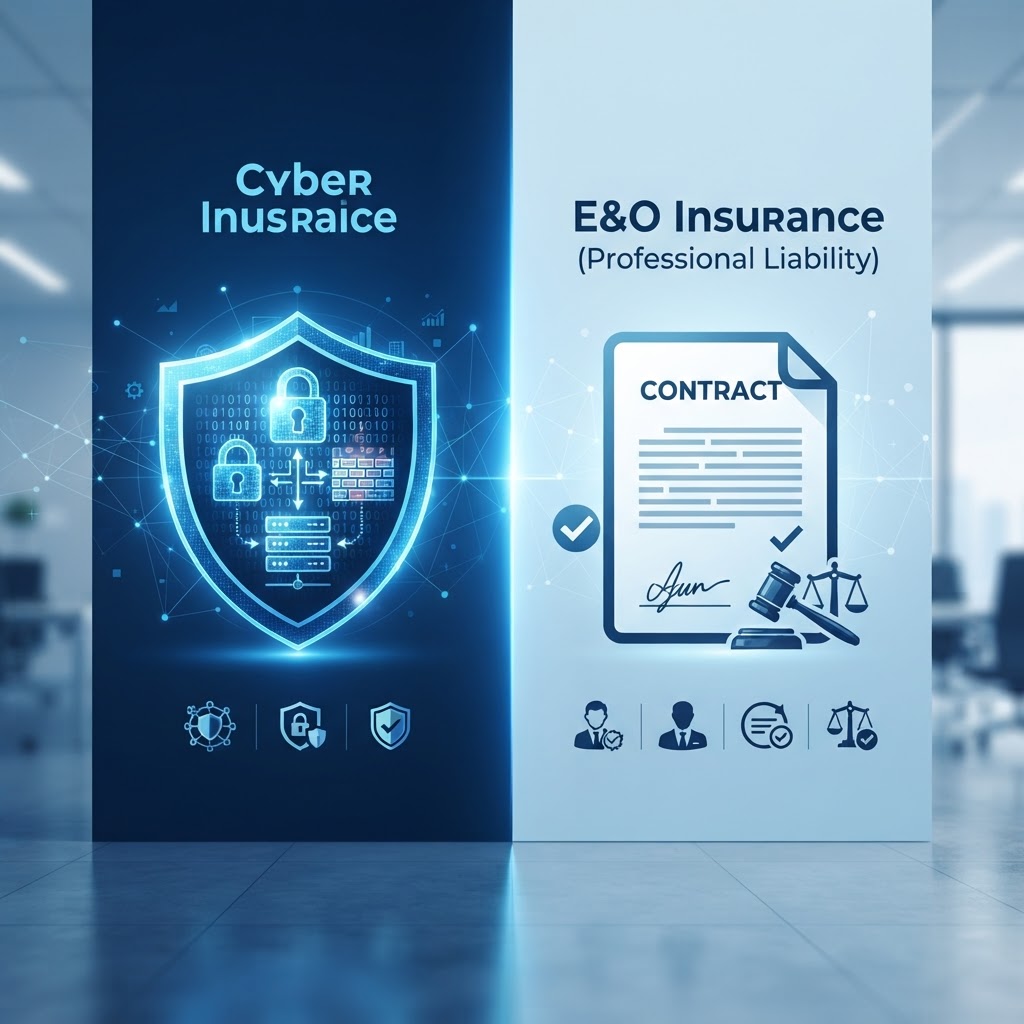
- Cyber insurance focuses on data security failures, while E&O insurance addresses failures in professional service delivery.
- Many businesses mistakenly believe their general liability policy covers both cyber risks and professional negligence.
- The distinction between E&O vs cyber liability is rooted in whether the financial loss stemmed from a data breach or a quality-of-work issue.
- A comprehensive risk management strategy often requires both policies to eliminate dangerous coverage gaps.
- Determining your business insurance coverage differences requires auditing whether your risk is primarily digital infrastructure or service-based outcomes.
In an increasingly digitized economy, the line between a software glitch and a professional oversight has blurred, leading to significant confusion among business owners regarding their protection. When a client sues because a project failed to deliver expected results, or when a massive data breach exposes private customer records, the financial fallout can threaten the survival of your organization. Understanding the nuances of cyber insurance vs errors and omissions (E&O) is no longer a niche task for legal teams; it is a fundamental requirement for any leader responsible for managing enterprise risk. This guide breaks down these critical policies to ensure your business remains resilient against both modern digital threats and traditional professional liabilities.
Defining Cyber Insurance: Protecting Against Data Breaches
Cyber insurance, often referred to as cyber liability insurance, is designed specifically to mitigate the costs associated with data breaches and other digital-based threats. Unlike policies that deal with physical damage or professional incompetence, cyber insurance coverage is primarily concerned with the security of information assets. In an era where businesses of all sizes store sensitive client data—ranging from payment details to personally identifiable information (PII)—the risk of a malicious actor or an accidental leak is a constant shadow hanging over operations.
The core of cyber insurance is two-fold: first-party coverage and third-party coverage. First-party coverage addresses the direct costs your business incurs during a cyber incident. This includes expenses related to data forensic investigations to determine how a breach occurred, legal fees for regulatory compliance, and the massive undertaking of notifying affected customers. Furthermore, many policies cover the costs of public relations campaigns to restore your brand’s reputation and business interruption insurance, which replaces income lost while your digital systems were offline.
Third-party coverage, on the other hand, deals with the fallout from being sued by those whose data was compromised. If your company is held liable for failing to protect a customer’s financial information, third-party cyber insurance helps cover the legal defense costs and settlements. It is essential to recognize that cyber insurance is not a catch-all for every technological issue; it specifically targets the security posture of your systems.
Experts generally agree that the frequency and severity of cyber incidents have increased, making this policy a foundational element of modern tech liability insurance. Many carriers now offer additional services within these policies, such as credit monitoring for impacted individuals or ransom negotiation services in the event of a ransomware attack. However, it is vital to note that this insurance is not intended to cover the loss of a client project due to poor execution or a failure to meet contract specifications. Instead, it acts as a digital insurance policy, shielding your business from the unique, volatile costs associated with the internet and storage-based infrastructure.
Understanding E&O Insurance: Managing Professional Mistakes
Errors and Omissions (E&O) insurance, often known as professional liability insurance, serves as the primary safeguard against claims that your professional services caused financial loss to a client. While cyber insurance focuses on the integrity of your data, E&O is focused on the integrity of your work. It addresses the “did you do what you promised?” aspect of your business contracts. Whether you are a consultant, software developer, engineer, or financial advisor, clients rely on your professional expertise. If that expertise fails or produces an outcome that falls short of expectations, E&O is the safety net that prevents a single project failure from resulting in corporate insolvency.
Common triggers for an E&O claim include allegations of negligence, failure to perform a task as described in a contract, misrepresentation, or simple errors in professional judgment. For instance, if a software company builds a platform for a client that crashes continuously or does not meet the specified functionality, the client may sue for lost revenue or the cost of hiring another vendor to rectify the work. This is a classic E&O scenario.
Unlike general liability, which covers physical bodily injury or property damage, professional liability for businesses is strictly about economic loss resulting from a failure in service. The policy typically covers the costs of legal defense, court fees, and settlements or judgments. Because legal defense costs can accrue rapidly—even if your company is ultimately found not liable—having E&O coverage provides the financial stability to defend your reputation in court without draining your working capital.
The scope of E&O insurance is highly dependent on your industry. For technology firms, this is often packaged as “Tech E&O,” which bridges the gap between professional advice and software-based outcomes. It is important to emphasize that E&O insurance does not cover the intentional wrongdoing of an employee or criminal acts. It is designed to cover the honest mistakes that occur in the regular course of conducting business. By providing this buffer, E&O enables businesses to take on complex, high-stakes contracts with confidence, knowing that a professional error does not have to spell the end of the enterprise.
| Policy Type | Core Focus | Trigger Event | Best For |
|---|---|---|---|
| Cyber Insurance | Data Security & Privacy | Data breach, ransomware, hacking | Businesses holding PII, PHI, or card data |
| E&O Insurance | Professional Conduct | Negligence, failed delivery, misrepresentation | Service-based companies & consultants |
Why Businesses Often Confuse These Two Policies
The confusion regarding E&O vs cyber liability is understandable, particularly because the modern business environment forces these two domains to overlap. Most professional services today involve the use of technology, software, and digital communication, which creates a “gray zone” where a mistake in service might trigger a cyber incident. This intersection leads many business owners to assume that one policy acts as a comprehensive solution for both, creating a dangerous false sense of security.
One primary reason for this confusion is the way insurance is marketed. Many “packaged” business insurance products—often marketed to startups or small businesses as a “Business Owner’s Policy” or “Technology Package”—bundle various coverages together. While bundling is often cost-effective and convenient, it can obscure the specific definitions and exclusions of each coverage type. A business owner might see “professional liability” and “data protection” on their policy summary and assume they are fully covered for everything that could possibly go wrong in a project involving software.
Another factor is the shifting nature of litigation. If a software company delivers a faulty piece of code that subsequently leads to a data breach for the client, the client may sue the software company on multiple grounds: professional negligence (E&O) and breach of security obligations (Cyber). Because the same event—the coding error—led to the loss, it feels to the business owner like a single incident. However, insurance carriers often evaluate the root cause through the lens of their specific policy language. The carrier might argue that the damage resulted from a security failure, shifting the claim to the cyber policy, or conversely, that the loss was due to a service failure, shifting it to the E&O policy.
Finally, industry terminology is inconsistent. Some insurers use the terms interchangeably in sales collateral, or use proprietary names for policies that merge features of both. This lack of standardization makes it difficult for non-experts to distinguish between the two. When businesses fail to perform a detailed audit of their business insurance coverage differences, they often find that they have been paying for “overlap” that provides no additional value, or worse, they discover a gap in coverage that exists exactly where these two policies are supposed to meet. Navigating these distinctions requires a deliberate look at your business model: do you serve clients by delivering professional advice, or by managing and protecting their digital infrastructure?
Critical Coverage Overlaps and How to Avoid Gaps
While the distinct nature of cyber insurance and E&O insurance is clear on paper, the practical application often results in significant “gray areas.” For example, consider the liability associated with a “failure to perform” that is caused by a system outage. If your consulting firm provides software that is supposed to handle client logistics, and that software crashes due to a lack of updates, the resulting business loss to the client could be argued as a failure in service (E&O) or a failure in security management (Cyber). If your policies are not carefully aligned, you risk an insurer denying the claim by stating it falls under the “other” category, leaving you to pay out of pocket.
To avoid these gaps, the first step is to seek a “blend” or an “integrated” insurance policy. Many professional liability insurers now offer policies that include a cyber component, ensuring that the same carrier manages both lines of defense. When both policies are written by the same insurer, they are often designed to work in tandem. If a claim is submitted that could be construed as either cyber or E&O, the insurer is less likely to deny coverage based on a technicality of which policy “should” have covered it.
Another critical strategy is reviewing your policy exclusions. Many E&O policies contain specific exclusions for “cyber-related acts.” If you simply purchase an E&O policy and assume you are covered, you might find that the very digital risks inherent in your business are specifically excluded. Conversely, many cyber insurance policies exclude “professional service failure.” A clear, written dialogue with your broker or agent is essential. Ask them to simulate a claim: “If our software causes X financial loss to a client due to Y technical failure, which policy responds, and what are the specific coverage triggers?”
Finally, do not overlook the importance of your contractual obligations. Many clients will demand specific limits for both E&O and cyber liability in their master service agreements. Ensuring that your insurance limits match these requirements—without relying on the assumption that they provide the same coverage—is a vital part of risk management. By explicitly addressing these potential overlaps in your risk planning, you can ensure that you are not paying double for the same risk, nor are you left vulnerable to a situation where two insurers point fingers at each other while you are left with the legal bill.
Scenarios Where You Need Cyber Insurance but Not E&O
There are distinct business environments where the profile of risk is heavily weighted toward digital threats, making cyber insurance a mandatory requirement while E&O coverage might be seen as less critical or even redundant depending on the nature of the business model. This is especially true for companies that hold massive amounts of data but offer very little in the way of “professional advice” or long-term consulting.
Consider a standard e-commerce retailer. A company that sells physical goods online, holds credit card numbers for thousands of customers, and relies on a third-party cloud hosting provider to run its website is a prime candidate for cyber insurance. Their primary risk is not that they will provide “bad advice” to a customer; their primary risk is that their database will be compromised. If a hacker steals the credit card information stored in their servers, the retailer faces massive regulatory fines, legal costs for customer notification, and brand damage. In this case, E&O insurance would provide minimal value, as the business is not providing a professional service in the traditional sense; they are providing a retail service. The exposure is almost entirely digital.
Similarly, consider a digital storage or data archiving company. Their business model is built around the security and longevity of digital records. While they technically provide a “service,” their contract is primarily focused on the preservation of data. If a breach occurs, it is a catastrophic failure of their core value proposition. Here, cyber insurance is the absolute priority. Because they are not providing professional counsel or high-level strategic advice, the likelihood of a lawsuit alleging “professional negligence” in the vein of a consultant or architect is significantly lower.
However, it is vital to exercise caution. Even in these seemingly “cyber-only” businesses, there can be subtle professional liability risks. For instance, if the same e-commerce retailer offers custom branding advice or marketing services as an add-on, they have suddenly entered the territory where E&O is necessary. Furthermore, as businesses evolve, their risk profile rarely stays static. A company that begins as a simple data storage firm might pivot to provide analytics services, suddenly needing both cyber and E&O coverage. The key is to assess your daily operations: if your primary interaction with customers is the handling, storage, and transaction of sensitive information, your risk landscape is definitively leaning toward the cyber domain, but the absence of professional service delivery must be consistent across all your client contracts for cyber to be sufficient on its own.
Instances Where E&O Coverage Is Essential Over Cyber
While the digital threat landscape dominates headlines, the reality for many service-oriented businesses is that their greatest financial exposure stems from service failure rather than data theft. Errors and Omissions (E&O) insurance, often categorized as professional liability, serves as the primary shield against allegations of negligence, failure to perform, or the delivery of substandard work. While cyber insurance focuses on the digital environment, E&O focuses on the professional duty of care.
Consider a software development firm that delivers a platform to a retail client. If the software is buggy and causes the retailer to lose sales during a peak holiday season, the retailer may sue for breach of contract or professional negligence. In this scenario, cyber insurance—which is typically triggered by malicious intrusions, data breaches, or ransomware—would likely deny the claim because the damages resulted from a functional error in code development, not a security failure or a cyber attack. This is where E&O coverage is non-negotiable.
Furthermore, E&O is essential for consultants, accountants, architects, and marketing agencies. For an accountant, an E&O claim might arise from a simple clerical error that results in a tax penalty for a client. For an architect, it could be a miscalculation in a structural drawing. None of these scenarios involve the loss of data or a cyber breach, yet the potential for costly litigation and settlements is extreme. If your business model involves providing professional advice or specialized services where a client’s financial loss is a direct outcome of your performance, E&O is the foundational coverage required to stay in business.
There are also instances where clients mandate E&O coverage via contractual requirements. Many B2B contracts specifically outline the type of professional liability coverage a vendor must hold before they are allowed to bid on a project. Failing to have this in place could result in the disqualification of your firm. Because E&O is designed to cover the “human” element of business—the mistakes, oversights, and professional lapses—it provides a specific protection that cyber policies are fundamentally built to exclude.
Do You Need a Hybrid Policy or Separate Coverage?
The market for business insurance has evolved to accommodate the convergence of technology and professional services. Many insurers now offer “tech package” policies or endorsements that bundle E&O and cyber liability together. Deciding between a hybrid policy and separate, standalone policies depends entirely on the size of your organization and the complexity of your risk profile.
A hybrid policy, often referred to as an “all-in-one” or “integrated” policy, can simplify the administrative burden. By having one renewal date, one premium payment, and a unified set of general provisions, businesses save time and often experience fewer gaps in coverage. However, the downside to a hybrid approach is the potential for shared limits. If your policy has a $2 million aggregate limit for both cyber and E&O, a massive, multi-million dollar data breach could exhaust the entire limit, leaving nothing for a potential E&O professional liability claim that happens later in the policy term.
Standalone policies offer superior customization and protection. By separating the two, you can secure higher, dedicated limits for each risk. For a large enterprise or a firm handling sensitive consumer data, having a standalone cyber policy ensures that the specific nuances of digital forensics, business interruption, and ransomware extortion are covered by experts who specialize in cyber risk, rather than generalist underwriters. Standalone E&O policies also allow for more specific policy wording that aligns with the professional standards of your specific industry.
If you are a startup or a smaller business with limited budget, a hybrid policy may be the most cost-effective entry point. As you scale and your professional liabilities become more complex, transitioning to separate, robust policies is often the recommended path. It is vital to review your policy language for “silent cyber” exclusions—some traditional E&O policies might inadvertently exclude any losses that result from the use of technology, which could leave you without any coverage at all if a cyber event leads to an E&O claim.
Assessing Your Risk Profile: Which Policy Comes First?
Determining which policy takes precedence in your insurance portfolio requires a candid assessment of your business activities. Not every business faces the same threat distribution. To begin, map out the primary ways you interact with your clients and where you are most likely to face a financial claim.
If you generate the majority of your revenue from services where “failure to perform” is a significant risk—such as financial consulting, legal services, or structural engineering—your primary focus should be E&O insurance. Without it, you are exposed to the direct financial losses of your clients. Cyber insurance, in this specific case, becomes a secondary, though still important, layer of protection.
Conversely, if you handle large volumes of PII (Personally Identifiable Information), operate an e-commerce storefront, or host cloud-based infrastructure for others, your risk profile is heavily weighted toward cyber liability. In this environment, a ransomware attack or a data breach is the “existential threat.” For these businesses, the cyber policy is the priority.
| Business Type | Primary Need | Secondary Need | Best For |
|---|---|---|---|
| Management Consultants | E&O | Cyber | Mitigating lawsuits for bad advice. |
| E-commerce Retailers | Cyber | E&O | Securing customer data and transactions. |
| Managed IT Service Providers | Cyber & E&O | N/A | Protecting against system failures & hacks. |
| Independent Creatives | E&O | Cyber | Intellectual property and work quality. |
To assess your specific path, perform a “what-if” exercise. If your system goes down for 48 hours, what is the most likely claim? If it is clients suing for lost productivity, that is an E&O issue. If the primary damage is a breach of sensitive health records, that is a cyber issue. By understanding the source of your most likely litigation, you can determine which policy needs higher limits and stronger endorsements.
Common Mistakes When Buying Cyber and E&O Insurance
Purchasing professional insurance is complex, and even well-meaning business owners often fall into traps that result in inadequate protection. The most common mistake is assuming that “General Liability” (GL) covers these risks. General Liability is designed for physical bodily injury and property damage—it rarely covers digital harm or professional services negligence. Relying on GL for cyber or E&O risk is a recipe for a denied claim.
Another major error is failing to read the “Definition of Services” in an E&O policy. Many businesses undergo a “mission creep” where they start offering new products or services but fail to update their insurance policy. If your E&O policy defines your business as “Software Consulting,” but you have pivoted to “Cloud Hosting Services,” the insurer may deny a claim based on the fact that the services being provided were not disclosed during the underwriting process.
Regarding cyber insurance, a frequent mistake is ignoring the sub-limits for specific events, such as ransomware payments or social engineering (phishing). You might have a $1 million total cyber policy, but if the policy has a $50,000 sub-limit for social engineering, you are essentially self-insuring for the majority of a phishing attack. Always drill down into the sub-limits to ensure they match your expected level of exposure.
Finally, businesses often neglect to include “Prior Acts” coverage. When switching insurers or buying a policy for the first time, you need to ensure that the policy covers claims arising from work performed *before* the policy inception date, provided you were not aware of the claim. Without “Full Prior Acts,” you leave yourself exposed to lawsuits regarding old projects that you finished months or years ago.
Frequently Asked Questions
Does E&O insurance cover me if I get hacked?
Generally, no. E&O insurance is designed to cover financial losses caused by professional negligence or a failure to deliver agreed-upon services. If a hack occurs, that falls under the purview of cyber insurance, which covers data recovery, extortion payments, and notification costs. An E&O policy would only be involved if the hack resulted in a client suing you for a failure to provide the promised level of security.
Is cyber insurance legally required for my business?
In most jurisdictions, cyber insurance is not legally mandated for private businesses. However, specific industries—such as those dealing with HIPAA-protected health data or PCI-DSS credit card processing—may face stiff regulatory penalties for data breaches. While not “required” as a policy, having cyber insurance is often a functional requirement to satisfy contractual obligations with vendors and partners.
How are premiums determined for these policies?
Premiums for both E&O and cyber insurance are based on several factors, including your industry, annual revenue, the sensitivity of the data you handle, your history of claims, and the security measures you have in place. For cyber insurance, insurers will specifically evaluate your use of multi-factor authentication, encryption, and regular data backups.
Can I just buy one policy to cover everything?
While some insurers offer “packaged” policies that include both cyber and E&O coverage, these are not universal. Depending on the size of your business and your risk exposure, it may be better to hold separate, standalone policies to ensure you have adequate limits and specific language tailored to each risk rather than sharing a single, smaller limit.
What happens if I change my business services mid-policy?
You must notify your insurance broker immediately. Insurance policies are underwritten based on a specific description of your business activities. If you begin offering services outside of that scope, any resulting claims could be denied. Your broker can help you update your “statement of values” or professional profile to ensure your coverage remains active and comprehensive.
What does “consent to settle” mean in these policies?
In many E&O and cyber policies, a “consent to settle” clause ensures that the insurer cannot force you to settle a claim without your approval. This is important for professional reputation, as a settlement can sometimes be perceived as an admission of guilt. Conversely, some policies include a “hammer clause,” which may limit the insurer’s liability if you refuse to accept a settlement they believe is reasonable.
Conclusion
Navigating the nuances of cyber insurance and Errors and Omissions coverage is an essential exercise for any modern business. While the former protects your organization from the volatile and often invisible threats of the digital world, the latter shields you from the financial and reputational fallout of professional performance failures. Because these risks are distinct, they require a thoughtful, tailored approach to your insurance strategy.
Do not wait for a security breach or a lawsuit to discover gaps in your coverage. By assessing your risk profile today, understanding the difference between professional negligence and digital threats, and ensuring your policy limits are sufficient, you can build a resilient foundation for your business. Whether you opt for a comprehensive hybrid package or standalone policies, the goal remains the same: ensuring that an unexpected event does not derail your company’s long-term success.
Ready to secure your business against unforeseen liabilities? Start by auditing your current coverage and speaking with a licensed insurance expert who specializes in your industry. Protecting your future begins with the decisions you make today.
By insureiqguru Editorial Team
Leave a Reply