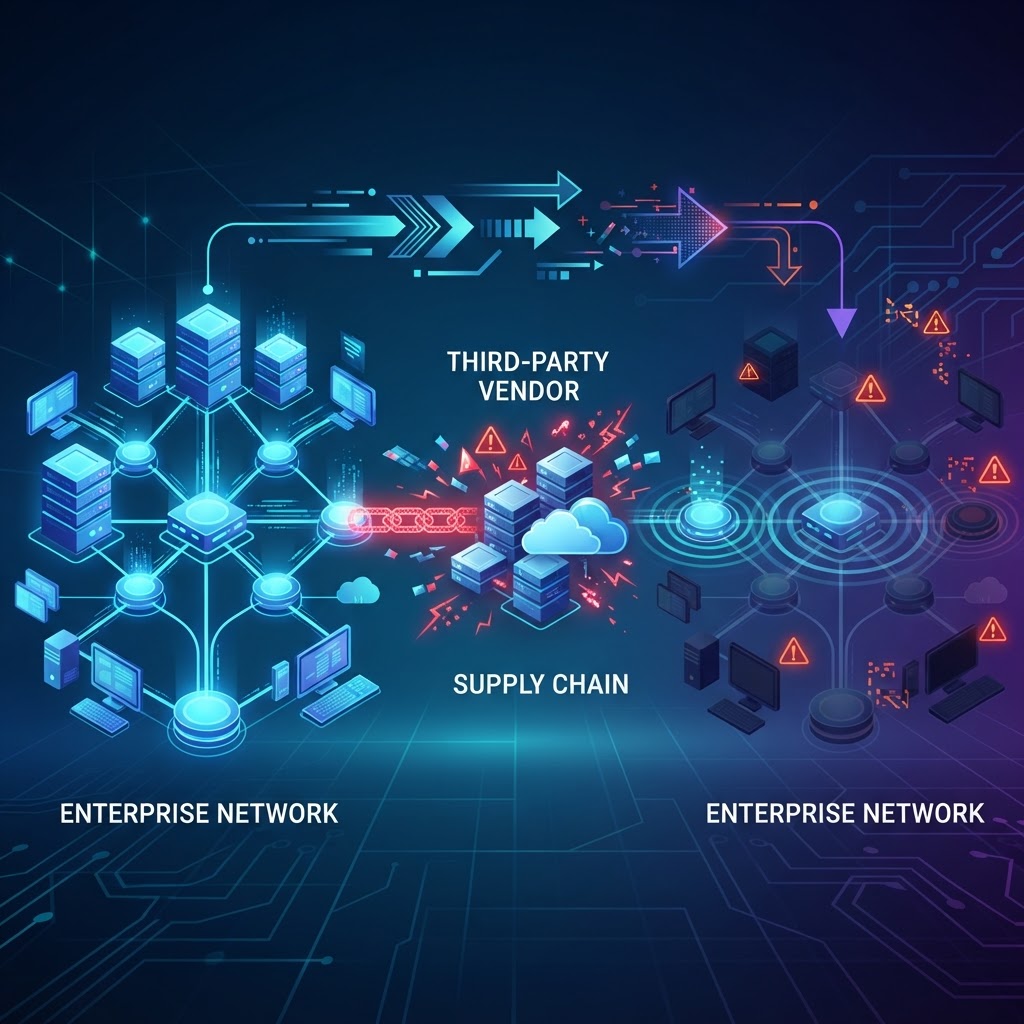
- Cyber contingent business interruption (CBI) protects companies from financial losses stemming from cyber attacks on third-party vendors, suppliers, or service providers.
- Traditional business interruption policies often exclude digital dependencies, making dedicated cyber insurance for vendors a necessity in the 2026 threat landscape.
- Identifying critical digital supply chain dependencies is the foundational step for accurate risk assessment and coverage limits.
- Standard CBI triggers typically require a physical event or service failure caused by a covered cyber peril, necessitating clear contractual language.
- Proactive vendor risk management is as vital as the insurance policy itself to ensure the viability of a claim during a crisis.
In the interconnected digital landscape of 2026, a company’s operational resilience is no longer defined solely by its internal cybersecurity hygiene. Even the most robust enterprise can be brought to a standstill by an outage occurring in a server farm halfway across the globe or a security breach within a mission-critical software provider. As businesses lean more heavily into cloud-native infrastructure and integrated ecosystem platforms, the focus of risk management has shifted outward. This evolution makes understanding cyber insurance contingent business interruption (CBI) a non-negotiable priority for modern executives and risk managers. This guide explores the mechanics, vulnerabilities, and strategic implementation of CBI coverage to help your organization survive the ripple effects of a supply chain cyber attack.
What Is Cyber Contingent Business Interruption Insurance?
At its core, cyber insurance contingent business interruption is a specialized insurance product designed to indemnify a business for loss of income and extra expenses resulting from a cyber incident occurring at a third party upon which the business depends. In the contemporary digital economy, businesses rarely operate in a vacuum. Most organizations rely on a complex network of cloud service providers, managed service providers (MSPs), software-as-a-service (SaaS) platforms, and specialized logistics vendors to maintain daily operations. When one of these entities suffers a cyber attack—such as a large-scale ransomware deployment or a distributed denial-of-service (DDoS) event—the primary victim isn’t the only one feeling the sting.
CBI coverage acts as a financial bridge. Without it, if your primary payment processor or your cloud-based inventory management system goes dark for several days, the resulting loss in revenue is often considered an “uninsured event” under standard policies. CBI specifically addresses this gap. It is important to distinguish this from general liability. While third-party cyber liability typically covers you for damages you might cause to someone else, CBI covers the financial impact on your own bottom line caused by the failure of those you rely on.
In 2026, insurance carriers have refined their underwriting processes to scrutinize the digital supply chain more closely. Policies now frequently require specific endorsements to trigger coverage for non-physical causes of loss. Understanding the scope of your CBI coverage involves looking at the definition of “dependent entities.” Are you only covered for your primary cloud host, or does the policy extend to the downstream software vendors your host relies upon? The definition of these parameters is what separates a policy that provides true security from one that offers only a false sense of protection.
Moreover, the modern CBI landscape has moved beyond simple revenue replacement. Many modern policies include provisions for “extra expenses.” If a critical third-party vendor fails, you may need to pivot rapidly to an alternative provider, hire emergency consultants, or pay for overtime labor to catch up on lost time. CBI policies are increasingly designed to capture these secondary costs, recognizing that the cost of interruption is rarely limited to the missed sale. As we explore the complexities of these products, it becomes clear that CBI is less of an “extra” and more of a foundational layer of modern operational continuity planning.
Why Businesses Are Vulnerable to Third-Party Cyber Events
The fragility of the modern digital supply chain is rooted in consolidation and hyper-dependency. As organizations strive for efficiency, they have consolidated their infrastructure into a handful of major cloud service providers and niche SaaS solutions. This centralization creates a “single point of failure” phenomenon. When a major cloud provider experiences an outage, thousands of dependent businesses go offline simultaneously. This is the definition of digital supply chain risk: the systemic threat that an incident in one node of the network will trigger a cascade of failures across the entire ecosystem.
The complexity of these interdependencies often remains hidden until a crisis occurs. A manufacturing firm might know its cloud server provider, but it may not fully account for the cybersecurity posture of the platform that handles its automated supply chain logistics. If that platform is compromised, the manufacturing firm cannot receive orders or dispatch shipments, even if its own internal servers are perfectly secure. The attacker does not need to bypass the manufacturer’s firewall; they only need to compromise the weaker link in the chain.
Furthermore, the threat landscape has evolved to target the supply chain intentionally. Ransomware syndicates and state-sponsored actors have recognized that attacking a single software vendor can provide them with access to hundreds or thousands of that vendor’s clients. This is often referred to as a “one-to-many” attack vector. By embedding malicious code into a widely used software update, a threat actor can distribute their impact instantly. This shift toward targeting vendors rather than end-users has left many businesses vulnerable, as they lack the visibility or the leverage to audit the security practices of every vendor they engage with.
The vulnerability is compounded by the “black box” nature of modern software. Businesses integrate APIs and third-party tools daily, often without deep technical due diligence on the security architecture of those tools. This reliance on “black box” dependencies means that firms are essentially outsourcing their risk without having the insurance or contractual protections in place to mitigate that risk. When a vendor suffers a data breach or an operational outage, the ripple effect is immediate, and the financial impact on the dependent business can be catastrophic, often exceeding the firm’s available cash reserves if the outage lasts for an extended period.
| Approach | Key Focus | Best For |
|---|---|---|
| Traditional BI Extension | Physical assets/Standard operations | Small businesses with low digital integration |
| Standalone Cyber CBI Policy | Digital outages and service interruptions | Enterprise firms with high cloud dependency |
| Vendor Risk Management Program | Contractual security requirements | Regulated industries and high-growth startups |
How CBI Coverage Differs From Standard Business Interruption
It is a common misconception among business leaders that a standard commercial property or general business interruption (BI) policy will provide protection against a cyber-induced shutdown. Standard BI insurance is historically predicated on the concept of “physical damage.” To trigger a standard policy, a company typically needs to demonstrate that property has been destroyed or rendered unusable by a physical peril, such as fire, flood, or a structural collapse. In the eyes of many traditional insurers, a software glitch or a server outage does not meet the “physical loss” threshold unless it is directly linked to hardware destruction.
CBI coverage is fundamentally different because it is designed for the intangible nature of modern cyber risk. A CBI policy is triggered by the impairment of digital services, regardless of whether a physical asset was actually damaged. This distinction is crucial in 2026, where the most damaging attacks—such as ransomware, data exfiltration, or cloud service outages—rarely involve the actual smashing of hardware. Instead, they involve the encryption of data, the disruption of network traffic, or the compromise of access credentials.
Furthermore, standard BI policies often include specific “cyber exclusions” that explicitly strip away coverage for anything related to digital systems. If your facility loses power because a storm destroyed a transformer, your standard BI policy likely covers the resulting downtime. If your facility loses access to its mission-critical CRM because of a widespread cyber attack on your cloud provider, your standard BI policy will almost certainly deny the claim. CBI fills this void by specifically defining “cyber incidents” as a legitimate peril for triggering business interruption.
Another key difference lies in the breadth of the geographical and relational scope. While standard BI might cover you for a loss occurring at a nearby utility supplier (such as a local power grid failure), CBI is global. Because digital supply chains transcend borders, CBI coverage is designed to follow the data, not just the physical location of the assets. This global reach is essential for modern businesses, as their service providers may be located in diverse jurisdictions, each with different legal and regulatory environments regarding data security and uptime commitments.
Finally, the calculation of loss is often more complex in a CBI context. Standard BI calculates losses based on historical physical performance—how many units did you produce, or how many customers did you serve before the fire? CBI calculation involves a digital baseline: what was the expected transactional throughput, and how far did it dip during the service failure? Insurers have had to develop new actuarial models that account for the non-linear way in which digital service outages unfold. Recognizing the differences between these two types of coverage is not just an insurance exercise; it is an exercise in identifying the true threats to your business model.
Identifying Your Critical Digital Supply Chain Dependencies
Before you can purchase appropriate insurance, you must map the geography of your digital dependencies. You cannot insure what you cannot identify. This mapping process, often referred to as “Digital Supply Chain Mapping,” is the foundational task for any organization looking to leverage cyber insurance for vendors effectively. Start by conducting a comprehensive audit of your IT stack. Identify every third-party service that your business cannot operate without for more than four hours. These dependencies generally fall into three categories: Cloud Service Providers (CSPs), Managed Service Providers (MSPs), and niche software or SaaS tools.
Once you have identified these providers, you must determine their “criticality level.” Not all vendors are created equal. If a marketing analytics tool goes down, you might experience a minor inconvenience. If your primary cloud hosting provider experiences a region-wide outage, your entire business might go dark. Prioritize your list based on the potential revenue impact of a 24-hour, 72-hour, and one-week outage. This tiered approach helps in setting appropriate coverage limits for your CBI policy, as you may decide that only your most critical “Tier 1” vendors need to be explicitly listed or considered in your policy’s scope.
The identification process should also involve the legal and procurement departments. Review your service level agreements (SLAs) with these providers. What are their liabilities in the event of a breach? Do they offer service credits? Understanding the contractual landscape helps you determine what the insurance needs to cover and what is already addressed by your vendor contracts. Be wary of “contractual blind spots” where a vendor’s liability is capped at a fraction of your actual potential loss. This is exactly the gap that your CBI insurance should be structured to cover.
Another often-overlooked aspect of mapping is “fourth-party” risk. Your direct vendor (a SaaS company) is likely hosted on a major cloud provider (e.g., AWS, Azure, GCP). If your SaaS vendor is secure, but the cloud provider they rely on has an outage, you are still affected. While you may not be able to list every fourth-party provider, your risk assessment should account for the fact that a large portion of your digital supply chain ultimately rests on a small number of hyperscale cloud providers. Assessing your concentration risk—where too many of your critical dependencies rely on the same underlying infrastructure—is a key step in both risk mitigation and insurance purchasing.
By treating the digital supply chain as a map of potential failure points, you can move away from vague, blanket coverage towards a strategy that is data-driven and actionable. When you sit down with your broker, being able to present a clear, documented map of your critical dependencies will not only help you secure better pricing and terms but will also dramatically simplify the claims process should an incident occur. It shows the insurer that you are a sophisticated risk manager who understands where your vulnerabilities lie.
Common Triggers for a Contingent Business Interruption Claim
A CBI coverage claim is not automatic. It relies on a specific sequence of events, known as “triggers,” that must be met for the insurer to accept liability for the loss. In the current 2026 market, these triggers are more precise than ever. The most common trigger is a “failure of a dependent service.” For this to apply, the third-party service provider must have experienced an actual failure of their systems—typically caused by a cyber event—which leads directly to the inability of the insured to conduct their own business activities. It is important to note that a mere degradation in performance, such as a slow network connection, may not satisfy this trigger unless it results in a total or near-total stoppage of operations.
A second common trigger involves “denial of service” attacks. If a critical vendor is hit by a massive DDoS attack that prevents their legitimate clients from accessing their tools, this usually counts as a valid CBI event. However, coverage often hinges on the “authorized access” requirement. Some older or more restrictive policies might only trigger if the incident resulted from a malicious breach, such as a hacker infiltrating the vendor’s database. If the outage was caused by an “accidental” cyber event—such as a botched software patch update—there may be a dispute over whether the policy covers it. Ensure your policy language is broad enough to cover both malicious attacks and operational cyber failures.
A third trigger often found in modern policies is the “security failure” or “data breach at a third party.” In this scenario, you do not necessarily need to be taken offline. Instead, if a third party suffers a breach that compromises your data, your business might be forced to cease operations for a period to perform forensic investigations, reset credentials, or migrate to new systems. This is an increasingly common trigger as companies become more risk-averse regarding their own cybersecurity posture. If your vendor tells you to stop using their service until they can prove the breach is contained, that is a trigger for a claim.
It is also vital to understand the “waiting period” or “deductible” trigger. Almost all CBI policies include a time-based deductible, commonly referred to as the “waiting period.” This might be 8, 12, or 24 hours. The insurance does not kick in until the service interruption exceeds this duration. This means that if your most critical vendor has an outage that lasts for 10 hours and you have a 12-hour waiting period, you absorb the entirety of that loss. Negotiating a shorter waiting period can be a high-value strategy for businesses with extremely low tolerance for downtime.
Finally, geographic triggers and naming requirements are common. Some policies require that the vendors be “scheduled” or specifically named in the policy document. Others offer “blanket” coverage for any service provider that meets certain criteria. If your policy requires you to name your vendors, you must be disciplined about updating that list whenever you onboard a new critical supplier. Failing to update this schedule is a common reason for claims being denied. Always verify with your broker whether your policy provides blanket or scheduled coverage and what the implications are for your supply chain management process.
Coverage Limits and Sublimits in 2026 Cyber Policies
As the cyber threat landscape matures, the architecture of cyber insurance policies has become increasingly nuanced. By 2026, underwriters have largely moved away from blanket, all-encompassing limits for Contingent Business Interruption (CBI). Instead, they are utilizing granular sublimits to manage the systemic risk inherent in digital supply chains. Understanding these distinctions is critical for risk managers seeking to avoid unexpected out-of-pocket expenses during a major disruption.
Typically, a policy will feature a primary aggregate limit—the total amount the insurer will pay for all claims under the policy. However, CBI often resides within a sublimit, which caps the maximum payout for losses originating from a third-party vendor rather than your own internal network. Because a single cloud service provider outage can impact thousands of policyholders simultaneously, insurers are cautious. They often set these sublimits lower than the aggregate limit to protect their own balance sheets against correlated, catastrophic losses.
Furthermore, insurers now commonly apply “waiting periods” or “deductible hours” specifically to CBI claims. Unlike your primary business interruption coverage, which might trigger after 8 to 12 hours of downtime, a CBI clause might necessitate a 24, 48, or even 72-hour waiting period before coverage commences. In a fast-paced digital environment, a 48-hour delay can lead to massive revenue loss that remains entirely uninsured.
Policyholders must also watch for “named vs. unnamed” vendor clauses. Some policies offer broader coverage if the disruption occurs at a vendor specifically named in the policy schedule, whereas unnamed vendors—even if critical—may be subject to much tighter sublimits. The evolution of 2026 cyber policies emphasizes the “vendor mapping” process. If your policy language is too vague, you may find that a cloud software provider you rely on daily is not technically classified as a “covered vendor” under your specific policy terms.
Evaluating Your Vendors’ Cybersecurity Posture
In the modern era of interconnected commerce, your security is only as strong as the weakest link in your digital ecosystem. Evaluating third-party risk is no longer a peripheral task handled solely by IT departments; it is a core business necessity that influences your insurance eligibility and premiums. When a supply chain cyber attack occurs, the ripple effects can be catastrophic, and insurers are increasingly requiring proof of “vendor due diligence” before they will honor a CBI claim.
To evaluate your vendors effectively, consider adopting a standardized framework. Do not simply rely on a vendor’s verbal assurance that they are “secure.” Request their latest SOC 2 Type II report, which provides independent verification of their internal controls. Furthermore, look for evidence of continuous monitoring. Static annual assessments are rapidly becoming obsolete; today’s best-in-class vendors use automated security ratings platforms to track their partners’ vulnerabilities in real-time.
Key areas to scrutinize during your evaluation include:
- Incident Response Capability: Do they have a documented, tested plan for responding to a breach? How quickly can they notify you?
- Geographic Risk: Where are their data centers located? Are they subject to conflicting international data privacy regulations that might impede recovery efforts?
- Dependency Mapping: Do they use fourth-party vendors? A major security lapse at a cloud infrastructure provider may cascade through your software vendor and eventually hit your operations.
- Access Management: Do they utilize robust multi-factor authentication (MFA) and the principle of least privilege when accessing your systems or data?
By conducting these evaluations, you not only improve your operational resilience but also provide your insurance carrier with the documentation needed to justify your coverage. In many cases, demonstrating a rigorous vendor management program can lead to more favorable negotiation of sublimits or even a reduction in the waiting periods associated with your CBI coverage.
| Assessment Tool/Strategy | Primary Focus | Best For |
|---|---|---|
| SOC 2 Type II Reports | Historical operational effectiveness of controls. | Verifying long-term compliance and security hygiene. |
| Security Rating Platforms | External attack surface visibility and real-time scanning. | Monitoring large vendor pools for new, active vulnerabilities. |
| Direct Security Questionnaires | Specific business process risks and internal policy adherence. | Deep-dive audits of mission-critical partners. |
| Penetration Test Summaries | Active detection of exploitable weaknesses. | Validating the efficacy of vendor-specific security patches. |
Steps to Take Before a Contingent Cyber Outage Occurs
Proactive preparation is the single most effective way to minimize the damage of a digital supply chain disruption. While you cannot prevent an attack on a third-party vendor, you can control the speed and efficacy of your business’s reaction. The following steps should be institutionalized as part of your comprehensive business continuity plan:
1. Develop a Vendor Dependency Inventory: You cannot protect what you haven’t identified. Create a comprehensive list of all third-party software, hardware, and service providers. Classify them by criticality: Tier 1 (business-critical), Tier 2 (supporting), and Tier 3 (ancillary). Your insurance focus should be entirely on Tier 1 providers.
2. Negotiate “Right-to-Audit” Clauses: Ensure that your contracts with key suppliers include a “right-to-audit” or at least a requirement for them to share their annual security assessment summaries. This ensures you are not flying blind regarding their security maturity.
3. Establish Manual Workarounds: If your cloud-based CRM or ERP system goes offline for three days, does your business grind to a halt? Develop offline, manual processes for essential operations, such as manual inventory tracking or paper-based invoicing, to ensure the business stays solvent during a digital blackout.
4. Test Your Incident Response Plan with Supply Chain Scenarios: Many organizations practice “tabletop exercises” for ransomware affecting their own network. You must also include scenarios where a key vendor is the source of the breach. Simulate the communication channels you will use if email is compromised, and ensure key leadership knows exactly when to trigger the notification process for your insurance provider.
5. Maintain Financial Reserves: Even with insurance, the payout can take months to process. Ensure you have sufficient liquidity to cover the “waiting period” and the potential gap between your loss and the final claim settlement.
How to Properly Calculate Your CBI Coverage Requirements
Calculating the correct amount of CBI coverage is an exercise in financial modeling rather than mere guessing. Start by reviewing your financial statements to identify your “dependent revenue streams.” If you rely on a specific logistics platform to ship your products, your revenue is directly tied to the uptime of that platform. If that platform goes down, how much does your daily net income drop?
Consider the “Maximum Tolerable Downtime” (MTD) for each major vendor. If a vendor is out for 48 hours, what is the dollar impact on your operations? If they are out for a week? Often, the loss is not just direct revenue; it includes customer churn, potential contractual penalties for missing service-level agreements (SLAs), and the cost of expedited shipping or manual intervention required to keep operations moving.
To reach an accurate CBI limit recommendation, follow this formula:
- Estimate Daily Loss per Tier 1 Vendor: Calculate the gross profit contribution for each business process dependent on that vendor.
- Apply a Duration Multiplier: In 2026, many experts recommend planning for at least a 14-day outage, given the complexity of remediating supply chain attacks. Multiply your daily loss by 14.
- Add Extra Expenses: Include the cost of temporary IT personnel, forensic auditors, and communication specialists required to manage the crisis.
- Review against Policy Terms: Ensure that the sublimits offered by your insurer cover the highest probable loss identified in your model, rather than just an arbitrary round number.
It is also vital to engage your CFO and your legal counsel in this process. Their perspective on contractual liabilities and cash flow constraints will refine your coverage needs far more accurately than IT metrics alone.
Frequently Asked Questions
Does standard business interruption insurance cover cyber-related supply chain issues?
No. Standard business interruption insurance is typically triggered by physical damage to property, such as fire or flood. It usually excludes cyber events entirely. To protect against losses from digital supply chain outages, you must purchase a dedicated cyber insurance policy that explicitly includes Contingent Business Interruption (CBI) coverage.
What exactly is a “digital supply chain risk”?
Digital supply chain risk refers to the possibility that your organization will suffer financial or operational losses due to a security breach, system failure, or outage at a third-party vendor you rely on. Because your systems are connected to these vendors via API, cloud integration, or shared infrastructure, their security vulnerabilities effectively become your own.
Are cloud service providers (CSPs) automatically covered under CBI policies?
Most policies provide coverage for major cloud service providers, but the scope can vary. Some policies apply a broad definition that includes any “cloud service provider,” while others may limit coverage to a pre-defined list of vendors. It is essential to review your specific policy schedule to confirm which providers are included and if any are specifically excluded.
What is the difference between Business Interruption and Contingent Business Interruption?
Business Interruption (BI) coverage applies to losses resulting from a cyber attack on your own network and IT systems. Contingent Business Interruption (CBI) coverage applies specifically to losses resulting from a cyber attack on a third-party vendor or supplier that prevents you from conducting your normal business activities.
How do insurance companies verify my claim during a CBI event?
Insurers will require detailed forensic reporting to verify that the vendor’s outage was indeed the proximate cause of your financial loss. They will typically look for documentation such as the vendor’s public incident disclosures, your internal logs showing a loss of connectivity, and financial records correlating the duration of the outage with your specific revenue decline.
Can I increase my CBI sublimits if my business relies heavily on one vendor?
Yes. If your vendor due diligence indicates a high concentration of risk with a single provider, you should discuss this with your broker. While the insurer may be hesitant to offer high limits due to systemic risk, they may agree to higher sublimits if you can demonstrate superior security protocols, such as redundant backup systems or a well-documented failover plan that mitigates the potential severity of the outage.
Conclusion
The digital supply chain is the backbone of the modern economy, yet it remains the most significant, often overlooked, vulnerability in the enterprise risk portfolio. As we look toward the ongoing developments in 2026 and beyond, it is clear that reliance on third-party vendors will only intensify. This shift demands a sophisticated approach to insurance—one that moves beyond basic policy acquisition and into the realm of strategic risk management.
Contingent Business Interruption coverage is no longer an optional add-on; it is a fundamental safeguard against the unpredictable nature of our interconnected world. By meticulously mapping your dependencies, vetting your vendors, and modeling your potential financial exposure, you transform your cyber insurance from a mere expense into a resilient pillar of your business continuity strategy. Do not wait for a third-party failure to expose gaps in your protection. Contact your risk advisor today to audit your current CBI limits and ensure your organization is prepared for the inevitable challenges of the digital age.
By insureiqguru Editorial Team
Leave a Reply