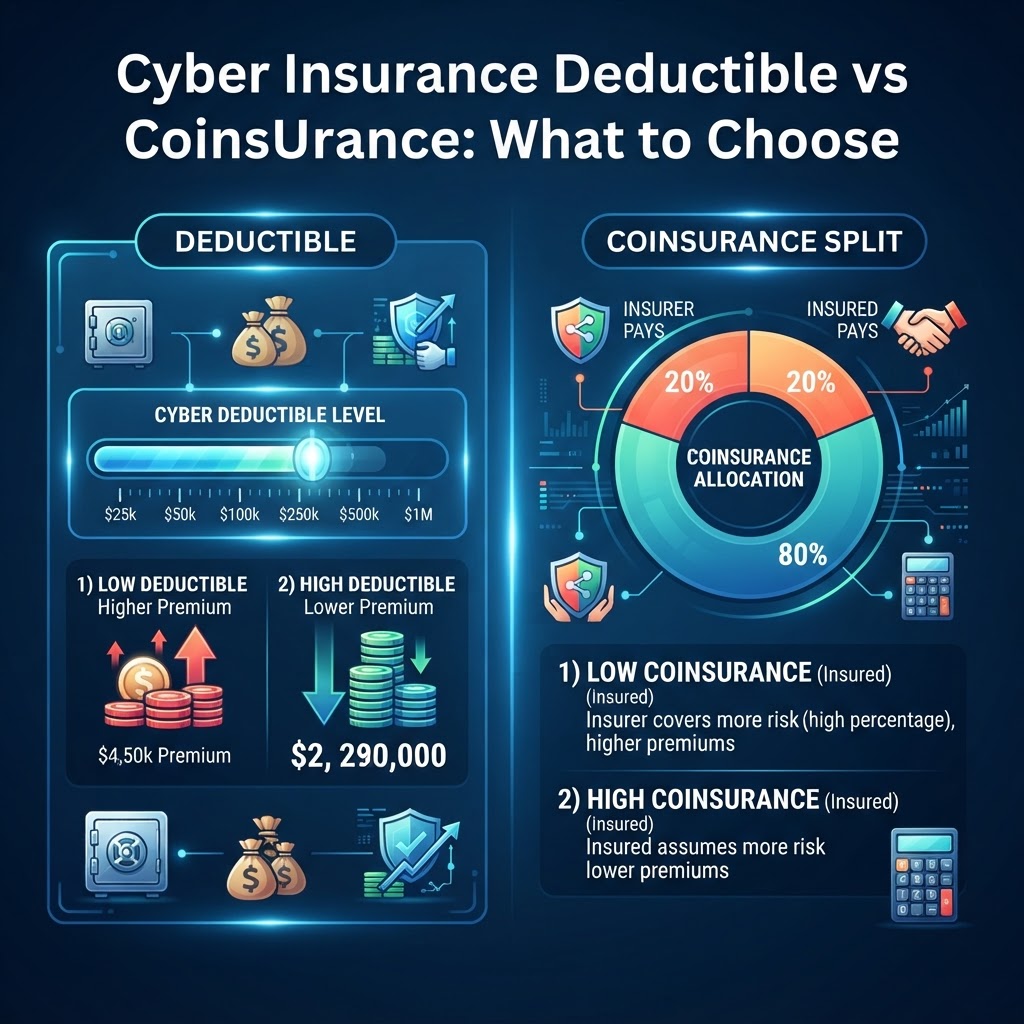
- A cyber insurance deductible is the fixed dollar amount a business must pay before the insurer covers the remaining loss.
- Coinsurance in cyber insurance functions as a percentage-based cost-sharing mechanism for specific claim amounts.
- High deductibles can significantly lower annual premiums but create substantial immediate financial exposure during a security incident.
- Determining the right balance between deductible levels and coinsurance requires a thorough assessment of your organization’s risk appetite and cash flow.
- Effective business risk mitigation relies on aligning your policy structure with your specific recovery time objectives and capital reserves.
In the modern digital landscape, the question is no longer if a business will face a cyber threat, but when that threat will materialize into a costly disruption. As organizations increasingly rely on interconnected systems and massive data stores, cyber insurance coverage has evolved from an elective safety net into a fundamental pillar of comprehensive business risk mitigation. However, navigating the nuances of policy language—specifically the interplay between a cyber insurance deductible and coinsurance—can be daunting for risk managers and executives alike. Understanding these financial structures is not merely an exercise in accounting; it is a vital step in ensuring your organization remains solvent following a ransomware attack, data breach, or prolonged system outage. This guide unpacks the mechanics of these cost-sharing instruments to help you make an informed decision that protects your balance sheet without overspending on premiums.
Understanding Cyber Insurance Deductibles
At its core, a cyber insurance deductible acts as the “first-dollar” responsibility of the policyholder. When a covered event occurs—such as a business email compromise leading to fraudulent wire transfers or a malware infection encrypting critical infrastructure—the business is generally required to pay a predetermined, fixed dollar amount out of pocket before the insurance carrier assumes liability for the remaining expenses. This concept is fundamentally similar to the deductible on a standard commercial property or auto insurance policy, serving as a self-retention mechanism that keeps the insured party invested in the security of their own digital ecosystem.
From the perspective of an underwriter, the deductible serves two primary functions. First, it filters out minor, routine IT glitches that do not constitute a true “cyber loss,” thereby reducing the administrative burden on the insurer. Second, it creates a moral hazard barrier; by requiring the business to share in the financial consequences of a breach, the insurer incentivizes the policyholder to maintain robust cyber risk management protocols. If the business had zero financial exposure, there might be less motivation to invest in employee training, patch management, or advanced endpoint detection systems.
For the policyholder, selecting the right deductible is a strategic exercise in risk financing. A business that chooses a high deductible essentially assumes a larger portion of the risk in exchange for lower annual premiums. This can be a savvy move for organizations with strong cash reserves or those that operate in industries with high-frequency, low-impact incidents where the cost of the deductible is rarely triggered. Conversely, smaller firms or those with tighter liquidity may prefer a lower deductible. While this increases the upfront premium, it provides greater budget predictability, as the company knows exactly how much it will have to pay in the event of a catastrophic claim.
It is critical to note that in the context of cyber insurance, the deductible often applies per claim, though some policies offer aggregate deductibles or sub-limits for specific coverage components. For instance, you might have one deductible for business interruption costs and a separate, smaller deductible for legal and forensic notification costs. Understanding exactly how these deductibles apply—and whether they are applied on a per-incident or per-policy-period basis—is essential. Before binding any coverage, risk managers should examine their historical incident data to determine the size of losses they can comfortably absorb on their own. By analyzing the “most likely” versus “worst-case” scenarios, your organization can calibrate its deductible level to strike a balance between immediate premium relief and the potential for a burdensome out-of-pocket expenditure when a crisis hits.
How Coinsurance Works in Cyber Policies
While the deductible is a flat dollar amount, coinsurance in cyber insurance is a percentage-based mechanism. It represents the portion of a loss—above the deductible—that the policyholder is responsible for covering. If a policy includes a coinsurance provision, the insurance company does not pay for 100% of the insured loss after the deductible is met. Instead, the business and the insurer split the remaining costs based on the agreed-upon percentage, such as 90/10 or 80/20, until the policy’s limit of liability is reached.
The introduction of coinsurance is often seen in high-risk sectors or for specific high-stakes coverage components, such as ransomware payments or long-term business interruption. For example, if a company suffers a data breach costing $1 million, has a $50,000 deductible, and a 10% coinsurance clause, the math becomes complex. First, the $50,000 is subtracted from the total, leaving $950,000. The insurer would then pay 90% of that remainder ($855,000), while the business pays its 10% share ($95,000) on top of its initial $50,000 deductible. In this scenario, the business’s total out-of-pocket exposure is $145,000.
Why do carriers include this? Much like the deductible, coinsurance is a tool for alignment. In instances where the insurer has less control over the final outcome—such as in complex legal negotiations or long-drawn-out recovery processes—coinsurance ensures that the insured has “skin in the game” throughout the lifecycle of the claim. It encourages the policyholder to work actively with the forensic teams and legal counsel provided by the insurer, rather than taking a passive approach. Furthermore, coinsurance can sometimes allow for more flexible policy pricing. Insurers may offer more aggressive coverage limits to businesses that are willing to accept a percentage-based share of the risk, effectively mitigating the insurer’s total exposure to a single, massive “black swan” event.
When evaluating a policy with coinsurance, it is vital to look for “coinsurance caps.” A well-structured policy should clearly state the maximum amount that the coinsurance can total, preventing a catastrophic loss from becoming a completely ruinous financial burden. Without a cap, a percentage-based liability could theoretically scale to an unsustainable amount in the event of a massive, multi-million-dollar breach. Businesses should also verify if coinsurance applies to the *entire* policy or only to specific “bad-actor” risks. In many contemporary cyber policies, insurers apply coinsurance specifically to ransomware events to ensure the business is highly motivated to avoid paying excessive extortion demands unless absolutely necessary. As you evaluate your insurance policy terms, ensure that your legal and finance teams understand the mathematical weight of these percentages, as they represent a variable cost that can significantly shift the total financial impact of an incident.
| Risk Strategy | Mechanism | Best For |
|---|---|---|
| Low Deductible/No Coinsurance | High Premiums, Minimal Out-of-Pocket | Smaller firms with low cash liquidity |
| High Deductible/No Coinsurance | Lower Premiums, High Immediate Exposure | Cash-rich companies with strong security |
| Moderate Deductible + Coinsurance | Balanced Premiums, Controlled Risk Share | Enterprises wanting to minimize total loss impact |
The Financial Impact of High vs Low Deductibles
The decision regarding the size of your cyber insurance deductible acts as a lever that directly affects the efficiency of your risk finance strategy. By choosing a high deductible, an organization is essentially opting for a “self-insured retention” model for smaller incidents. This is a common strategy for large enterprises that maintain a dedicated contingency fund for operational disruptions. By retaining the first $100,000 or $250,000 of a loss, these companies can often negotiate significantly lower premium rates. This premium savings can, over several years, more than offset the cost of an occasional mid-sized incident. However, this approach requires extreme financial discipline. If a business fails to properly reserve these funds, a sudden cyber event could force them to reallocate capital from critical growth areas, such as R&D or expansion, causing a secondary ripple effect that damages the business’s long-term performance.
On the other side of the spectrum, a low deductible provides a safety net that favors cash-flow consistency. For small-to-medium-sized businesses, the unexpected hit of a six-figure expense can be devastating. By opting for a lower deductible—perhaps in the range of $5,000 to $25,000—the business ensures that its primary operational budget remains largely untouched, transferring the vast majority of the financial risk to the insurance carrier. The trade-off is higher annual insurance premiums, which are categorized as fixed operating expenses. While this can feel like an extra burden during a “quiet” year with no incidents, it provides peace of mind and structural stability, allowing leadership to focus on core business operations rather than contingency accounting.
Furthermore, the deductible level often dictates the speed and level of engagement from the insurer during the claims process. In some policy structures, if the loss is expected to be well below the deductible, the business may choose to handle the incident internally without notifying the carrier. While this might avoid a spike in future premium renewals, it carries inherent danger. Experts generally agree that cyber incidents frequently escalate in scope; what starts as a localized malware infection can quickly evolve into a massive data exfiltration event that exceeds the deductible threshold by orders of magnitude. By not involving the insurance provider early on, the business may miss out on essential resources like specialized breach counsel, forensic experts, and PR crisis management firms that are included in the policy coverage.
Ultimately, the choice of a deductible should be viewed as an extension of your overall business risk mitigation strategy. It is not purely about the cost of the policy; it is about defining your tolerance for financial volatility. A firm with highly mature security—regular penetration testing, robust off-site backups, and a clear incident response plan—may be justified in taking on a higher deductible because they have lowered the probability of an incident occurring and reduced the potential severity if one does occur. Conversely, a business operating with technical debt or incomplete endpoint protection should prioritize a lower deductible to ensure that the insurer’s financial backing is accessible as early as possible in the event of an inevitable breach.
Why Coinsurance Matters for Large Scale Breaches
In the event of a catastrophic breach—such as a nationwide supply chain compromise or a ransomware attack that cripples an entire industry sector—the difference between having a simple deductible and a combined deductible-plus-coinsurance structure becomes starkly evident. A large-scale breach often triggers multiple coverage components: business interruption, incident response costs, legal fees, notification expenses, and potential regulatory fines. While the deductible is a one-time “gatekeeper” cost, the coinsurance percentage applies to the entire claim amount as it scales upward. This is why coinsurance is the primary tool insurers use to manage their own risk when facing systemic threats that could impact thousands of policyholders simultaneously.
Consider the scenario of a multi-million dollar business interruption claim. If a company is unable to operate for two weeks due to an encrypted server environment, the losses can quickly mount into the seven figures. If your policy has a 20% coinsurance clause, your organization is effectively responsible for 20 cents of every dollar of that loss. In a multi-million dollar event, this percentage can result in a significant financial hit that exceeds the initial, fixed-dollar deductible many times over. This is where the “cap” becomes the most important clause in the entire insurance policy. Without an aggregate cap on coinsurance obligations, the policyholder’s financial exposure remains uncapped, which can lead to severe balance sheet instability.
Large-scale breaches also force companies to deal with “soft costs” that may not be fully covered by the insurance policy, such as lost customer trust, reduced market valuation, and long-term litigation exposure. Coinsurance compounds this burden. By forcing the business to absorb a percentage of the direct financial costs, the insurer is effectively ensuring that the business remains an active partner in the recovery process. This is particularly relevant when it comes to negotiating with threat actors. If the insurer were solely responsible for the ransom, there would be a significant risk of a “pay-first, worry-later” mentality. Coinsurance ensures that the business considers the total cost—including their own share—before making major strategic decisions during the crisis.
For the CFO and board of directors, the primary takeaway is that coinsurance is a variable liability. Unlike a premium, which is a budgeted fixed cost, and a deductible, which is a known capped expense, coinsurance is an unknown quantity that scales with the severity of the disaster. When presenting a cyber insurance policy for approval, these leaders should simulate a “worst-case” loss scenario to quantify exactly what their percentage-based contribution would be. If that potential liability exceeds the company’s emergency reserves, then the policy terms must be renegotiated to either include a lower coinsurance percentage or a strictly defined cap that aligns with the organization’s risk appetite. By understanding how coinsurance functions in the high-stakes environment of a major breach, organizations can move beyond basic insurance procurement and into a more sophisticated stage of true cyber risk management.
Comparing Out-of-Pocket Costs During a Claim
Navigating the out-of-pocket reality of a cyber claim requires a deep dive into the “Insuring Agreement” of your policy. It is a mistake to view insurance as a blanket solution that covers every cent lost during a crisis. Instead, think of it as a tiered structure. First, you have the deductible, which is the “entry fee” to trigger the coverage. Second, you have the coinsurance, which is your “share of the journey.” Third, there are sub-limits—often hidden deep in the fine print—that may cap the coverage for specific types of losses, such as social engineering fraud or data restoration costs.
To truly understand your out-of-pocket costs, you must perform a “gap analysis” between your projected loss scenarios and your policy’s specific language. For instance, if your business relies heavily on cloud infrastructure, an outage might be covered under your business interruption clause. However, if your policy has a 12-hour “waiting period” or “deductible period,” you are technically responsible for the lost revenue generated during those initial 12 hours. This is an out-of-pocket cost that functions similarly to a deductible but is often overlooked because it is measured in time rather than currency. Adding up these layers—deductible, coinsurance, sub-limits, and waiting periods—is the only way to arrive at a realistic figure for what a major breach will cost your business.
When comparing products, it is also useful to look at the “Advantage of Coverage” for businesses that have already implemented advanced cyber risk management tools. Many insurers now offer premium credits or lower deductible options for companies that can demonstrate consistent usage of multifactor authentication (MFA), regular offline backups, and annual tabletop exercises. By investing in these security measures, you aren’t just reducing your risk of a breach; you are actively lowering your potential out-of-pocket costs by qualifying for more favorable insurance policy terms. This creates a virtuous cycle: improved security leads to better insurance terms, which in turn frees up capital that can be reinvested into even better security infrastructure.
Finally, remember that the cost of a claim goes far beyond what is written in the insurance contract. There are significant intangible costs: the time spent by executive leadership managing the crisis, the cost of employee turnover after a security incident, and the potential for long-term reputation damage that drives away future customers. Insurance, even with the best deductible and coinsurance structure, is only designed to mitigate the *direct* financial costs. As you read through your policy, keep a spreadsheet of the “what-if” costs. List the potential deductible, multiply the expected recovery costs by your coinsurance percentage, and add in the potential for sub-limit exhaustion. By comparing this total against your company’s cash reserves, you can identify if your current insurance setup is adequate, or if you need to build a larger internal reserve to complement your cyber coverage. This proactive approach to out-of-pocket cost estimation is the hallmark of a mature, risk-aware organization.
Factors Influencing Your Policy Structure Choices
When tailoring your cyber insurance program, the decision-making process regarding deductibles and coinsurance is rarely one-dimensional. It requires a deep dive into your organization’s operational realities, financial health, and threat landscape. Several interconnected factors dictate whether your business should lean toward a higher retention (deductible) or share a larger portion of the loss burden via coinsurance.
First, the nature of your data and industry regulatory environment is paramount. Businesses in highly regulated sectors, such as healthcare or finance, often face mandatory notification costs and potential regulatory fines that remain static regardless of the size of the breach. In these scenarios, a higher deductible might seem attractive to lower premium costs, but if you experience a high-frequency, low-severity event—such as a localized ransomware attack that does not trigger massive legal fees—you might find yourself paying out of pocket repeatedly. Conversely, in industries prone to catastrophic, single-event data exfiltration, the coinsurance model can act as a shock absorber, ensuring the insurer remains a deeply invested partner during the remediation process.
Geographic footprint and the sensitivity of intellectual property also weigh heavily. A company operating across multiple jurisdictions must account for varying legal costs and data protection regulations, such as GDPR or CCPA. If your risk profile is concentrated, you may prefer a higher deductible to maintain more control over the selection of incident response vendors, provided your internal security team is robust. However, if your exposure is broad and unpredictable, sharing the risk through coinsurance often aligns your financial incentives with those of your carrier, ensuring that expensive, specialized forensic talent is deployed early to minimize total loss.
Finally, your current cybersecurity maturity—often referred to as your “security posture”—is the primary lever for negotiation. Carriers provide more flexible policy structures to businesses that demonstrate proactive risk mitigation. If you have implemented Multi-Factor Authentication (MFA), regular penetration testing, and immutable backups, you are in a stronger position to negotiate a lower deductible or eliminate unfavorable coinsurance clauses. Underwriters view these businesses as lower-risk entities, and the resulting structure should reflect that investment.
Balancing Premiums with Risk Appetite
The fundamental trade-off in cyber insurance is between immediate cash outflow (premiums) and potential future cash outflow (out-of-pocket losses). Finding the equilibrium between these two requires a clear understanding of your business’s risk appetite. Risk appetite is defined as the total amount of risk an organization is willing to accept in pursuit of its objectives. If your organization has significant cash reserves, you may view cyber incidents as manageable operational risks, allowing you to absorb higher deductibles in exchange for a lower annual premium.
For organizations with thinner margins or less predictable cash flow, the volatility associated with a large deductible can be destabilizing. In these cases, opting for a higher coinsurance percentage—where the insurer covers a fixed portion of every dollar of loss—is often preferred. While this increases the premium slightly, it provides a predictable “co-pay” structure, preventing a single incident from severely depleting your working capital. This strategy essentially uses the insurance policy as a hedging instrument against catastrophic financial volatility.
Experts often suggest a “tiered” approach to risk retention. In this model, the organization sets a maximum potential out-of-pocket loss they can sustain before it affects their long-term solvency. By working with a broker, you can stress-test different deductible levels against potential claim scenarios. If the deductible is too high, it provides a false sense of security; if the coinsurance is too burdensome, it may lead to under-reporting of incidents to avoid the cost-sharing trigger. The goal is to set these thresholds at a point where the business remains incentivized to practice strong cyber hygiene while being fully protected against existential threats.
| Structure Type | Primary Financial Impact | Best For |
|---|---|---|
| High Deductible | Low Premiums, High Out-of-Pocket | Cash-rich firms with strong incident response teams. |
| High Coinsurance | Higher Premiums, Predictable Costs | Small to mid-sized firms sensitive to volatility. |
| Low Deductible/No Coinsurance | Highest Premiums, Predictable Recovery | Firms in high-risk sectors with limited reserves. |
| Captive/Retained Risk | Custom Costs, High Complexity | Large enterprises with long-term actuarial planning. |
How Deductibles Affect Insurance Carrier Relations
The deductible is more than a financial number; it represents a behavioral agreement between the insured and the insurer. When a policy has a high deductible, the insurance carrier effectively views you as a partner in the loss. This can alter how the claims process unfolds. When a policyholder retains a significant portion of the risk, the insurance carrier may be more willing to grant the insured autonomy in selecting their preferred legal counsel or forensic firm, as the insured has “skin in the game” to ensure that costs remain controlled.
Conversely, when a policy has a minimal deductible and no coinsurance, the insurer assumes the vast majority of the financial burden. In such cases, insurers are often more rigid regarding the “Panel of Vendors.” They may require that you use their specific list of pre-approved forensic firms, legal counsel, and public relations experts. Because the insurer is footing the bill for the entirety of the loss above the minimal deductible, they naturally prioritize vendors with whom they have established fee arrangements and proven track records.
A high deductible can also serve as a barrier to frivolous reporting. If your policy has a $5,000 deductible versus a $100,000 deductible, your propensity to report minor, potentially non-compensable incidents may change. While insurers want you to report breaches promptly, a deductible structure that is too low can lead to frequent “nuisance claims” that eventually impact your experience modification factor (your loss history), potentially increasing your premiums during the next renewal cycle. Maintaining an appropriate deductible level signals to the carrier that your organization is disciplined, responsible, and prepared to handle minor IT mishaps, thereby preserving the insurer-insured relationship for when it truly matters: during a catastrophic event.
Strategic Risk Transfer and Retention Planning
Strategic risk transfer is the art of moving risk to a third party (the insurance company) while retaining only that which you can comfortably handle. Effective cyber risk management begins with a comprehensive data audit. By categorizing your data based on value and sensitivity, you can determine which risks should be transferred and which should be retained. For example, the risk of a minor phishing attempt that results in a temporary account lockout is an operational cost better handled through internal IT training rather than insurance.
Risk retention planning should be a formal exercise conducted at the board level. Many organizations utilize a “Risk Registry” that quantifies the financial impact of various cyber scenarios, such as ransomware, business email compromise, or data theft. By mapping these scenarios against your current insurance limits, deductibles, and coinsurance requirements, you can identify “coverage gaps.” A coverage gap is any scenario where the combination of your deductible and coinsurance would result in a financial loss greater than your established risk appetite.
To fill these gaps, some organizations explore “layering” their insurance. This involves buying a primary policy with a standard deductible and a secondary “excess” policy. This strategy allows you to optimize your retentions at different levels of exposure. Furthermore, consider how your retention strategy impacts your business continuity planning (BCP). If a significant portion of your capital is tied up in a high deductible, ensure you have a liquid reserve fund earmarked specifically for cyber incidents, so that the financial burden does not cripple daily operations during the restoration phase.
Evaluating Your Business’s Cyber Financial Resilience
Cyber financial resilience is a measure of your company’s ability to absorb, recover from, and adapt to the financial shock of a cyber incident. It is not just about having an insurance policy; it is about how that policy integrates into your broader financial structure. To evaluate your current resilience, start by conducting a “Loss Sensitivity Analysis.” This involves projecting the total cost of a breach—including downtime, customer churn, regulatory fines, and legal fees—and determining what percentage of that total is covered by your current insurance structure.
Consider the “Time to Recover” (TTR) metric in your evaluation. If an attack renders your systems offline for 10 days, what is the daily burn rate of your business? If your insurance policy has a waiting period or a specific coinsurance structure that only kicks in after certain forensic findings, will your cash flow survive the delay? Financial resilience requires that you match your insurance payout terms with your operational recovery timeline.
Furthermore, review your policy annually. The cyber threat landscape is not static, and neither should your insurance program be. As your business grows, your dependency on digital infrastructure increases, and the financial impact of a breach compounds. If you have digitized more of your supply chain or migrated more operations to the cloud, your historical deductible levels may no longer be appropriate. Regular communication with a dedicated cyber insurance broker is essential to ensure that your financial resilience keeps pace with your digital transformation.
Frequently Asked Questions
What is the difference between a deductible and coinsurance in a cyber policy?
A deductible is a fixed, dollar-amount portion of a claim that you must pay before the insurance coverage begins to pay out. Coinsurance, on the other hand, is a percentage of the total claim that the policyholder is responsible for covering, meaning you share the cost of the loss with the insurer in a proportional manner once the deductible has been met.
Can I negotiate these policy terms during renewal?
Yes, terms are often negotiable. Insurers are more likely to offer favorable terms, such as lower deductibles or reduced coinsurance, if you can provide evidence of a maturing security posture, such as the implementation of advanced threat detection, frequent employee training, and third-party audit reports that demonstrate low risk exposure.
How does a high deductible affect my insurance premiums?
Generally, a higher deductible leads to a lower annual premium. Because the insurance company is taking on less financial risk for smaller, more common events, they can afford to reduce the cost of the policy. However, this requires your organization to have the cash reserves necessary to cover those potential losses internally.
Does cyber insurance cover regulatory fines?
Most comprehensive cyber insurance policies provide coverage for regulatory fines and penalties, provided that the policy language allows for it in your specific jurisdiction. However, it is vital to read the policy carefully, as some regions or types of fines may be uninsurable by law, or subject to specific sub-limits within the policy.
Why do some insurers require me to use their vendors?
Insurers often require the use of an approved “panel of vendors” (such as specialized legal firms or forensic experts) because these providers have pre-negotiated rates and established protocols with the insurer. This helps the insurer manage costs and ensures that the response is conducted by experts who are familiar with the insurance claims-handling process.
What happens if I cannot afford my deductible after a breach?
If you cannot afford your deductible, you may face significant delays in the claim resolution process, or you may be forced to seek alternative financing, which can be difficult during an active crisis. This is why it is critical to plan your financial risk retention strategies in advance and ensure that cash reserves or line-of-credit facilities are available to cover these obligations.
Conclusion
Navigating the nuances of cyber insurance deductibles and coinsurance is a critical exercise in modern business risk management. As we have explored, these terms are not mere administrative details; they are fundamental components of your financial recovery strategy. By carefully weighing your organization’s risk appetite, financial resilience, and operational security against the cost-benefit analysis of these policy structures, you can ensure that your business remains agile and protected in an increasingly digitized landscape.
The decision to hold more risk through higher deductibles or to transfer it through coinsurance should be viewed as a living strategy—one that evolves alongside your technology stack and threat environment. Do not view your cyber insurance as a “set it and forget it” expense. Instead, engage in proactive discussions with your legal, financial, and IT teams to ensure your coverage is calibrated to your current reality. If you are uncertain about whether your current structure is optimal, the time to conduct an audit is now—before the next major threat emerges.
Ready to optimize your cyber risk strategy? Connect with your broker today to review your current policy terms, perform a gap analysis, and ensure your business is positioned to weather any digital disruption with confidence.
By insureiqguru Editorial Team
Leave a Reply